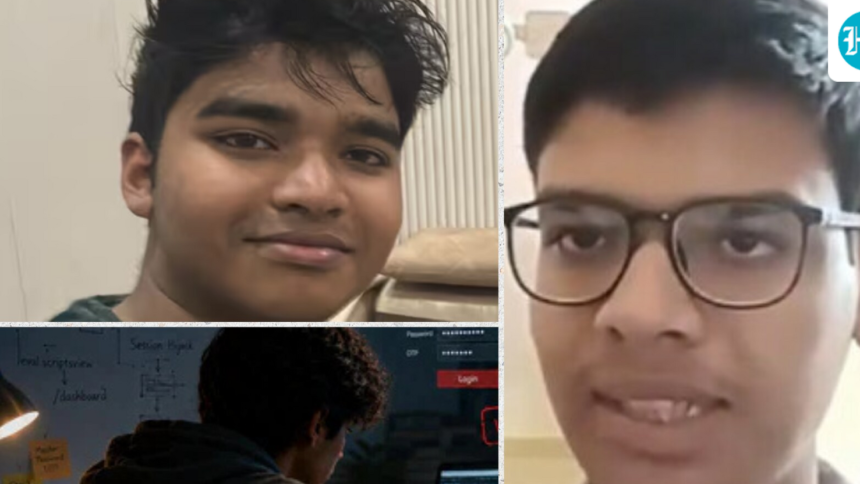
The nationwide controversy over the Central Board of Secondary Education’s first use of the On-Screen Marking System (OSM) for Class 12 was not driven by political parties or street demonstrations, but by three online teenagers – a student who was handed someone else’s answer sheet; Another 17-year-old dissected the OSM nodes; And a 19-year-old said he completely hacked the web portal.

These three, and many others like them on X and Instagram, forced CBSE to admit mistakes on some technical fronts, defend its system generally, and categorically reject allegations of corruption. The company running the OSM platform, Hyderabad-based Coempt EduTeck, has also denied any wrongdoing.
However, the Congress-led opposition has used the row to question Prime Minister Narendra Modi’s NDA regime, led by the BJP, with opposition leader Rahul Gandhi and others asserting that these students belong to Generation Z, the new generation at the heart of major political changes in the subcontinent.
Attack and defense on Sunday
On Sunday, May 31, both sides of the dispute witnessed new developments.
Rahul Gandhi met Vedant Shrivastava, the student who got the answer sheet wrong. They spoke of the familiar insults directed at them, such as “anti-national,” “deep state agents,” or being called Pakistanis. They also mocked being called “Soros agents,” a reference to the Hungarian-American investor and philanthropistGeorge SorosWhich the right-wing Hindutva party accuses of financing a “leftist agenda” among other things.
Earlier, he had participated A blog written by 17-year-old Sarthak Siddhant, who investigated CBSE’s “alleged manipulation of its selection process” in the OSM tender process. “Sarthak’s work shows that Generation Z in India is brilliant and fearless. Sooner or later, they will discover the whole truth,” Gandhi wrote.
The third teenager at the center of the controversy is… Nisarga Adhikary, 19, who apparently got a response from CBSE — not explicitly mentioned by the board — after he claimed to have discovered that the OSM web portal, where teachers mark scanned answer sheets, could be hacked.
“The identified vulnerabilities have been contained, and other exploitable vulnerabilities are being ruled out. We are grateful to all the vigilant citizens and ethical hackers who pointed out these vulnerabilities, some of whom we have reached out to directly,” the board posted on
Nisarga Adhikary then posted a clip from the song Yo Yo Honey Singh, saying that CBSE had “admitted” that there were loopholes; He deleted it before posting it again within two hours.
On the possibility of the portal being hacked again, he told HT: “My work is done.”
What fired it?
the The OSM, which was widely introduced for Class 12 this year, replaced the system of publishing physical answer books for examinees, with a more technology-focused system of scanned copies being assessed on a screen.
CBSE has maintained that the system improves transparency and reduces overall errors.
But after the results were announced in mid-May, The pass percentage in Class 12 fell to its lowest level in seven years, and students who applied for reassessment began reporting unclear scans, missing pages, unassessed answers and, in some cases, answer sheets that were not theirs.
CBSE issued a statement defending the OSM, calling it “fair, transparent and equitable”. He reiterated that it was possible to request a re-evaluation. Of the 98.6 lakh answer books assessed, CBSE’s own figures showed that 68,018 needed to be rescanned due to poor image quality and 13,583 were scanned manually after failed scans.
The face of the answer sheet does not match
The first major human face of the OSM class appeared in Vedant Shrivastava, a student based in Delhi. After scoring unexpectedly low marks in Physics, he applied for copies of his answer sheets and found that the sheet CBSE had shared with him did not match his handwriting.
His May 23 post on X has surpassed 2.5 million views, and screenshots also went viral on Instagram, the most popular platform among younger internet users.
CBSE responded directly to
Prior to this decision, Vidant had been trolled. Broadcaster on national television For example, the “Pakistani” jibe went viral, though he later apologized. His brother Siddhant said the family set up a new X-handle only because they couldn’t find a clear way to report the problem.
The investigator who surveyed the tenders
Sarthak Siddhant, a 17-year-old from Jharkhand, was unhappy with his results and spent days examining CBSE systems. An online detective who runs a blog, he compared tender documents of CBSE on a public procurement portal.
His blog, titled “How CBSE rewrote the rules in favor of Coempt EduTeck”, claimed that the eligibility and technical bar were lowered across three bidding rounds so that the final winner could qualify.
Read also | Gen-Z blog explodes: How 17-year-old Sarthak’s investigation into CBSE OSM tenders became focus of huge row
In interviews from Ranchi, Siddhant said he compared the old and new tender documents and counted “at least 15 differences.”
What is most obvious, according to him, is that the condition that prevented companies from being “blacklisted earlier” has been changed to “blacklisted now.” This change also allows vendor Coempt EduTeck, formerly known as Globarena Technologies, to qualify as it allegedly faced blacklisting by some universities in Telangana at one time, he said.
CBSE and the company rejected the suggestion that the rules are specific to any company. like HT also reported the changes, and officials said the board followed procurement protocols and awarded the contract to the lowest qualified bidder under the quality and cost framework. Adjustments in request for proposal (RFP) criteria across bidding rounds “should not be viewed as a hasty exercise, but as a process to correct shortcomings in previous rounds,” they said.
Siddhant’s blog was amplified by politicians from across the opposition spectrum. Sharing it, Rahul Gandhi described Generation Z in India as “smart and brave.” Congress communications chief Jairam Ramesh posted on the resignation of Education Minister Dharmendra Pradhan and the CBI probe. AAP president Arvind Kejriwal urged his followers to read it.
The pirates who got scared and reported
And in between, the investigation also came before Nisarga Adhikary, who described himself as an amateur cybersecurity researcher and also cleared Class 12 this year.
He said he found a master password present in the front-end code of the portal which allows the OTP step to be skipped. This means that the OSM Paper Inspection Gateway dashboard can be opened directly and can change the tags. he He told HT that he informed the government about the flaws in February as well, but these gaps remained.
CBSE’s response here changed quickly. On May 26, the board rejected the claim, saying the URL it cited was merely a testing site containing sample data. He said the operational assessment portal had a different address and was not hacked, and no breach was detected. In its explanation, the council made a typo in the URL it posted and had to reissue it.
Five days later, with the spread of Vedant and Sidhan doubling t Also, the board said the identified vulnerabilities had been “contained.” She said that a cybersecurity team from the government and the Information Technology Institute has been deployed to fortify the system.
Nisarga reacted with a meme featuring Punjabi rapper Honey Singh and his popular classic ‘Dope Shope’.
Company defense
Coempt EduTeck and its CEO, VSN Raju, called the claim a “completely false claim” that the entire system was flawed, saying the complaints amounted to “just one or two cases.”
In the case of the mix-up on Vidant’s answer sheet, he blamed a survey error, not the technology.
He also denied changing any bid status and said the scanners were standard and accuracy was “perfect”.
Regarding the hacking, he assured CBSE that the server accessed was for internal testing only.
As for the company’s past – it was previously Globarena Technologies, linked to the 2019 Telangana board exam fiasco – Raju said the rebranding was no secret and that the courts had exonerated the company in the Telangana case.
Politics and the broader moment
The row with CBSE came at a difficult time for the government’s examination machinery.
Education Minister Pradhan had already been under fire over a paper leak in the NEET-UG medical entrance exam on May 3. Then came the CBSE marks class, and on May 30 there was some delay in the CUET entrance test as well.
Pradhan took “full responsibility” and did not report any further problems with the examination systems.
In the NEET exam, the largest of its kind in India and perhaps in the world, the government told the Supreme Court that Prime Minister Modi is “personally supervising” the re-test scheduled for June 21.
CBSE said that no payment has been made to Coempt yet and the penalties will be reviewed after re-evaluation and supplementary examinations. Its reassessment portal is scheduled to open on June 1; This too It has been postponed to May 29.
“To ensure a transparent and error-free process of checking and re-evaluating the answer books of students intending to submit their applications on the post-results activities portal, it has been decided that the designated portal will now be functional from June 1, 2026. This is to ensure the highest standards and protocols of evaluation,” CBSE said about it.