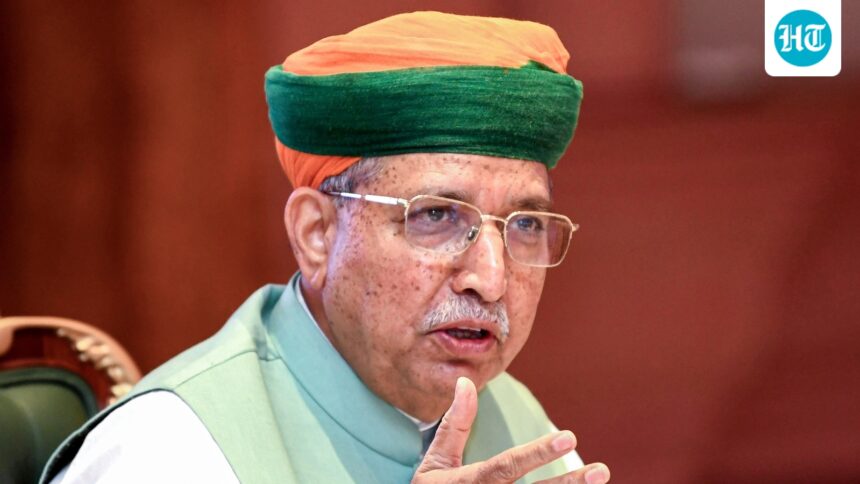
The government is looking into the systems followed in various countries for appointing judges, Union Law Minister Arjun Ram Meghwal said, while asserting that there is no “conflict” between the executive and the judiciary, and a good consultation process is being followed to fill vacancies in the higher judiciary.

He also said that amid increasing demand for courts, the government is working to strengthen alternative dispute resolution mechanisms.
In an exclusive interview with PTI, Meghwal said that the government is examining the systems adopted by various countries in appointing judges.
But he explained that appointment systems in other countries are being studied informally and no formal mechanism has been established to study them.
“Let’s see what comes out of that,” Megwal said while responding to a question about whether there could be an alternative to the college system.
In response to another question about the differences between the executive and the judiciary over the appointment of judges of the Supreme Court and the Supreme Court, Meghwal stressed that there is no “conflict” and “good consultations” are taking place.
“First of all, I would like to say that there is no conflict and that there is a good consultation process,” he stressed.
He said that there are occasions when the Supreme Court bench disagrees on the names proposed by the government. Likewise, the government is also backing away from its recommendations for reasons such as negative background checks, he said.
“But there is no conflict at all,” he noted.
Bill to end the Collegium system
Both houses of Parliament almost unanimously approved a bill to abolish the collegium system by establishing a body to appoint judges of the Supreme Court and the Supreme Court.
However, the Supreme Court struck down the National Judicial Appointments Commission (NJAC) Act along with the 99th Constitutional Amendment Act on October 16, 2015, declaring them unconstitutional and invalid.
In a 4:1 majority decision, the five-judge Constitution bench ruled that the NJAC violated the “basic structure” of the Indian Constitution by severely undermining the independence of the judiciary and the principle of separation of powers.
This landmark ruling dismantled the government-proposed commission and revived the decades-old collegium system of appointing judges to the supreme judiciary.
With over five million cases pending in the Supreme Court and 25 high and lower courts, the Modi government is pushing for alternative dispute resolution mechanism, including arbitration, to reduce pendency, Meghwal said.