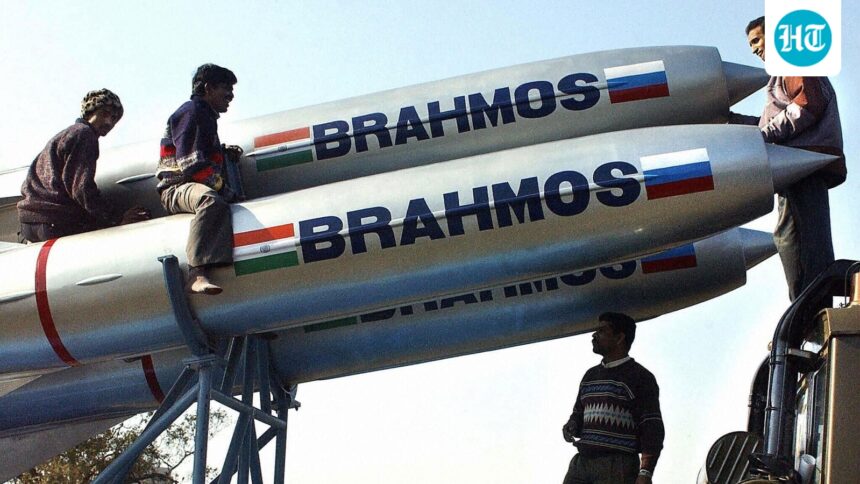
Defense Minister Rajesh Kumar Singh said on Saturday that the BrahMos missile deal with Vietnam had already been signed, while a similar agreement involving Indonesia was in its final stages.

Singh is visiting Singapore to attend the Shangri-La Dialogue, and his statements came in response to a question about potential buyers of the missile system.
“My understanding is that with both Indonesia and Vietnam, the agreement is in the final stages, and in fact, for Vietnam, my understanding is that it has already been signed, it may not have been announced publicly, but it has already been signed,” Singh said.
The Philippines, which signed a contract worth approximately US$375 million in 2022, was the first foreign buyer of the BrahMos missile system from India.
Indonesia said in March that it had concluded an agreement with India to purchase the BrahMos missile system.
Earlier this month, there were news reports that Vietnam was close to signing a BrahMos missile deal with India. But Singh’s comments on Saturday marked the first official word on the matter in the public domain.
However, the values of the Vietnam and Indonesia deals have not yet been officially revealed.
Referring to the broader issue of sharing advanced defense technologies, Singh said countries have generally sold advanced weapons systems and platforms to countries they consider friendly partners. “Obviously you share technology with people you trust,” he said.
He further said that India has a strong commitment to ASEAN countries, “and we treat all of you as ‘friendly foreign countries’ with whom we can share advanced defense technologies.”
The Association of Southeast Asian Nations (ASEAN) has 11 member countries – Brunei Darussalam, Cambodia, Indonesia, Laos, Malaysia, Myanmar, the Philippines, Singapore, Thailand, East Timor and Vietnam.
Several member states of the Association of Southeast Asian Nations (ASEAN), including the Philippines and Vietnam, have overlapping maritime claims with China in the South China Sea – one of the world’s busiest trade routes. India’s BrahMos exports to countries in the region have drawn attention as New Delhi expands its defense ties with Southeast Asian countries.
Singh told delegates at the Shangri-La Dialogue that India stands ready to work with partners across the region and beyond to build resilient supply chains, trusted defense partnerships, secure maritime commons, and collaboration on innovation. “Today, resilience has become one of the defining strategic requirements of our time.”
Drawing attention to geopolitical uncertainty, conflicts in Europe and West Asia, disruptions in maritime trade routes, supply chain vulnerabilities, technological disruptions and increasing strategic competition, Singh said these factors are reshaping the global security landscape.
“The lessons learned from recent years are clear. Defense preparedness cannot rely on fragile or overly concentrated supply chains. Countries today need defense industrial ecosystems that are flexible, reliable, diverse and technologically adaptive,” he said in a session on “Building Defense Industry Resilience.”
For India, resilience is not just about self-reliance, it is also about building trusted partnerships, diverse manufacturing networks, innovation ecosystems and secure supply chains that contribute to regional and global stability, he added.
The Defense Minister also said that India has undertaken major reforms in defense production, innovation and exports over the past decade. He said the country opened the sector to greater private sector participation, encouraged startups and small industries, strengthened local design and manufacturing, and expanded cooperation with global partners.
India is not only modernizing its armed forces, but is also emerging as a reliable hub for defense manufacturing and maintenance, Singh said.
He said government-owned companies account for nearly 72 per cent of India’s defense production, while the private sector contributes the rest. Three Indian government-owned defense companies were among the world’s top 100 arms producers.
The Indian defense industry has developed capabilities in areas such as missile systems, fighter aircraft and main battle tanks, while efforts are underway to bridge the gaps in propulsion technologies across land, air and sea domains, he added. He added: “Our goal is not to create exclusive blocs, but rather comprehensive and reliable partnerships that enhance collective security and reduce strategic vulnerabilities.”