A new Rafael Nadal documentary shows us an old and now unpopular way to build a legacy – strength through suffering and impossible odds.

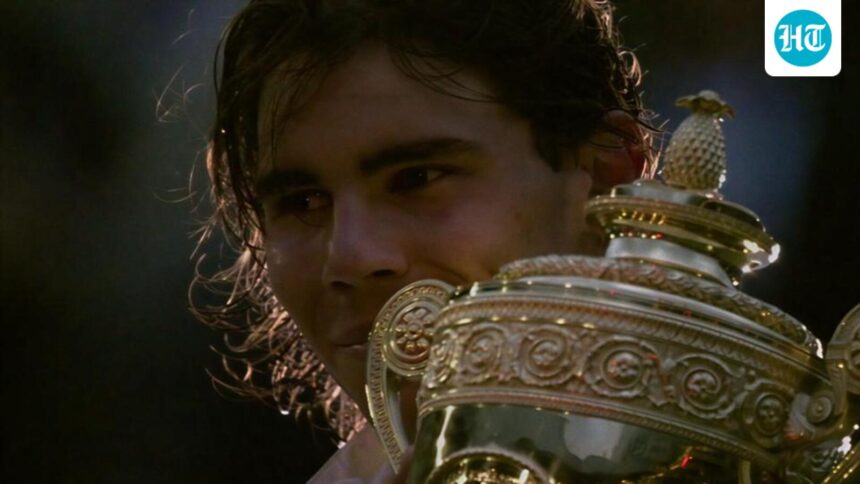
The greatest Stoics of ancient Greece and Rome will find relatives in Rafael Nadal, winner of 22 Grand Slam titles, including a record 14 titles at Roland Garros – also known as the French Open – played on clay, the most physically demanding surface in tennis. Fourteen titles in one tournament and on one surface is a statistical outlier in all sports.

But Nadal’s story is more than just titles. He is as well known for his ability to overcome pain as he is for his ability to spin powerfully with a ferocious forehand – “With him, it’s life or death,” chimes Novak Djokovic, one of Nadal’s greatest rivals, in Rafa, a new sports series about the Spanish champion that hits Netflix on May 29. Among the many gospels of endurance that appear in the narrative, its star, now 40 and living a post-professional tennis life with his family in Mallorca, Spain, is this one: The man endured suffering so he could overcome that suffering.
Dark stuff. Even as the world navigates wars, killings, prejudices and perhaps an El Niño moment of truth, the health industrial complex continues to rise unabated. Several trillion dollars go to reform systems. Wellness and self-improvement are the new luxury. If you suffer from anxiety, together you and AI can regulate your nervous system. If your boss unleashes torture, find longevity through slow living. Mental health means saying no, retreating to soulful caves with kitchens of healthy fats and soft, compassionate companionship.
In this age, where tolerance for pain must be measured in light of world events as well as personal alienation, the story of Nadal’s 20-year tennis career carries messages that could be read as “toxic” – when measured against the longevity era’s reckless disregard for suffering, pressure and acquiescence to difficult masters as a means of building legacies. Why do you even need an heirloom, new adults are likely wondering.
Picture this: When he was a teenager, Rafa had to get through the first hour of daily training with his uncle — the famous Uncle Toni, who was not a tennis player but a tough coach to his talented nephew — without drinking any water. From that era to his life now, the series sometimes makes Rafa’s decisions and demands seem like those of a Greek tragic hero. Elite athletes rarely look like that at all, especially talented ones who radiate the swag of someone born to play tennis.
Rafa has something universally human at his core: that making friends with pain pays off, and that nothing substantial or epic can be built without physical and emotional pain.

Director Zach Heinzerling (Stolen Youth: Inside the Cult at Sarah Lawrence, 2023, among other previous works) takes care to bring every bit of Rava’s pain principle to the screen. We see him preparing for some of his most memorable victories – with surgeries, tapes, painkillers, nerve anesthesias, and difficult and frustrating conversations with his inner circle. The non-linear narrative moves through snapshots of his early years – starting with his first ever tournament at the age of 11, where his uncle Tony molded him bit by bit to build his legendary strong appetite for suffering – to his victories over rivals Roger Federer and Novak Djokovic, and finally to the great champion saying “I have to stop” to his family (as intimately depicted at his home in Mallorca) in 2024 after losing to a low-ranked player in his favourite. Surface.
Rafa is nothing but a eulogy or adulation of celebrities. Interviews with his family, coaches, core team, and of course Federer, Djokovic, and Rafa himself, reveal a lot that ordinary tennis fans don’t know. Rafa’s vulnerability is on comfortable display as he talks about how he ended up embodying Uncle Tony’s stubborn insistence on strength and finding a way to win no matter the circumstances. I am this, I have become that, I have no regrets, but it wasn’t all good – that’s the implication. His wife, a childhood sweetheart and mother of his two children, doesn’t have much time in front of the camera, but she comes across as a character who has become somewhat reluctantly accustomed to Rafa’s appetite for risk and pain.
The details at the center of Rafa’s pain are textbook constancy: a lifelong Müller-Weiss Syndrome that prompted Nike to make a special insole for his boots that allowed Rafa to continue playing, parts of his leg and nerves severely numb just to play a final, perforated intestines after constant use of painkillers, the inability to swallow even saliva and living without a water bottle in his hands due to growing anxiety. “I’m not a winner, I’m a competitor,” he says. “For me, it’s very simple,” he later says, “I’m exploring my limits; tennis has become a race against time.” Then, he says, of the final phase of his career, when Carlos Moya, the Spanish tennis player and one of his childhood stars, and his uncle Tony, unceremoniously left the team, “I found more freedom.” A story in which there is no room for moderation or balance, and Rafa ends with an easy breath. You feel it after the four episodes have more or less convinced you that chasing ease isn’t necessarily the best solution for mental health.
You don’t have to be a tennis geek or even a tennis fan to be equally excited and frustrated by this series – the best to be released in the last couple of years. You’ll find out why Baby Boomer’s brutal boss wasn’t necessarily evil.
Raava is showing on Netflix from May 29.