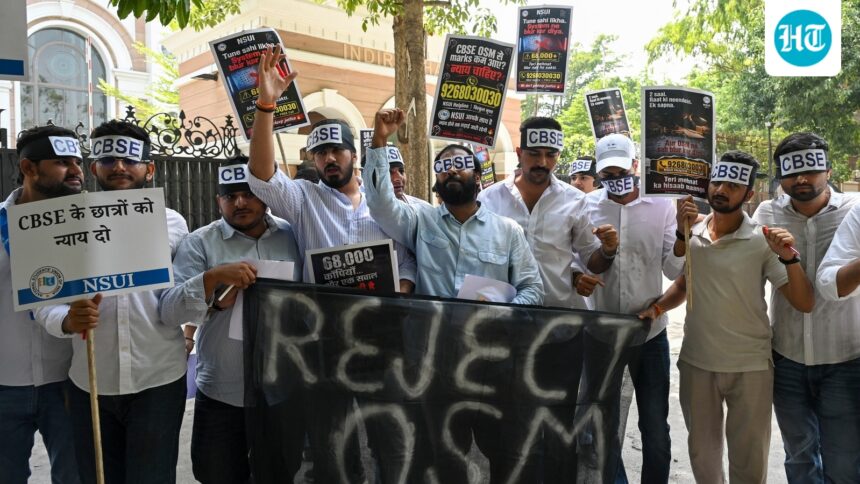
The Central Board of Secondary Education (CBSE) is under criticism over its use of the On-Screen Marking (OSM) system for assessment of Class 12 examinations. Now, it has come to light that an internal monitoring report has identified at least 36 technical, operational and assessment-related issues during the trial run of the system.

The board faced criticism from students and parents over technical issues, difficulties with payment and issues with access to services during the verification and re-evaluation process.
The dispute escalated after several Grade 12 students claimed irregularities in their grades. Some also claimed that scanned answer sheets uploaded by the board did not match the handwriting, leading to concerns about possible mix-ups within the OSM system.
Several ‘red flags’ ignored by CBSE while implementing OSM
A report prepared after piloting the screen marking system in five schools in Delhi in January 2026 had cited at least 36 technical, operational and assessment-related concerns, HT had earlier reported.
Concerns include the possibility of “blind or superficial screening,” poor supervision, lack of protection against data loss, and the absence of any system that allows evaluators to discuss or agree on labeling criteria. These concerns were raised weeks before the board was due to roll out the system across the country.
Hindustan Times has reviewed the report, which was prepared by internal observers and submitted to the board on January 21, just 19 days before CBSE officially announced full use of OSM for evaluation of Class 12 answer papers on February 9. CBSE started OSM evaluation on March 7.
An FAQ document issued by the CBSE in May, after the results sparked controversy, suggests that the board was aware of at least some of these concerns. Many of the measures later described by the Council as safeguards correspond directly to the issues raised in the January report.
Warning signs mentioned in the report
- The system “does not provide opportunities for raters to interact, deliberate or reach consensus during the allocation of marks, which is essential for fair and uniform evaluation,” the report said.
- She also warned against “the danger of superficial evaluation,” noting that “answer texts were submitted after adding footnotes and placing random marks without comprehensive reading, which leads to cases of blind or superficial scrutiny.”
- Another concern was the lack of “a mechanism for Additional Chief Examiners (AHEs) to return answer scripts to assessors when multiple errors are detected, allowing re-evaluation and correction before final submission”.
- The report noted that AHEs “were unable to review answer scripts of their choice, as the application automatically assigns scripts, limiting effective monitoring and quality assurance.”
- Two notes specifically pointed out flaws in the system: “Feedback is not visible to AHE even after verification” and “There is no requirement to display edits on the HE portal.”
- Technical issues created more problems. These included slow performance while marking steps, absence of an auto-save feature, inability to view question papers and marking systems together, instances where marks were entered digitally, students’ written answers were overshadowed, inconsistencies in subject codes, and no option to mark questions for incomplete answers.
- CBSE’s FAQ document, released on May 18 under the title ‘Know about OSM’, came as student complaints over marks continued to rise. Many of the measures included in the document addressed concerns already raised in the January report.
- According to the FAQ, the save feature was introduced, the process of deleting tags was changed, and the issue of tags covering written content was resolved. It also said that internet-related issues were addressed through high-capacity servers. Both of these issues were flagged during the test run.
CBSE on the findings of the report
CBSE did not respond to HT’s queries regarding the monitoring report or the concerns mentioned in it.
The FAQ described the trial run as providing “a blueprint for the modifications required in the system,” one official said.
CBSE had earlier said its OSM assessment portal is a “secure and robust IT platform” and confirmed that no compromise or vulnerability has been reported in the live assessment system.
Earlier, Union Education Minister Dharmendra Pradhan said that concerns had arisen over the evaluation process. “Today, some issues have come to light regarding the evaluation process of the CBSE Class 12 exam and the re-evaluation process will now begin,” he said.
Have calls for regional trials been ignored?
Among the “red flags” ignored by the board include ignoring suggestions from its own board members to conduct pilot projects across regional offices before introducing the OSM system, HT had earlier reported, citing meeting records.
Instead, the board conducted a two-day trial involving just 100 teachers in five schools in Delhi in January.
Teachers who participated told HT they advised the board not to go ahead with the rollout, saying the system needed better features, additional training and more time for users to become familiar with it.
Minutes of a June 2025 board meeting show that members suggested that OSM “can only be implemented across all topics after pilot projects in some topics across the board’s different regional offices are completed.”
The administrative body “took note of the proposal.” CBSE has 22 regional offices, but no such pilot projects were undertaken before the system was rolled out this year.
An evaluator told HT that teachers were under pressure from the board to complete the assessments quickly so that the results could be declared on time and the digital system could be presented as successful.