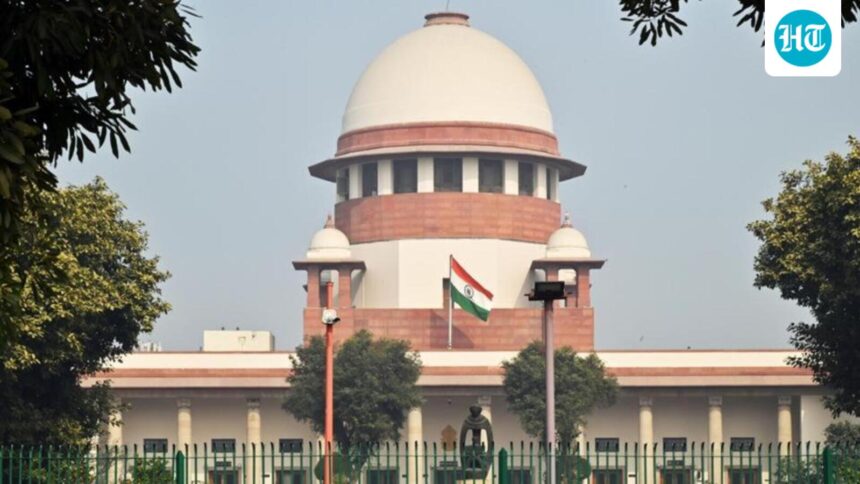
The Supreme Court on Friday issued comprehensive and binding directions to all high courts across the country mandating that bail applications be decided on the same day, or at the latest, within 24 hours of the hearing, setting a strict outer limit of three months for pronouncement of reserved judgements.

In a historic attempt to address judicial delays affecting personal liberty and speedy justice, a bench comprising Chief Justice of India Surya Kant and Justice Joymalia Bagchi invoked its extraordinary powers under Article 142 of the Constitution to put in place a national framework governing timelines, transparency and accountability in judicial performance, arguing that the intervention of the Supreme Court has become necessary “to achieve full justice to the parties”.
The ruling, which will serve as binding law for all high courts, offers enforceable remedies to litigants, automated monitoring mechanisms, and even reassignment of cases from judges who fail to pronounce judgments within the stipulated timelines. Advocate Fauzia Shakeel assisted the court as amicus curiae.
The court directed that in all matters in which a ruling is reserved, the higher courts “seek” to issue a reasoned ruling within a maximum period of three months from the date of the reservation on the matter.
Particular emphasis was placed on cases involving personal freedom. The court said the high courts should show “extra speed” in matters relating to ordinary bail, anticipatory bail, criminal appeals when the convict is in custody, and death reference cases.
“Once the bail application is heard, it is preferable that the order be pronounced and uploaded on the same day… If the order is reserved, it is expected that it will be pronounced on the next day and uploaded on the website,” the bench directed.
In another major reform affecting pre-trials and convicts, the bench directed that orders granting bail, suspending sentence or acquitting the convict in custody must be communicated to the prison authorities and trial courts on the same date of pronouncement of judgement.
The court also stipulated that defendants or convicts should normally be released on the same day, or at the latest, the next day, unless they are needed in another case or there is a delay in accordance with the bail conditions. Additionally, the trial court is directed to report compliance with these release orders to the Supreme Court bench that issued the order.
Recognizing the frequent delay in loading detailed judgments even after pronouncing the operative parts, the Supreme Court allowed the High Courts to pronounce the operative portion only in urgent matters where the delay could cause “irreparable loss” to the parties, but fixed a strict timeline for loading the detailed reasons.
The court said that a reasoned judgment must normally be uploaded within seven days and, if practical difficulties arise, within a maximum of 15 days.
The ruling specifically identified habeas corpus petitions, criminal appeals involving the acquittal of detained convicts, demolition and eviction matters, educational admissions and other urgent issues as instances where such immediate executive directives may become necessary.
The bench also made it necessary for every reasoned ruling issued in open court to be uploaded to the Supreme Court’s website within 24 hours.
At the same time, the court introduced a detailed accountability mechanism to monitor late rulings. It directed all Chief Justices of High Courts, on the administrative side, to ensure technological modifications in the High Court websites so that automated emails are generated every month containing details of all reserved judgments pending during that month. These automated alerts will be sent to the Chief Justice and the relevant judiciary.
The ruling also allows senior judges to confidentially circulate among judges the details of cases in which rulings have remained pending for more than two months after the reservation. If judgment is not rendered after three months, the Registrar General of the High Court will be directed to bring the matter before the President of the Court, who must inform the relevant court of the delay and request that the judgment be pronounced within a further two weeks. The Supreme Court added that if the judgment remains pending thereafter, the Chief Justice may refer the case to another body entirely for fresh hearing and disposition.
The court said that when the executive part has been pronounced but the reasoned judgment has not been uploaded within 15 days, the Registrar General must place the matter before the Chief Justice, who will then direct the court concerned to upload the judgment within another three days.
It is noteworthy that the Supreme Court has also created enforceable rights and remedies for litigants aggrieved by judicial delay. It held that if the judgment is not pronounced within three months of reservation, the parties may file an application before the Supreme Court seeking early pronouncement.
These requests must be listed before the competent court within two days, excluding holidays, while the registrar must inform the president of the court at the same time of all these requests. If after three and a half months the judgment remains pending, the parties may move the Chief Justice seeking to have the matter withdrawn from the relevant court and reassigned to another bench for a new hearing.
Likewise, when reasoned judgment is not loaded within 15 days of pronouncement of the executive part, litigants may request early loading through an application before the Supreme Court. If a detailed ruling remains unavailable even after one month, the parties may request that the matter be re-referred to another tribunal.
The court also ordered comprehensive reforms related to transparency in judicial record-keeping and case-setting systems. It directed that certified copies of judgments must now mandatorily state the date the judgment was reserved, the date it was pronounced and the date it was uploaded. When only the spoken portion is initially uttered, this date will be counted as the utterance date while the subsequent upload date will separately reflect the detailed judgment upload date.
The bench also stipulated that once the final hearings are over, the Supreme Court’s website must reflect that this ruling has been reserved. If only the operative portion is delivered, the case state must expressly so state.
When a reasoned judgment is uploaded, automated notifications will also be sent via email and SMS to the attorneys representing the parties in the matter.
The ruling arose out of proceedings initiated earlier this year when the Supreme Court, while hearing a case arising out of Jharkhand, noticed several criminal appeals involving life convicts where judgments remained reserved for years after the hearings were over.