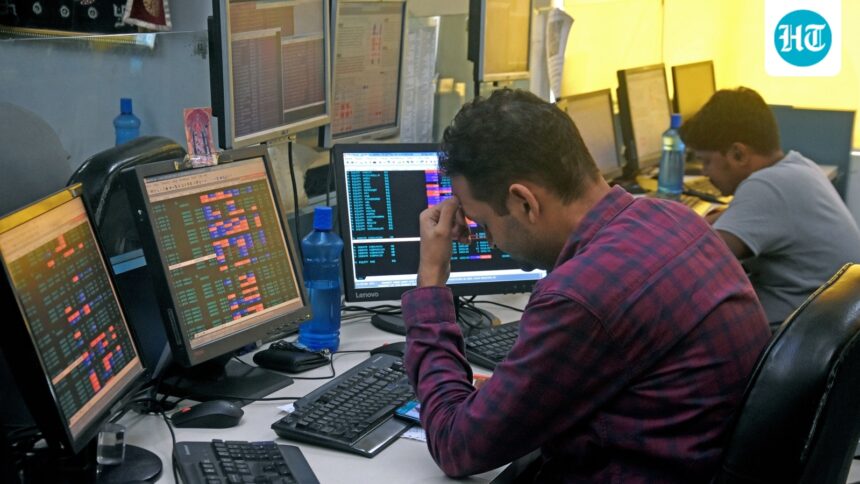
Indian stock markets witnessed a sharp sell-off on Friday, with benchmark indices falling in the final hour of trading as investors faced uncertainty over a possible peace deal between the US and Iran, the recent rebalancing of the MSCI index and concerns over rising crude oil prices.

The BSE Sensex closed down 1,092.06 points, or 1.44 per cent, to 74,775.74 points, while the NSE Nifty50 index fell 359.40 points, or 1.5 per cent, to settle at 23,547.75 points. The selling intensified towards the close, with the Sensex falling around 1,450 points from its intraday high of 76,220.02 and the Nifty falling from a high of 24,002.8.
Market breadth remained weak, with 2,507 shares declining compared to 1,568 advances on the Bahrain Stock Exchange.
Ambiguity regarding the peace agreement between the United States and Iran
The main reason behind this decline was growing uncertainty about the prospects for reaching a lasting peace arrangement between the United States and Iran. Investors, who led a strong rebound in April after a sharp correction in March, opted to take profits amid concerns that geopolitical tensions may persist.
“We are unlikely to see a sustained rise in Indian stocks unless the uncertainty over the US-Iran conflict is clearly resolved,” Arun Malhotra, founder and fund manager at CapGrow Capital, told Reuters.
The Nifty index had fallen by 11.3 per cent in March before rebounding by 7.5 per cent in April, making the markets vulnerable to profit taking.
MSCI rebalancing is fueling late selling
Losses swelled in the final half-hour of trading as the MSCI index realignment for May took effect. Passive funds that track MSCI indices typically adjust their portfolios at the close on the rebalancing day, which often results in increased volatility and sharp movements in heavyweight stocks.
According to IIFL Capital, India’s weight in the MSCI Emerging Markets Index, which rose to around 20 per cent in July 2024, is expected to fall to around 11.2 per cent after the latest rebalancing exercise.
Oil prices remain a concern
While Brent crude futures fell by about 19 percent during May, prices are still more than 27 percent higher than levels seen before the Iranian conflict. As the world’s third-largest importer of crude oil, India remains vulnerable to rising energy prices, which could fuel inflation and lead to a widening of the current account deficit.
Concerns over oil prices, coupled with geopolitical uncertainty, have made investors cautious about Indian stocks, analysts said.
Foreign investors remain selective
Market experts pointed out that foreign investors remained selective towards Indian stocks amid concerns over valuations, rising oil prices and the absence of a strong rally in technology led by artificial intelligence, which has fueled many global markets.
Financial sector stocks and IT heavyweights fell 1.2 percent and 0.9 percent, respectively, adding pressure on benchmark indices. Shares of Reliance Industries fell 7.7 per cent during the month, weighing heavily on the Sensex and Nifty indices.
Sector and stock specific pressure
Among the major losers for the month, ONGC stock fell 11.4 per cent amid profit-taking after a strong rally over the past four months and concerns over production delays in key projects. ITC shares fell 8.9 percent after analysts warned that recent price hikes could impact cigarette volumes.
However, some pockets of the market remained resilient. Adani Enterprises shares rose 22 percent after US authorities dropped fraud charges against Gautam Adani. Metal stocks also rose, with Hindalco and National Aluminum Company rising 8.6 percent and 6.3 percent, respectively, supported by strong domestic demand and global supply concerns linked to the Iranian conflict.
Markets end the month in red
Friday’s decline pushed both benchmarks into negative territory for the month. The Nifty ended May down 1.9 per cent, while the Sensex lost 2.8 per cent. Broader markets outperformed despite weakness in large caps, with Nifty Midcap and Smallcap indices posting gains amid optimism over corporate earnings.
Investors will now monitor developments in the Middle East, crude oil prices, foreign fund inflows and local economic indicators for signals about the market’s next move.