Even in an era of declining television production, there’s still enough room to fly under the radar — which is exactly what the series’ first season was. Competitors I did it in America. A smart, soapy, and, at times, downright sexy (I blushed!) adaptation of Jilly Cooper’s 1988 novel of the same name, it was an even bigger hit in its native UK. But with a notable promotional campaign from Disney, which is streaming it on Disney+ and Hulu, a pornographic setting for its Cotswolds backdrop, and more fawning reviews for season two, its profile in the US is on the rise.
Also, it never hurts to have David Tennant in your corner.
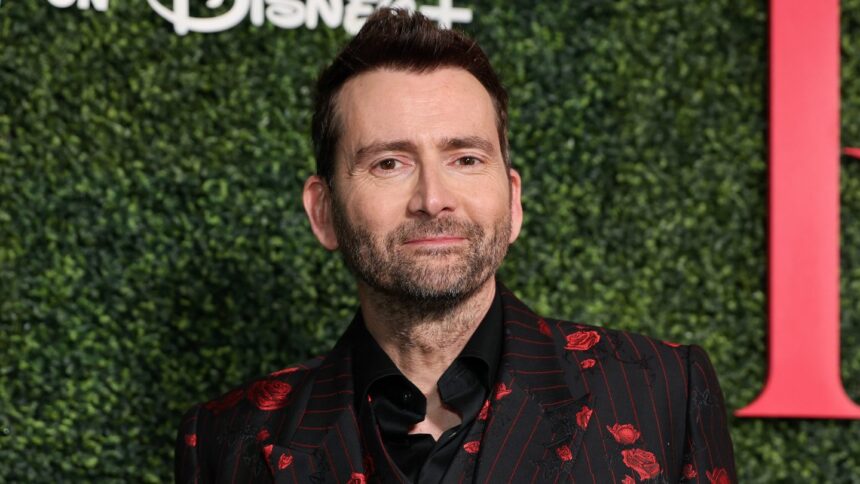
One of the greatest theatrical actors of his generation, and arguably the most successful actor to work with Doctor WhoTennant plays Lord Tony Baddingham. He’s a ruthless TV executive who carries the kind of chip on his shoulder that can only come from being new money in the Margaret Thatcher era of Great Britain.
“A lot of what Gilly writes is embedded in the British class system and what that means and all the complexities and weird nuances of that,” Tennant says. “There is power that comes with money, but real power comes with bloodline. This is part of the ceiling that is created in a society that has a king at the top. There are rooms that you simply are not allowed to enter.”
on Competitorsviewers are invited into many of those rooms — even if Tennant’s alter ego is not. Speaking during the latest episode of Hollywood Reporter Podcast I have a ring (Spotify, Amazon Music, Apple) The actor has immersed himself in the unique role that sex plays in his series, and is happy to return to… Doctor Who When he was summoned and why, in hindsight, he realized that exact version of Broadchurch The idea he pitched to Fox in 2014 probably wasn’t the best idea.
I probably wouldn’t have mentioned this if it wasn’t on Disney+, but there’s a lot of sex in it Competitors.
There are quite a lot, yes.
The first thing you see in the first episode is a couple locking themselves in the bathroom of the Concorde, which immediately tells you the time period. Have you ever flown on a Concorde?
I’ve never done that. It existed, but I had never been in the kind of world that was riding such extraordinary devices. We shot on an actual Concorde plane for this sequence. There’s one in a museum in Bristol. They allowed us to board the ship and photograph it. I don’t think toilet fucking was depicted on the old original Concorde. They built a toilet. But the main piece of Concorde was on board the actual plane. It’s a very small thing.
The show walks a very fine line with intimate scenes. There are a lot of them, but they don’t seem to be free. Before you came on board, what were the conversations like about how sex would appear in this series?
As Jilly Cooper did in the original novel, I think sex is always there because it reveals something about character. So, for example, the first scene is about Robert Campbell Black (Alex Hassell) – his freedom, his promiscuity, his masculinity. It has to do with the fact that he exists in a high-flying world. So that was depicted in this kind of augmented reality.
There is a sex scene later in the first series with my wife Monica, which is somewhat discreet and secretive. This speaks to what their relationship is. The other sex scene in that series was with Nafessa Williams’ character. There’s something very aggressive and animalistic about that because that’s their relationship. That’s what they are to each other. I think that’s true for all the sex on the show. Some are a bit ugly at times too. Some are full of joy and liberation. Some of them are experimental. Some are nice. I think all of this exists because this part of the story we’re telling is about the sexuality of these characters. A lot of them are very driven by the mechanics of sex, and the dynamics of those relationships, just as they were in the original novel. Each scene presents what we understand about the plot and characters. But it’s done tastefully and cheerfully, and oftentimes it’s fun, too. I think that’s completely unapologetic.
Did you have a relationship with Jilly Cooper’s books before this?
They were certainly in the cultural ether. I knew who Jilly Cooper was, but she was kind of smugly dismissive. I think I probably got it by osmosis, really. The legend was that it was sold to frustrated housewives to read on the beach when they went on an all-inclusive holiday to Malaga. Perhaps because she was a woman writing at a certain time, it was easy to dismiss her. But the books continued. They were resilient despite it all. She writes about humans, human nature, and the foibles of human interaction, sexual and otherwise. You might say she’s more like Dickens than Jackie Collins.

Ethics on Competitors It exists on its own scale, so I wouldn’t describe your character as evil, but you’ve played a lot of them – serial killers, psychopaths, the devil. Was there a moment in your career when you noticed a trend?
It’s interesting, as someone who absolutely hates conflict, as someone who suffers a lot from guilt and isn’t particularly liberated due to a lack of morality in real life. I suppose the word is fun, to imagine what it would be like to walk around in these exquisitely tailored three-piece suits and shoes. I mean, it’s fun to play, right? It’s fun to imagine what life would be like if you didn’t care.
I suppose this is also notable because your entry into the international arena was as well Doctor Who. Your portrayal of that character was very strange and driven by the idea of doing the right thing.
I ended up playing some outlier characters who often occupied the less savory corner of the narrative. But the devil gets the best tunes, I think. Those are interesting to play. But that doesn’t mean that something like a “doctor” isn’t, because he’s someone who has universes in his brain. It’s great to play too. Someone who can talk faster than we think. I believe that there is no single reason why anything looks particularly attractive or attractive. When a character is delicious, there can be a million reasons why they are delicious. You can taste it right away.
How would you describe your relationship with Doctor Who? A lot of actors in your position would distance themselves from a franchise like this, but you never would.
I’ve loved it since I was a little kid. I was so obsessed with him as a show and as a character. So when the unexpected circumstances arose that I was asked to take over the show, a show that had not existed for many years in between, it seemed like an incredible, impossible opportunity. I loved it. It was everything I hoped it would be. It has certainly changed my life in so many ways, both professionally and personally, that I don’t feel the need to turn away from it. I also realize that I probably can’t. If I never worked again, the first line of my obituary would probably have been written. Doctor Who This kind of attracts interest and enthusiasm.
I want to go back to what I said a moment ago about suffering from guilt. Not to cure you, but what do you mean by that? What do you feel guilty about?
Everything, absolutely everything. I am a Scottish Presbyterian. It’s my engine. Everything was sent to make me feel bad about myself. That’s it, really. I don’t have any deeper idea than that. (He laughs.) It must be partly upbringing and partly psychology. I often worry that the person did not do the right thing, did not act appropriately, or was not as kind as they should have been. I think having a kind of strong sense of that allows me to understand characters like Tony Baddingham, who doesn’t have any of that.
You basically played your character from Broadchurch In a new edition in the United States, Grace Pointwith an American accent. This was while you were still making Broadchurch In the UK was that an interesting exercise for you as an actor?
Impressive. But it’s interesting that you say you don’t think that will happen now. Maybe it shouldn’t have happened then. The world was indeed closer to a monoculture than it had been up to that point. There was a tradition Long consists of an American show and then a British version of this show and vice versa. We almost expected it. Often they didn’t translate, but we had to go, didn’t we?
There was a lot.
with Broadchurchit was a sensation at home and a minor sensation in the States and I think it got more columns than it got eyeballs, so there was a feeling of, “Let’s put it on one of the major networks and there’ll be an audience waiting for it.” Those who wrote the column inches were saying, “No, we’ve already seen this.” It was a little dead when it arrived as an idea. I say that now only in hindsight. I think if we were going to do that, we should have done a completely different show. We did the same show, and I had the opportunity to recreate it. This is an exceptional thing to be asked to do. I won’t say no. I won’t let someone else do that.

On the subject of your obituary, I would argue that you are as connected to your numerous productions of Shakespeare as you are to him. Doctor Who. What role has given you the most satisfaction?
Performing Hamlet at the Royal Shakespeare Company was a traumatic moment for me, but it was also extremely terrifying. villageThis is probably the thing I look back on with the greatest satisfaction and pride. But living through it was very stressful. As I continued to run, every night I felt like, “I know I got away with it last night, but I can’t get away with it again.” I was kind of longing for it to be over. Hamlet’s type of mind expands. It’s just glorious.
I assume this kind of repetition will lead to boredom rather than stress.
If only I was bored instead of afraid! But that makes it seem like I wasn’t craving the whole thing. Not long ago, I did Macbeth. Nothing else is as challenging and exciting. I feel very lucky to have had to do some of these plays, and there are definitely a few on my bucket list.
What’s at the top of your wish list?
Now, maybe Iago in Othello. The psychology of this character is deeply disturbing. But, you know, what a part.
There’s a classic clip of Judi Dench being persuaded by Graham Norton to recite Shakespeare, from memory, on the spot. If you were put in a similar situation, is there a monologue you could pull out of your ass?
I don’t have that kind of recollection. Because I think Judi Dench could do the full script of A Midsummer Night’s DreamThe entire play. I once asked her: Is this true? “Maybe,” she said — which meant it was definitely true.