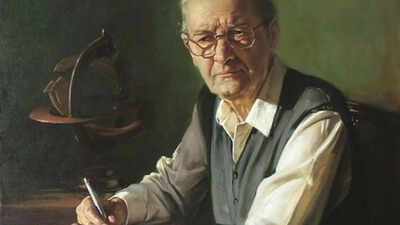
The history of science is crowded with people whose ideas arrived before the rest of the field was ready for them. Tibor Janti belonged somewhere in that unstable category: respected in small circles, barely recognized outside of them, and almost absent for years from broader discussions of how life began.
His work circulated quietly through Hungarian scientific publishing during the Cold War, a time when geography could decide whether theory moved on or disappeared into local archives.As National Geographic reported, when Ganti died in 2009, most people studying the origin of life were still focused on RNA, genetics, or isolated chemical reactions. His name rarely appears in mainstream accounts of biology.
However, the model he spent decades refining, which he called the chemist, is slowly returning to the scientific conversation, in part because modern laboratory work has begun to drift toward the questions it had long asked.
Tibor Jante’s journey In the matter of life
Ganti was born in 1933 in Vác, a town north of Budapest. His early life unfolded through the political turmoil that reshaped Hungary after World War II. By the time he entered higher education, the country sat firmly within the Soviet sphere, and scientific exchange with Western Europe remained limited and unequal.
He first trained as a chemical engineer before moving into biochemistry. The distinction was important. Many biologists of the period approached living systems through taxonomy or genetics, while Ganty tended to think in terms of interactions, structures, and interactive processes. He seemed less interested in cataloging life than in reducing it to its abstract mechanisms.In the 1960s, he began writing about molecular biology at a time when DNA research was transforming the field.
Even then, he seemed unconvinced that scientists really understood what made an organism alive. Genes alone don’t seem to be enough. Metabolism did not occur on its own.
How did Janty A Minimalist model of life itself
At the center of Ganti’s model is a surprisingly simple arrangement. The smallest viable living system would require three interconnected parts working at the same time, he said. One component processes raw materials from the environment into usable energy and chemical building blocks.
In normal biology this is similar to metabolism.Another part stores and replicates information. Modern organisms use DNA and RNA for this role, although Ganti did not insist on any specific molecule. The third element was physical containment: a membrane that separated the system from the outside world. Without limits, reactions will simply spread through the environment and disappear.What mattered was not the individual parts themselves but their dependence on each other.
The membrane will depend on the metabolism of the building. The genetic system will require metabolic products to copy itself. Metabolism, in turn, depends on the regulation established by the membrane. Combined, the system can sustain itself and reproduce.
Why Tibor Janti Chemoton Theory It remained neglected for decades
Part of the reason Ganti remained a mystery was practical. Much of his work first appeared in Hungarian, and translations arrived slowly. Scientific impact often depends as much on timing and clarity as on the quality of the ideas themselves.Cold War isolation did not help. Eastern European scholars often found themselves disconnected from dominant Western academic networks, conferences, and publishing channels. Some theories have gone badly across this divide.There were intellectual reasons as well. During the late twentieth century, many origin-of-life researchers moved toward simpler models. The RNA universe hypothesis became particularly influential because it provided a clearer narrative: perhaps self-replicating RNA appeared first, with everything else following later.The alchemist looked more chaotic in comparison. It required several systems to come together in a coordinated way. For researchers searching for the single crucial spark that separates chemistry from biology, Jantti’s framework seemed overly complicated.
From isolated reactions to cooperative networks: the new direction in origin of life studies
Over the past two decades, origin of life research has moved away from the search for a single magic molecule. Attention has turned toward interaction: how membranes, transcription systems, and chemical cycles might have reinforced each other on early Earth.This does not mean that scientists have “proven” the chemist. They didn’t. No laboratory has assembled a complete synthetic system that fully matches Ganti’s description.However, many areas of research are now moving in directions similar to his thinking. Experiments involving protocells, small membrane-bound structures capable of growing and dividing, explore how primitive parts might have behaved under early Earth conditions.
Other work investigates how simple chemical networks are able to maintain themselves through metabolism-like cycles.Some teams have been able to produce fatty acid membranes that grow naturally in water. Others have explored RNA replication within simple cellular compartments. Piece by piece, the field has become less focused on isolated interactions and more interested in cooperative systems. The chemist sits comfortably within this newer perspective.