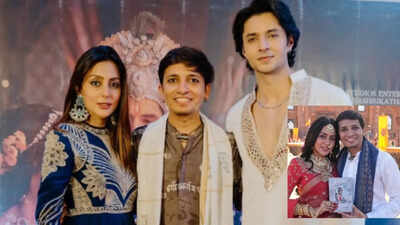
National Award-winning writer Ram Mori’s latest film ‘Krishnavataram Part 1: The Heart’ has caught attention for its unique take on Lord Krishna’s journey through the eyes of Satyabhama.
Based on his 2025 novel Satyabhama, the film explores Krishna’s life after his separation from Radha and his relationship with Rukmini and Satyabhama. In an exclusive interview with ETimes, Ram Muri shared interesting thoughts about the film and its emotional story.
How do you feel seeing your novel Satyabhama being turned into a devotional film on the big screen like Krishnavataram Part I: The Heart?
First of all, I feel deeply grateful, it’s a very special feeling as a writer because this is my first Hindi film. The entire experience of writing the dialogues and script for this film was an unforgettable experience and has definitely made me more confident as a writer.
I have written about seven Gujarati films, but this is my first Hindi film, so I really feel like I’m completely new. I often tell my friends that now I can relate to Priyanka Chopra much more.
How she left Mumbai for Los Angeles and had to reinvent herself from the start. In Mumbai, when I work, I feel like no one connects me with my previous Gujarati films. So, as a screenwriter, it’s like I’m starting everything over again, and honestly, I enjoyed that part too.
We already have a rich tradition of literature being adapted to cinema, and I’m so happy that I’m now part of this amazing tradition that a film of my work has been made. What’s more, I feel lucky to have had the opportunity to adapt it myself. Screenwriting and bookwriting are two very different art forms, yet they are deeply interconnected. Satyabhama is the best-selling novel in Gujarati. Readers of all age groups have lavished their love, especially Generation Z.
Seeing my book characters come to life on the movie screen is an enormous joy and honor for me as a writer.
What inspired you to write about the stage that Lord Krishna went through after his separation from Radha?
When it comes to Krishna, what has always amazed me the most is his journey. It never truly ends and continues today. As a writer, whether writing Rajadhiraj’s monumental musical, Satyabhama’s novel, or Krishnavataram, I have come to understand more deeply that Krishna and his stories are immortal.
Over time, they became more personal. Also, I now realize that Krishna’s separation from Radha was never a real separation.
They were never apart at first. Radha herself was another form of Krishna, who taught the world the meaning of pure love. Krishna Gokul was a gopa, a Giridhar. But the phase that followed was the phase of Mathuradipati, Ranchhod, Jagdish and Dwarkadesh.
I have always loved seeing Krishna in the roles of the perfect hero, ruler, friend and teacher. I think this was the biggest inspiration behind writing the next chapters of his story.
Why did you choose to focus on the emotional journeys of Rukmini and Satyabhama in the story?
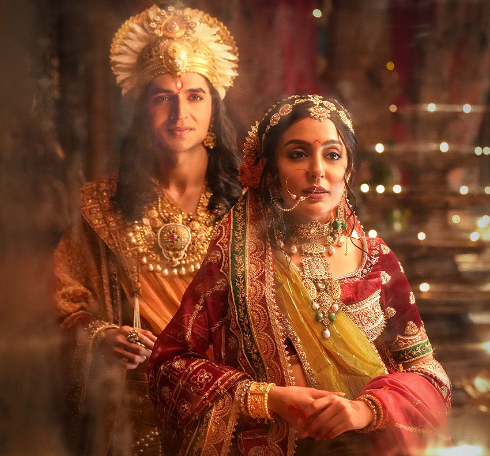
Basically, both the novel and the film are told from Satyabhama’s point of view. Here, Satyabhama explores Krishna. In that journey, the stories of Radha, Rukmini, Jambavati, and the sixteen thousand Krishna gopis unfold naturally, which was a bonus for me.
These stories have always attracted me deeply as a reader and fan. I knew I wanted to explore the emotional depth of Radha-Krishna, Rukmini-Krishna, Satyabhama-Krishna, and Jambavati-Krishna.
I wanted to understand the love and wisdom woven into those layers. I’m sure readers and viewers experience it in a similar way. Once you understand someone’s emotional core, that person begins to feel more intimate and personal towards you.
How important is it for modern audiences to present mythology with emotional realism?
Our stories and histories have all the answers we need today. Motivation, belief, energy, support – you name it. I have always felt these things deeply in our traditional stories. The new generation is becoming increasingly rooted. An entire generation feeling the lack of emotional depth and connection in relationships is gradually turning towards spirituality. At a time like this, telling historical and traditional stories through cinema seems quite right.
There is a strong connection between the novel Satyabhama and the film Krishnavataram, especially with new age audiences.
As a writer, what is the most challenging aspect of humanizing divine figures like Krishna, Rukmini and Satyabhama?
All of these characters are divine beings born in human form. The only real challenge was ensuring that we never disrespected them and never diminished their grace. I kept that in mind in every dialogue and every scene. Their pain, love, happiness, sadness, anger, and jealousy are all deeply human feelings.
However, while writing them, there was always a constant awareness in my mind that they were divine manifestations.
Can you share one moment from the film editing process that was particularly emotional or memorable for you?
For the past five years or so, my life has revolved around Krishna Rajadhiraj, Satyabhama, and now Krishnavataram. But the process itself was incredibly fun. I’m the type of person who likes the process more than the results. When my director, Hardik Gajjar, first informed me that Prakash Kapadia would be joining Krishnavataram with me as a writer, I literally danced for joy.
I know almost every dialogue from his films ‘Devdas’, ‘Bajirao Mastani’ and ‘Padmaavat’ by heart, all of them written by Prakashbhai, as he is one of my favorite screenwriters.
So, having my name along with Prakash Kapadia’s in the dialogues and script credits of Krishnavataram is one of the most memorable moments of my career. My close friends are now playing this little game after watching the movie “These must be yours… These must be Prakashbhai’s”” And honestly, it gives me tremendous joy as a writer.
Since this is the first part of a trilogy, what can audiences expect from the upcoming chapters?
The first part explored the heart, and now our producers Sajjan Raj Kurup, Shobha Sant, Poonam Shroff and Parth Gajjar are focusing on the Mahabharata and Moksha. The story of Krishna is wide-ranging. Krishna’s divine play is endless. Sending my heartfelt best wishes to Creative Land Studios on this beautiful journey ahead.