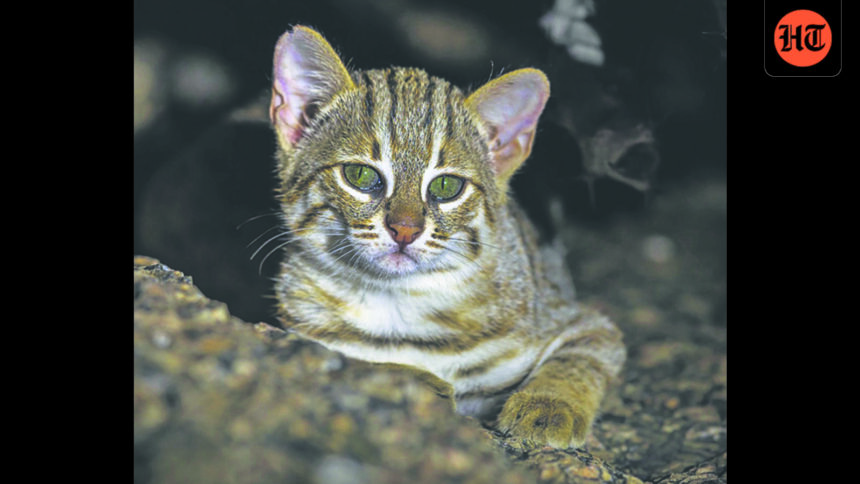
The rusty cat (Prionailurus Rubiginosus), among the world’s smallest cats, has been documented for the first time in the Chambal National Park in Uttar Pradesh by researchers from the Wildlife Institute of India (WII), with the paper noting that the finding also represents the first confirmed record of the species from southern Uttar Pradesh.

The study, published May 26 in the Journal of Threatened Taxa, documented two road kill incidents involving rusty cats along the Bharthana-Sindus Road in the Etawah district in 2025. The researchers said the new discovery helps pinpoint a new location for the species, allowing for local conservation measures. It is a “near threatened” species according to the IUCN Red List.
“We have reported two road kill incidents of the rusty cat Prionailurus Rubiginosus in Chambal National Park, Etawah District, Uttar Pradesh,” the newspaper reported. “Our records are the first documented incidents of rusty-spotted cats in southern Uttar Pradesh and also within the boundaries of the Chambal National Park.” He said.
According to the newspaper, the first body of a male cat was found on March 14, 2025, near the Yamuna River, while the second, of a female, was recorded on April 24, 2025, on the same stretch of road near Chakkar Nagar. Both animals are found near valleys and forest patches associated with the Chambal River landscape.
The findings are ecologically significant because the Chambal-Yamuna overlapping landscape contains an extensive network of valleys and forest patches that may support small carnivores, the researchers said. The newspaper pointed out that “this area between the two rivers consists of a network of rugged canyons and valleys, extending for about 480 kilometers in a 10-kilometer-wide belt of the Chambal River.”
Vishnupriya Kulipakam, a scientist at the Wildlife Institute of India (WII) and part of the study, told HT that it is difficult to estimate the number of cats in the area at present, but surveys are planned.
“Systematic surveys will shed good light on this issue. Team members have also reported unconfirmed direct sightings several times. These repeated observations over a short period may indicate that the area may be supporting a large number of these species,” she said, adding that the valleys contain healthy populations of many wildlife species.
Wildlife biologist Qamar Qureshi, who was also part of the study and previously worked at WII, said the findings highlight the importance of focused conservation in the region.
“As more camera traps are set up across the country and local surveys are carried out, we are finding more locations where the rust-spotted cat is present. The presence of two of these cats here, especially road kill incidents, also indicates the need for focused protection measures in the area. As in any sensitive area, one may have to focus on providing safe corridors for wildlife to pass through.”
The study also warns that vehicular traffic poses an increasing threat to these species, noting that multiple roadkill incidents indicate that vehicular traffic was a significant threat to the rust-spotted cat.
This research paper comes soon after the recent publication of another research paper, which confirmed the sighting of an adult rust-spotted cat and her kitten in Kot village in Faridabad in July 2025. The research was conducted by the Department of Zoology at Indira Gandhi University in Mirpur, Haryana.