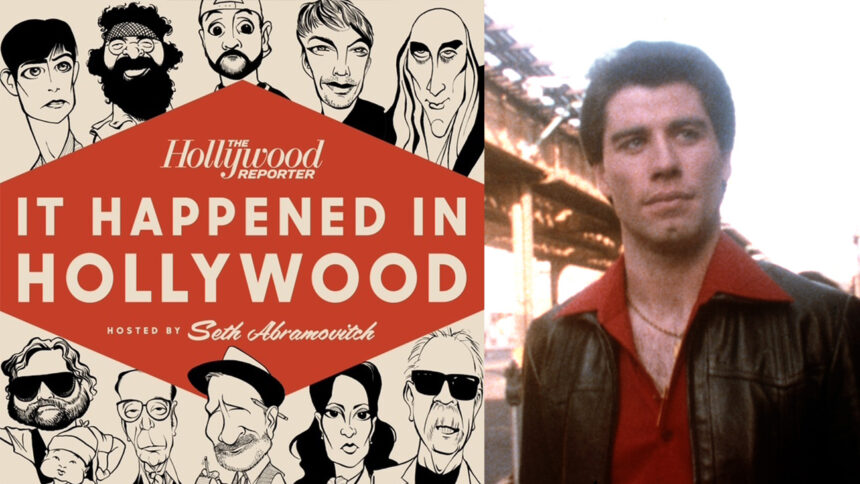
John Badham remembers Saturday night fever As a production it is held together partly by instinct and partly by aluminum foil.
When the director joined the production, the original director had just been fired after receiving an Oscar nomination rockyJohn Travolta’s fame had already caused near-riot conditions in Brooklyn, and the nightclub at the center of the film was transformed with Christmas lights and reflective sheeting purchased from the cheap downtown. Nearly 50 years later, Badam can still laugh about how lame the whole thing was.
“I turned on the lights, and the place looked horrible,” he said in the show’s latest episode. It happened in Hollywoodrecalling the now famous disco group. “But when I spent the night, it was a surreal dream.”
Listen to Badham revisit the making Saturday night fever Now, what emerges is not the polished mythology that has built up around the film over the decades, but something stranger and more human. The film arrived with the glow of a pop phenomenon, but beneath the white suit and Bee Gees soundtrack was a rushed production that relied on nerves, improvisation and the unnerving magnetism of the 23-year-old Travolta the moment he became a movie star.
Badham barely survived another collapsed production, an early version of the film Wiz Starring Diana Ross, when producer Robert Stigwood suddenly called him in to take over what was then called Tribal rituals for the new Saturday nightbased on Nick Cohen’s acclaimed novel New York Article in the magazine. The original director, John Avildsen, had clashed with Stigwood over the script and was fired in circumstances so absurd that they seem like an invention. According to Badham, Stigwood knew that Avildsen had just received an Oscar nomination rockyHe congratulated him warmly, then informed him of his expulsion.
The timing was actually tough because Travolta needed to finish the film in time to start rehearsals for it fat Opposite Olivia Newton-John. Badham, who had only one production in his directorial career, suddenly found himself rebuilding the production in less than two weeks.
However, the film that emerged from this scramble still feels startlingly alive. Rewatch Saturday night fever Now, what’s most affecting isn’t the nostalgia machine surrounding it, but how bruising and sad the film actually is. Tony Manero, who plays Travolta, spends most of the film trapped inside cramped apartments, ugly family feuds, racial tensions, and endless conversations, waiting for Saturday night to briefly transform him into someone worth looking at. The disco scenes don’t play out as a fantasy so much as a temporary escape.
Badham described his style as wanting the film to look “as if a British documentarian had arrived in Brooklyn and was just filming what he saw”, and this tapestry still hangs over the film. The dancers don’t look polished in the Broadway sense. They seem provincial and a bit rough around the edges – the kind of people who learned by watching each other rather than through formal training.
Even the famous nightclub itself was mostly just an illusion. The production took a rundown disco in Brooklyn called 2001 Odyssey and transformed it with lighting tricks and low-budget ingenuity. The illuminated dance floor, which is now iconic enough to end up in a Smithsonian museum, was custom-designed for about $15,000. The shimmering walls were sheets of aluminum foil that the production designer hung to reflect colored light throughout the room.
Then there was Travolta himself, who at that point occupied a space close to what Timothée Chalamet’s territory is today: a popular, instantly recognizable teen idol, able to shut down a city block just by standing on it. On the first day of shooting, a group of girls spotted him under the elevated tracks in Brooklyn and began shouting “Vinnie Barbarino,” leading to what Badham estimates was a crowd of about 15,000 people within hours.
The crew resorted to fake call sheets, pre-dawn shooting schedules and even replicas of Travolta’s cars in an attempt to stay ahead of the chaos. None of them worked well.
But what Badham understood immediately was that Travolta knew exactly who Tony Manero was. The director describes him as a young actor looking for less a performance than someone who is instinctively attuned to the character’s vanity, insecurity and swagger. This remains the great balance of the film. Travolta never asks the audience to justify Tony’s ugly qualities. It simply lets you understand how much this child needs those few hours under the lights every Saturday night.
The music also arrived with a strange kind of inevitability. Over the years, a persistent myth has developed that the famous dance scenes were set to Stevie Wonder songs and later combined with Bee Gees compositions. Padam says this was never true. According to the director, Bee Gees demos were actually used during filming long before the soundtrack became one of the best-selling albums in history.
“They never read the script,” Badham said of the group. “But Stigwood told them the story and they took it and ran away with it.”
Even the title arrived almost by accident. During a meeting in Stigwood’s apartment, the executives struggled in vain to improve it Tribal rituals for the new Saturday night Badham even jokingly suggested Saturday night fever. The room immediately became silent.
Suddenly everyone understood that this was the title.
Which, in retrospect, seems like the perfect origin story for the movie itself.
Listen to the full conversation with John Badham in the latest episode of the show It happened in HollywoodWherever you get your podcasts.