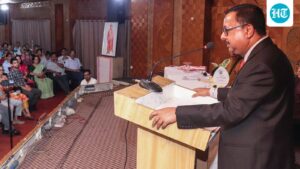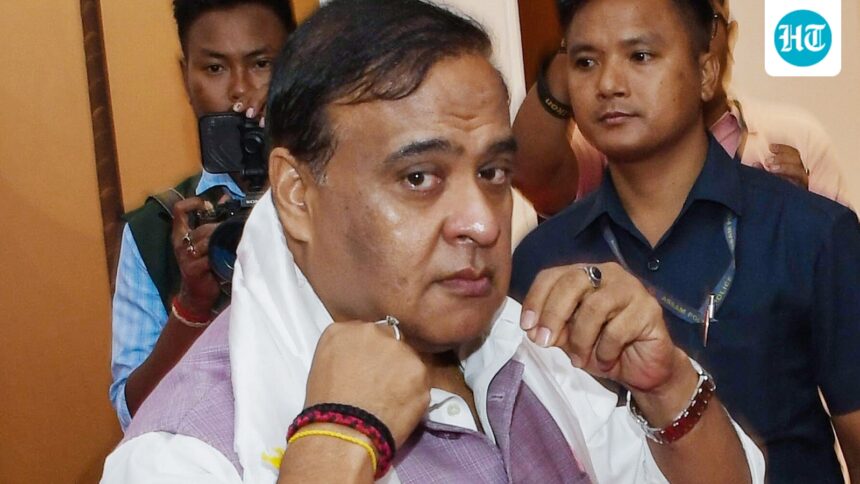
The Assam Assembly on Wednesday passed the controversial Uniform Civil Code Bill by voice vote after a five-hour debate that sparked sharp resistance from the Opposition which termed the legislation a “political stunt”.

The law provides for mandatory registration of direct relationships, marriage, and divorce, including when one partner is a resident of the state, and prohibits polygamy.
Chief Minister Himanta Biswa Sarma said it was a “watershed moment in the history of Assam”.
“Passing this law in Assam will be a big step towards gender justice. Many have asked why the scheduled tribes are kept out of UCC. We are aware that the tribes have been residing in India for a long time and have their own customary laws regulating their lives, which provide rights to women and discourage polygamy. They have been kept out as a sign of respect and because they already have their own rules and regulations similar to the UCC laws since long,” Sarma said.
Assam is the third BJP-ruled state, after Uttarakhand and Gujarat, to adopt a common set of laws relating to personal matters such as marriage, divorce, inheritance and succession for all citizens.
What is Union Carbide Corporation?
The UCC is a controversial and polarizing issue that refers to a common set of laws regarding personal matters such as marriage, divorce, inheritance, and succession for all citizens. Article 44 of the Constitution, one of the directive principles of state policy, calls for the establishment of UCC. But religion-based civil laws have governed personal matters since independence.
The All India UCC is the third unfulfilled ideological promise of the BJP. The construction of a Ram temple in Ayodhya and abrogation of Jammu and Kashmir’s semi-autonomous status under Article 370 of the Constitution, the other two major ideological goals, have been achieved since the BJP came to power at the Center in 2014.
Like laws enacted by Uttarakhand and Gujarat, the Assam legislation also excludes scheduled tribes (STs), who constitute 12.45% of the state’s population according to the 2011 census.
Bharatiya Janata Party vs Opposition
During the discussion, opposition leaders said that there was no need for the law in the first place since there were laws in place to address polygamy and child marriage and that the legislation was a political ploy. They also complained that the law was not truly as uniform as its name claimed, as it excluded Scheduled Tribes (STs) from its ambit and targeted Muslims, who account for 34% of the state’s population.
Assam Chief Minister Himanta Biswa Sarma responded to the criticism.
“We have clearly mentioned in our pre-election manifesto that if we win, we will bring UCC… The Congress has concerns about how the bill will affect practices followed under the Quran and Sharia, but they have not mentioned once about the Bhagwat Gita or the Ramayan, which shows that the party represents only one community,” Sarma told the assembly.
Sarma, who described UCC as a big step towards gender justice, also hit back at the opposition for questioning the exclusion of tribals.
“Many have asked why the untouchable tribes are kept out of UCC. We are aware that the tribes have been residing in India for a long time and that they have their own customary laws regulating their lives, which provide rights to women and discourage polygamy. They have been kept out as a sign of respect and because they already have their own rules and regulations similar to UCC’s laws since long ago,” he said.
He added: “Are we going to treat someone who is not sick? UCC will try to provide radiotherapy and chemotherapy where the cancer is, and nowhere else… The new law stipulates mandatory registration of all marriages, divorces and direct relationships, prohibits polygamy, and guarantees equal inheritance rights to sons and daughters as well as to elderly parents. It also opposes so-called ‘love jihad’, by ensuring that marriages and cohabitation relationships do not occur through coercion or deception.”
Rabram Narzary of the Bodoland People’s Front (BPF), which is part of the ruling coalition, thanked the government for keeping STs out of its purview and sought clarification on how the new law will ensure the rights of ST women married to non-STs, if they get a divorce.
Prakash Chandra Das, of the ruling Asom Gana Parishad, accused the Congress of being against women and their rights. “By not supporting this legislation, they have once again lost an opportunity to redeem themselves,” Das said.
Congress Legislative Council Party leader Wajid Ali Chowdhury said UCC would violate personal freedoms and create social and religious tensions in a diverse country like India, and asserted that existing laws are sufficient to ensure gender justice.
“This legislation has been introduced in the House of Representatives without broad consultation with political parties, social groups, religious bodies, organizations and the public. How can it be unified if some are kept out, and how will it empower women if they are not included?” asked Congress MLA Jakir Hossain Sikdar, calling the legislation a “political stunt”.
“We already have laws in Assam prohibiting polygamy, child marriage and compulsory registration of marriage and divorce. Why do we need UCC after all? I would request the Speaker to allow wide consultation on the bill and not allow the ruling parties to pass it on the basis of their majority. Since this bill is not uniform and does not cover everyone, I propose to change its name,” he added.
All India United Democratic Front (AIUDF) MLA Mazipur Rahman said the implementation of UCC violates the fundamental rights and existing legal provisions guaranteed to all including Muslims, who constitute 34.22% of the population of Assam (2011 Census).
“I support some provisions of the new law like banning triple talaq, child marriage and registration of live-in relationships. But there is a clear violation of the guidelines of the Quran regarding some marriage practices as it tries to control who should get married, and it violates fundamental rights. I think UCC has been brought in bad faith,” Trinamool Congress’ Sherman Ali Ahmed said.
Akhil Gogoi of Raijor Dal said there was scope for harassment by officials and the new law violated personal freedoms. He said: “The draft law aims to put private relationships under bureaucratic control by mandating the registration of live relationships and issues related to them through the appointment of a sub-registrar who, in turn, will report these relationships to the local police station.”