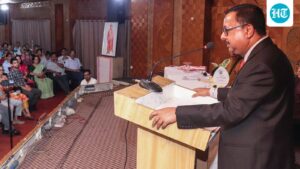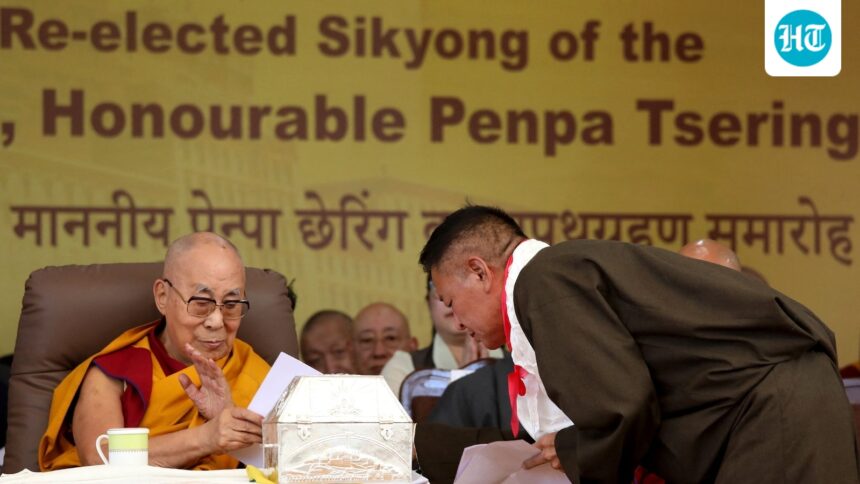
The head of the Tibetan government-in-exile, Penpa Tsering, on Wednesday reiterated his commitment to the “middle path policy” established by Tibetan spiritual leader the Dalai Lama to resolve issues with the Chinese government, as he was sworn in here after being re-elected to the post.

The Sikyong (head) of the Central Tibetan Administration, in a speech to a crowd after the swearing-in ceremony at McLeod Ganj, also accused the Chinese government of trying to “erase” Tibetan identity and spreading “disinformation” aimed at weakening Tibet’s unity.
Penpa Tsering said the “middle way policy” that seeks to resolve the Sino-Tibetan conflict through non-violence, dialogue and mutual benefit will be permanent.
He added: “We will continue back-channel communications with caution and consistency with the Chinese government until a solution is reached.”
A statement said the Tibetan leader called on community members, both living inside Tibet and in exile, to preserve the Tibetan language, culture and religion.
“The 17th Cabinet of the Central Tibetan Administration, the democratically elected government in exile, reaffirms our commitment to keeping the thought and counsel of the Dalai Lama at its core,” Penpa Tsering said.
He added, “We must support fair justice based on rules and regulations, harness collective efforts by implementing principled policies, and move forward to achieve the common goal.”
He added that the TTA will continue social and political welfare initiatives “with the primary goal of sustaining the Tibetan struggle in the long term until a just solution to the Tibet-China conflict is reached.”
Attributing all the achievements of his administration to the “boundless blessings and far-reaching noble deeds” of the Dalai Lama, he also expressed gratitude to the government and people of India, the United States and other countries for their “continuous support for the Tibet cause.”
Concluding his speech, Sikyong prayed for the Dalai Lama’s long life and expressed his hope that Tibetans living inside and outside Tibet would eventually be reunited.
The Central Tibetan Administration is organizing a Tibetan cultural festival at the Police Square in Dharamshala from May 28 to 30.
India is home to the largest Tibetan community in the world, with an estimated population of 80,000 to 100,000 Tibetan refugees and their descendants.
Since the arrival of the Dalai Lama in 1959, the Tibetan community has maintained its language, culture and Buddhist traditions while residing in settlements across the country.
The Tibetan government-in-exile, which serves as the political and cultural center of the Tibetan community, operates from the MacLeod gang.
The Dalai Lama voluntarily delegated all political and administrative powers to the “democratically elected” Tibetan leadership, ending nearly 400 years of dual role as spiritual and temporal head.