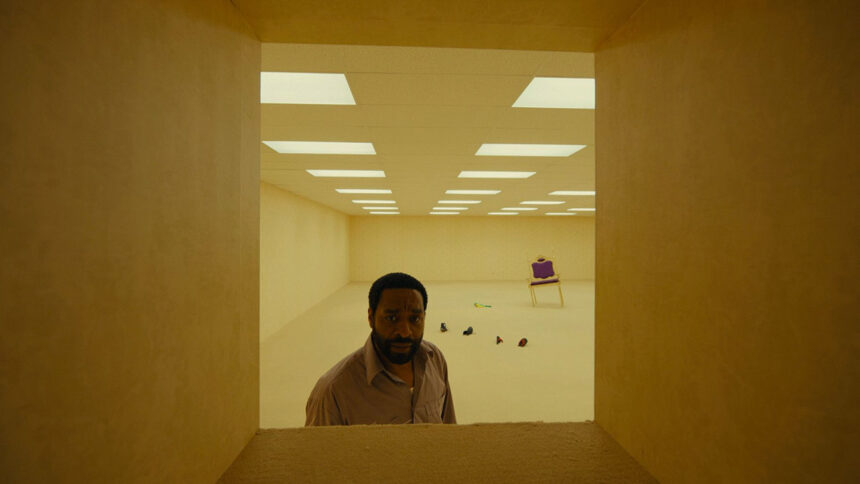
Appropriately for a surreal world composed of inexplicable corners, stretching across impossible dimensions and seemingly, in the words of one explorer, cobbled together by “builders on acid,” Back Rooms, as a premise, has no set parameters. You probably don’t think of it as a story so much as a shared alternate reality, originating as an internet urban legend and then taking on a life of its own as fans added bits of lore and began turning them into works of their own.
Now the concept seems poised to break containment into the mainstream Back roomsa brilliantly produced film that features a buzzing studio (A24), bona fide superstars (Chiwetel Ejiofor, Renate Rainsef) and established genre leaders (James Wan, Osgood Perkins) among the producers.
Back rooms
Bottom line Disturbing but never scary.
release date: Friday 26 May
ejaculate: Chiwetel Ejiofor, Renate Rainsef, Mark Duplass, Finn Bennett, Lukita Maxwell
exit: Ken Parsons
screenwriter: Will Sudek
Rated R, 1 hour and 50 minutes
But if the film embodies something of the interesting unease of the concept — as 20-year-old director Ken Parsons draws from his own backroom-set short films, made when he was just a teenager — the patchy storytelling made me wonder if some of the creepier thoughts might be better left as whispers in the dark.
Although the back rooms are unspeakably strange (“Imagine describing a dog to someone who’s never seen one and then asking them to draw it,” the characters answer when asked to explain it), the world we traverse to get there is almost suspiciously normal. In a sleepy California suburb circa 1990, Clark (Ejiofor) is a failed architect who makes his living as the owner of Cap’n Clark’s Ottoman Empire — or rather tries to, since the discount furniture store’s complete lack of customers indicates a business on the verge of collapse. His life has become so miserable that he sees therapist Marie (Rensif) to deal with the collapse of his marriage.
One night while watching TV in the store late (because he’s been sleeping there since his wife kicked him out after a bitter fight over booze), he ventures downstairs to tinker with the crusher, and that’s when he discovers that he can sort of… It slips Through a wall, just as easily as entering a beam of light. On the other side was a room not unlike the windowless, carpeted basement from which he emerged. But this building is lit in a sickly institutional yellow, with all of its furniture piled up haphazardly in the middle. It also seems like it will go on forever. No matter how deep Clark wanders, all he finds are more rooms, hallways, stairs, doorways, and crawl spaces.
It’s a deliciously creepy concept, evoking the same racial anxiety that other borderline horror stories like the unsettling 2022 film do. Skinamarink Or Mark Z. Danielowski’s 2000 novel House of leaves: If structures like homes, offices, and stores are meant to contain and protect, then there is something disturbing about the person who refuses to conform to those boundaries—who turns so far beyond the known laws of the universe that what should have been a safe space becomes a trap.
The horrors in this trap take time to reveal themselves. At first, our and Clark’s anxiety stemmed mostly from scenes that, while not overtly threatening, simply made us feel afraid. mistake: A reverse-printed stop sign stuck in a dark room, a piece of cardboard with a tape recording of messages in foreign languages, and shoes embedded in the floor at an angle that suggests said floor has suddenly materialized out of nowhere to cut right through it.
But the weirdness itself has its limits. The more time we spend exploring the back rooms, the less creepy and more random these oddities feel. They seem designed not according to some internal logic of this universe or the psychology of these characters but simply as an attempt to keep us guessing; It only works until it becomes clear that there are no meaningful answers in the future.
Meanwhile, Clark and Mary (not to mention other minor characters played by Mark Duplass, Finn Bennett, and Luketa Maxwell) are drawn in very broad strokes. Even allowing for that, one of the film’s main concerns is the way we create mental loops that keep us fixed in our tragedies, and the choice to define each of them by a single formative trauma and nothing else makes them too flat to care about.
I think the advantage of Clark’s lack of any other traits, including the instinct for self-preservation, is that it makes him a perfect conduit for us into this universe: since he never stops to consider whether wandering freely around what amounts to a haunted maze might be a bad idea, we never have to stop looking around, either. The farther he went, the scarier things became. The monster’s roar that initially seemed distant seemed to become louder and more frequent, evidence of its violence becoming more pronounced and harder to ignore (although it was never obvious; Back rooms He trades more on fear than blood.
In his best moments, Back rooms We come to terms with something bittersweet about the way our memories distort a little each time we access them, until they are stripped of real details and we’re left with nothing but the emotional imprint they left behind. In one stunning sequence, the camera slides over a series of living room floors, each increasingly abstract until all that remains is a bleak black hole radiating menacingly from around the corner. In another scene, grotesque human figures appear frozen in a dinner table scene, so lacking in feeling or strength that they do not protest even when they are stabbed.
At its worst, Back rooms It attempts to raise the stakes by replacing subliminal chills with more overt but also more generic thrills, culminating in an action climax that seems to exist solely to meet audience expectations of how a mainstream horror film is supposed to end. The film wants to invite you in, but the more the back rooms try to explain themselves, the more everyday they feel. This world is best left in the shadows, where unsuspecting souls can fall down their rabbit holes before they even know what hit them.