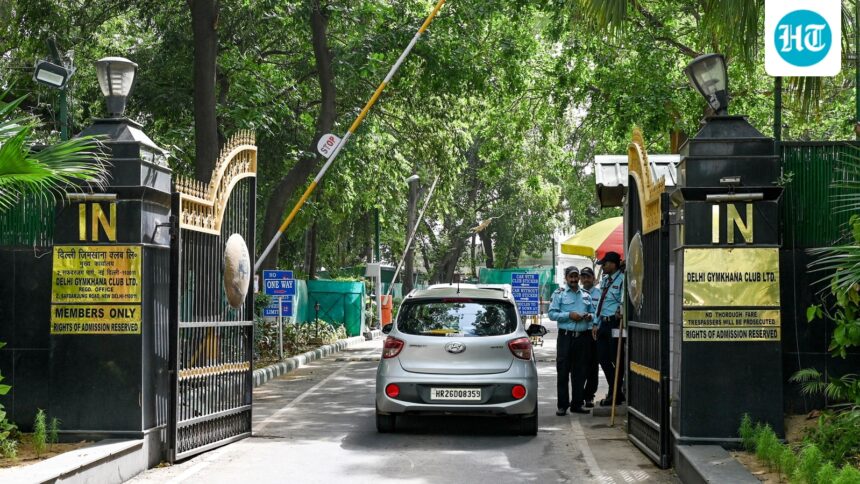
The central government told the Delhi High Court on Tuesday that it has given the Delhi Gymkhana Club, or DGC, an opportunity to vacate the building “spontaneous”. The government said that if the famous club is not evacuated, “it will not mean that the police will rush to the place and the center will seize the building by force.”

Solicitor General Tushar Mehta told the Supreme Court that the possession will be seized as per law.
“We cannot go and vacate it,” he told a bench of single judge Avneesh Jhingan.
“We will do the takeover only as per the procedures laid down in law. It cannot be on the fifth day, because we will have to issue notice, etc. It does not mean that on the fifth day, someone will give approval,” the legal officer said.
This comes after the Center asked Lutyens’ Delhi Gymkhana Club to hand over its headquarters by June 5, stating that the 27.3-acre plot of land was required to “strengthen and secure defense infrastructure”.
The Supreme Court refused to immediately restrain the Center from taking further coercive action as per its notice, stating that it would not take “immediate possession” of the property and that any action would be implemented in accordance with the law.
“Taking into account the issuance of summons, and in view of the statement made by the Secretary-General, no further interim directions are required and, at the expense of repetition, the statement is that the eviction, if so, will be in accordance with law after prior notice,” Justice Jhingan said in the order.
Founded in 1913, the Delhi Gymkhana Club is described by its members as one of the oldest sporting and social institutions in the capital, with a heritage value that goes beyond the value of its commercial land.
Read also | How the closure of Delhi Gymkhana will affect India’s global image, writes former IPS director Azad | opinion
What is a Delhi Gymkhana class?
The order, issued by the Land and Development Office (L&DO) of the Union Ministry of Housing and Urban Affairs, states that the buildings, located in a sensitive and highly strategic area of Delhi, are urgently required to strengthen and secure defense infrastructure and for other vital public security purposes.
Club member Vijay Khurana, whose claim is supported by nearly 500 members, has sought to prevent the Center from “unlawfully limiting” the club’s perpetual lease rights and forcibly confiscating them. The lawsuit also seeks an interim direction to maintain the status quo of the property.
The lawsuit argued that the May 22 notice failed to provide relief and thus violated Section 300A of the Constitution.
The club’s lawsuit also alleged that the Center’s letter dated December 18, 2009 expressly provided for the “restoration of ownership and titles of the club,” acknowledging that the perpetual lease dated February 2, 1928 granted ownership rights to the club.
“The impugned notice is a malicious and colorful practice…an attempt to enforce forced eviction through executive force rather than through due process,” the lawsuit said.
Arguments for Delhi Gymkhana Club
Senior advocate Abhishek Manu Singhvi, representing member Vijay Khurana, urged the Delhi High Court to direct the Center not to take any action after the notice. He said the order was issued without notice or opportunity to be heard.
Senior advocate Kapil Sibal, counsel for the last elected body of the Delhi Gymkhana Club, said that Clause 4 (cited by the Re-entry Centre) was added before the Constitution was drafted. They cannot pass this order, it is related to Article 14.