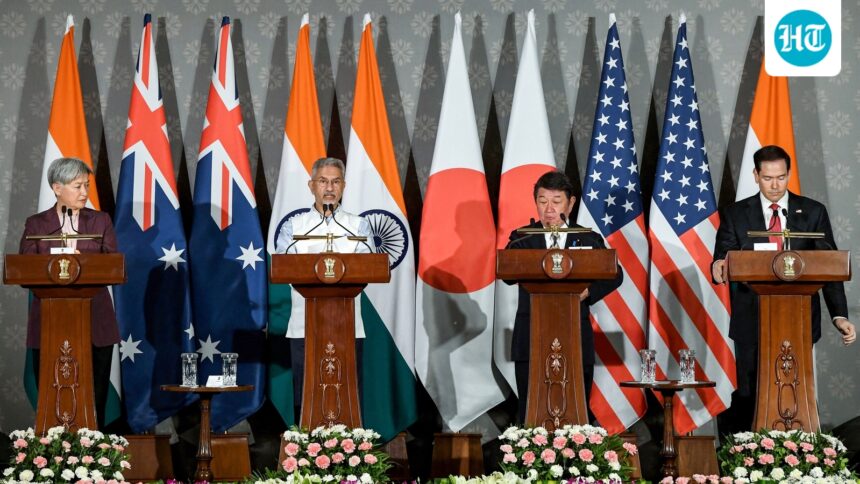
The Quad grouping, which includes India, the United States, Australia and Japan, was announced on Tuesday Expanding cooperation in the field of minerals and bioenergy while unveiling new measures to strengthen maritime surveillance and port infrastructure across the Indo-Pacific region, with External Affairs Minister (EAM) S Jaishankar describing the meeting as “productive”.

The group’s foreign ministers met in New Delhi, where Jaishankar chaired the meeting.
It was also attended by US Secretary of State Marco Rubio, Australian Foreign Minister Penny Wong, and Japanese Foreign Minister Toshimitsu Motegi.
Elaborating on the takeaways on social media after the meeting, Jaishankar pointed out the key decisions finalized by the group. The first of these three initiatives is the Indo-Pacific Maritime Surveillance Initiative.
“A maritime surveillance initiative in the Indo-Pacific region and a common operational picture in the maritime field were agreed upon. We will consider forming an expert committee on port infrastructure, and cooperate on a pilot port project in “Fiji, and on submarine cables,” S Jaishankar wrote on X.
The second outcome of the Quad meeting, according to the EAM team, is a Quad meeting Critical Minerals Framework signed by India and the United States.
“QUAD has been finalized. The India-US Critical Minerals Framework has also been signed. QUAD is working with other like-minded countries in this sector,” Jaishankar wrote.
The third main conclusion that came out of the New Delhi meeting is the Energy Security Initiative in the Indo-Pacific region.
“The QUAD Initiative on Energy Security in the Indo-Pacific region was announced in technology, management, policy, international market analysis and emergency response exercises,” he further wrote.
What other foreign ministers said
In his media statement, US Secretary of State Rubio said that the Quad meeting decided to launch the Maritime Surveillance Cooperation Initiative in the Indo-Pacific region.
He said it would benefit from our country’s maritime surveillance capabilities in the Indo-Pacific region.
Rubio also announced the expansion of the Indo-Pacific Maritime Domain Awareness Initiative among the QUAD nations.
The US Secretary of State also said that the Quad decided to put forward a new initiative to strengthen port infrastructure in the Pacific Islands.
“The reason maritime security is so important, beyond the fact that current events remind us of what can happen when maritime security is compromised, is the fact that 60 percent of global maritime trade passes through the Indo-Pacific region,” Rubio said.
He said it is a vital national interest not only for the four Quad countries but also for countless countries around the world.
“The second initiative: We will engage in port infrastructure issues, in response to insufficient port capacity in the Pacific Islands,” he said.
“We are announcing plans to work with Fiji to develop port infrastructure in that country. This will be the first time that QUAD partners will work together on a port infrastructure project,” he said.
Australian Foreign Minister Wong said that the Quartet recognizes efforts to reach a diplomatic solution to ensure freedom of navigation in the Strait of Hormuz.
She added: “We have realized the importance of preserving the principle of freedom of navigation and our opposition to any proposal to impose fees,” referring to Iran’s plan to demand fees for crossing the strait.
“We are working together to strengthen cooperation against fraud centers, especially in Southeast Asia,” Wong said.
The Australian Foreign Minister said that the Quad will initially coordinate maritime surveillance efforts in the Indian Ocean.