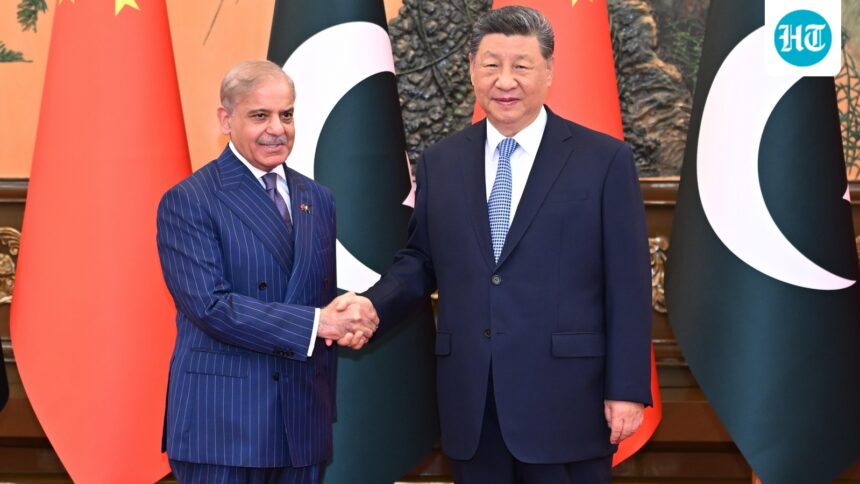
The Indian Foreign Ministry responded sharply to references to Jammu and Kashmir in the recent joint statement issued by China and Pakistan. “India’s position is consistent and known to the parties concerned. The Union Territories of Jammu and Kashmir and Ladakh have always been and will always remain an integral part of India,” MEA spokesperson Randhir Jaiswal said on Tuesday.

He added: “No other country has the right to comment on the same matter.”
He added: “With regard to the so-called CPEC projects, some of which are located in Indian sovereign territory, we strongly oppose and reject any moves by other countries to strengthen or legitimize Pakistan’s forced and illegal occupation of these territories, affecting India’s sovereignty and territorial integrity. This has been clearly conveyed to the Pakistani and Chinese authorities several times.”
“We have also seen references to the so-called ‘cross-border water resources cooperation’ between China and Pakistan. Since the two countries do not share any border, the issue of so-called ‘cross-border water resources cooperation’ does not arise. India has never recognized the so-called 1963 Boundary Agreement between Pakistan and China,” the MEA statement said.
What does it mean
It must be noted here that the references to Jammu and Kashmir and “transboundary water resources” indicate in the joint statement that Beijing wants to play the Kashmir card along with the water resources card to appease its ally in Islamabad in any case.
In the joint statement, Pakistan once again had to reiterate that it is committed to the “one China policy” which says Taiwan is part of China. It is customary for Beijing to have all prominent visitors from other countries repeat the one-China policy and its claim to Taiwan.
The statement once again makes clear that China will not yield an inch towards India when it comes to appeasing Pakistan, which is widely seen as its supplicant.
The reasons for these signals are clear, as Beijing also wants Islamabad to allow this Gwadar is to serve as a Chinese naval base in the northern Arabian Sea, at the mouth of the Persian Gulf.
For its part, India once again reiterated its opposition to the illegal China-Pakistan Economic Corridor and the fact that Pakistan illegally ceded 5,180 square kilometers of territory in the Shaksgam Valley to China in 1963.
What did the Pakistani-Chinese statement say?
The joint statement of Pakistan and China was issued on Tuesday at the conclusion of the official visit of Prime Minister Shehbaz Sharif to China from May 23 to 26. President Xi Jinping and Premier Li Qiang held separate talks with Prime Minister Shehbaz, and the two sides said they had reached a new broad consensus on further deepening the strategic cooperative partnership between China and Pakistan in all circumstances.
Shahbaz also attended the ceremony commemorating the 75th anniversary of the establishment of diplomatic relations between the two countries.
The statement said that the Pakistani side informed the Chinese side of the latest developments regarding the situation in Jammu and Kashmir. China said the issue should be resolved in accordance with the UN Charter.
The two sides also expressed their willingness to conduct “cooperation in the field of transboundary water resources,” without specifying the details of the cooperation as the rivers between China and Pakistan pass through Indian territory.