

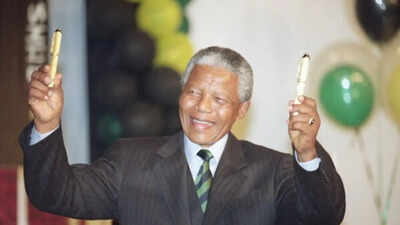
Today’s quote by Nelson Mandela
Some quotes seem important because they sound cool. Others survive because they feel personal. Nelson Mandela’s words seem to belong to the second category. At first glance, it seems that the quote is only talking about language.
Someone reads it and might think it’s a simple observation about communication. However, read it again, and it starts to feel even bigger. It begins to seem like a reflection of human nature itself.People understand information every day. They read headlines, answer emails, listen to instructions, and sit in on conversations. Understanding words is not difficult in many situations. Feeling connected through these words is a completely different experience.
It seems that this difference is what Mandela focuses on.Many people know this feeling without stopping to think about it. Someone may be speaking to you in a language you understand perfectly, and you follow every sentence effortlessly. Then suddenly you hear your own language, one associated with childhood memories, family conversations and familiar surroundings. Something changes almost immediately.
The message no longer seems like simple information. It’s a personal feeling.This quiet transformation is what makes this quote resonate decades later.
Today’s quote by Nelson Mandela
“If you talk to a man in a language he understands, it goes to his head. If you talk to him in his language, it goes to his heart.”
What is the meaning behind Nelson Mandela’s quote?
Mandela’s quote, at its core, seems to separate understanding from emotional connection. These ideas often sound similar, but they are not the same thing.The first part of the quote talks about talking to someone in a language they understand. In practice, communication is successful.
The information reaches the person. Facts are shared and ideas are delivered. The mind processes the message and understands it.The second half goes somewhere deeper. Speaking to someone in their language, according to Mandela, reaches the heart. The meaning here extends beyond literal vocabulary or grammar. Language often carries memories, identity, and emotional experiences that remain attached to a person throughout their life.Many people have experienced moments where hearing their native language in a faraway place creates an unexpected emotional reaction. Travelers sometimes describe hearing their native language in another country and suddenly feeling comfortable and familiar. The words themselves may be ordinary. The feeling associated with them is what changes.Mandela seems to be referring to something similar. Humans rarely respond solely to information.
It also responds to recognition. There is something powerful about feeling understood in a personal way.Communication experts often point out that effective communication is not just about getting the message across accurately. It also involves building trust and emotional understanding. Mandela succeeded in condensing this larger idea into one sentence.
Experiences that may have shaped Mandela’s thinking
Nelson Mandela lived a life shaped by struggle, division, and social change.
South Africa itself contains a rich and complex mix of cultures and languages. Throughout Mandela’s life, language was linked not only to identity, but also to politics, power, and belonging.Mandela reportedly realized the importance of language as a bridge between people. There are often repeated stories about him learning or using other people’s languages as a sign of respect. For some people, language is just a practical tool.
It seems that Mandela saw something bigger in this.He understood that when people feel valued, barriers sometimes begin to dissolve. This idea may seem small when written down on paper, but in societies divided by history and conflict, small gestures can carry enormous significance.Perhaps his years in prison, his role in South Africa’s transformation, and his experience working across different communities reinforced a simple lesson.
People don’t just want to hear. They want to feel seen.This distinction is important.
Why is this quote still relevant today?
The interesting thing about this quote is that it sounds surprisingly modern even though it comes from a completely different period of history.People are constantly communicating today. Messages arrive every few minutes. There are emails, texts, social platforms and video calls. Information travels incredibly quickly.However, many people still say they feel disconnected.That seems like a strange contradiction. Communication happens everywhere, but sometimes it’s hard to find a true connection.Mandela’s words seem like a reminder that communication is not simply measured by size. Saying more does not automatically mean relating more.People often remember moments when someone made an effort to meet them on a personal level. The teacher may be using familiar language to calm the student.
It could be a friend learning phrases from another culture. There might be a stranger trying to speak someone’s native language even though they don’t speak it perfectly.The effort itself is often important.People tend to remember effort.
There may be a bigger lesson hidden beneath the words
Many people read Mandela’s quote as something broader than language itself. They see it as a lesson about empathy.Speaking someone’s language doesn’t always mean sharing vocabulary.
Sometimes that means understanding how they think, what they value, or what experiences have shaped their lives.People often say that they “speak different languages” even when they literally speak the same language. They usually mean that they struggle to communicate emotionally rather than linguistically.This interpretation gives Mandela’s statement another dimension. It becomes less concerned with talking and more concerned with understanding someone else’s world.Perhaps this is why the quote continues to travel through generations. It works on multiple levels at the same time.
Other famous quotes by Nelson Mandela
- “Education is the most powerful weapon you can use to change the world.”
- “It always seems impossible until it’s done.”
- “I never lose. I either win or learn.”
- “The greatest glory in life lies not in never falling, but in getting up every time we fall.”
- “I hope your choices reflect your hopes, not your fears.”
- “Resentment is like drinking poison and then hoping it kills your enemies.”
Why do people still come back to these words
Some quotes survive because they sound clever. Others survive because people see parts of their own experiences within them.Mandela’s words seem to still live on because they touch a feeling that many people instantly recognize. Most people have had a moment when they felt truly understood. Maybe it happened through language.
It may have happened through kindness, effort, or familiarity.Information reaches the mind every day. Human contact tends to last longer.That seems to be the quiet thought beneath the quote. On the surface, it’s about language. In fact, it may be about people and the simple desire that everyone has, which is the desire to feel understood.
Get all the live updates on the US-Iran conflict, the Israel-Iran war, Donald Trump’s reactions, and the impact of the global oil market here.