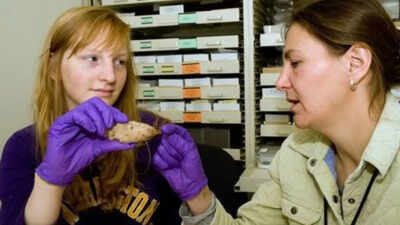
Computer: University of Washington
A small plot of land next to a chain-link fence on the University of Washington campus turns out to have a much older story than anyone who worked there on a typical day would have guessed.
It started almost accidentally, as soil near a greenhouse was turned over and a piece of stone that didn’t quite match the usual rubble of the campus landscape was lifted. At first glance, it looked like something that could easily be misplaced, but the shape and finish suggest that it has traveled over a much longer period of time. What followed prompted archaeologists to take a closer look at a place that, despite its modern buildings and constant foot traffic, still bore traces of a past life beneath its surface.
An ancient stone tool discovered beneath the campus reveals hidden history
The discovery came during routine volunteer work near a plant greenhouse, where soil is often loosened and cleared using hand tools. Among the stones and compacted earth, a piece of flaky rock emerged, its edges too deliberate to be considered random debris.It was later identified as a projectile point rather than a simple arrowhead, and is larger and more accurate than initially assumed. Not long after, specialists from the Burke Museum of Natural History and Culture returned to the site and opened some small test pits around the area.
Two additional pieces of stone tools appeared, scattered and not neatly placed, as if the earth had preserved them through time rather than preserving them in any organized way.The piece is believed to be thousands of years old, with estimates suggesting it is between 4,000 and 6,700 years old. This range loosely links it to the period when volcanic ash from the eruption of Mount Mazama, which later formed Crater Lake, settled across parts of the region and became a marker in archaeological strata.Its size and shape fit comfortably with other stone tools recovered from the Pacific Northwest dating back to that broad era. Nothing about it seems unusual given the deep history of the area, but what makes it unusual is not its shape but the place where it appeared: a crowded campus, covered by decades of construction, paths and infrastructure.
What lies beneath the idea of a “new” Earth?
The idea that this land was ever “unused” doesn’t really hold up.
Archaeological records, along with historical accounts and oral history, indicate that indigenous communities lived across these stretches for thousands of years before the university was established.Until the late 19th and early 20th centuries, families remained attached to portions of what is now campus land before being fully absorbed into university property. This continuity falls strangely beneath modern assumptions about how cities grow, as if old presences had simply been removed rather than gradually folded under new layouts.
Get all the live updates on the US-Iran conflict, the Israel-Iran war, Donald Trump’s reactions, and the impact of the global oil market here.