

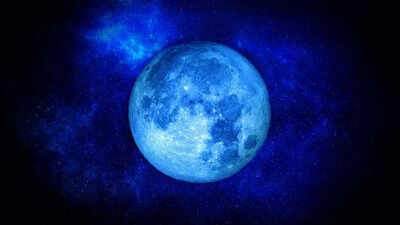
This week the sky is doing something that it only occasionally manages to do without paying much attention to it. The second full moon arrives during the same calendar month, the kind of strange timing that sounds more dramatic than it actually is when you first hear it, but becomes strangely satisfying once you notice how much the lunar cycle refuses to conform to human calendars.
At sunset, the moon begins its slow rise, bright enough to wash out the soft stars while still low enough to have the familiar orange hue. Nights in late May tend to feel busy in the sky anyway, as the planets move toward the horizon and the familiar constellations begin their seasonal retreat westward.
Blue moon 2026 : When and how will we see the smallest full moon of the year?
The next blue moon, which will occur at 8:45 UTC on May 31, 2026, is not only a blue moon but also the farthest full minimoon of the year.
Despite the name, a blue moon does not change color.This event is also considered a minimoon, which means the moon is approaching its peak; The farthest point in its orbit from Earth for this month. At this distance, the Moon appears slightly smaller in the sky, although the difference is too subtle to be easily noticed by the human eye.According to EarthSky, the May 30-31 full moon will be the smallest in 2026, positioned about 252,360 miles (406,134 km) from Earth, compared to the moon’s average distance of about 238,900 miles (384,472 km).
Blue moon in May 2026: What skywatchers can expect in the final days of the month
The month of May concludes with what sky watchers call a blue moon display, although nothing changes in its appearance. It is simply the second full moon in the same month, made possible by a mismatch between the 29.5-day lunar cycle and our fixed calendar. A full moon appears at the beginning of May, and another arrives as the month runs out of space.The most interesting moment is not the specific moment of fullness, but the evenings on either side of it.
On May 30, the moon rises near sunset and appears very large near the horizon, a trick of the atmosphere and perspective that always seems more dramatic than it should. It bears a warm orange color at first, then gradually whitens as it rises higher and clears the thick air near the ground.By May 31, it settles into its full official phase. Nothing changes radically visually, although the timing completes the course that earns it the label that people like to repeat.
A blue moon rises on May 30, and Venus and Jupiter begin to converge
The most viewed part of the sequence tends to be the moonrise on May 30. That’s when the full moon rises to the glow of twilight, just as daylight loosens its grip. Finding a clear view toward the southeast mattered more than anything else that evening. Buildings, trees, and even low hills can interrupt the moment it appears.When the horizon first clears, it often appears larger than expected, sitting heavy and orange against the fading light.
The effect does not last long. Within an hour, it becomes the familiar bright white disc that most people recognize, but that brief early phase tends to be what sticks in the memory.Far from the moon, two planets quietly dominate the western sky after sunset. Venus is the conspicuous planet, bright and low, and is hard to miss even when the sky is still bathed in twilight. Jupiter sits higher, less dense, but stationary. And every evening, the distance between them decreases a little. It’s slow enough that you might miss it if you look at it just once, but it can be noticed over a few nights. By early June, the separation becomes close enough that the pair almost seems like a deliberate arrangement rather than two independent planets moving on their own paths.On June 9, they reach their closest binary, lying low in the west after sunset. The event is short-lived, but striking in its simplicity. No special equipment is needed, just clear vision and a little patience as the sky darkens.