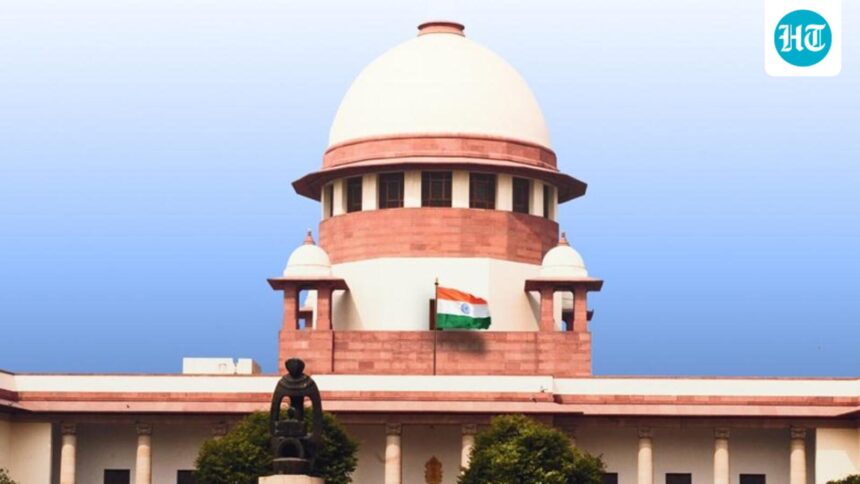
The Supreme Court on Tuesday stayed the implementation of the Delhi High Court ruling that ruled that law students could not be barred from appearing in examinations solely on the ground of insufficient attendance, and observed that law colleges across the country were “suffering” due to the ruling.

A bench of Justices Vikram Nath and Sandeep Mehta passed the interim order while issuing notice on the petition filed by the Bar Council of India (BCI) against the November 2025 ruling of the Delhi High Court.
“Issuance of replyable notice on July 21. In the meantime, the effect and operation of Section 249 of the impugned judgment will remain suspended. However, the same shall be effective with prospective effect,” the bench ordered.
During the hearing, the court noted that the consequences of the Supreme Court ruling were being felt by law institutions, especially the National Law Universities (NLUs), where students are increasingly resisting compulsory attendance requirements.
“All NLUs are suffering. No student wants compulsory attendance. Even those who have passed out are supporting the students,” the bench noted.
The court also questioned BCI’s delay in approaching the Supreme Court against the ruling. “Why did you come so late?” Ben asked.
BCI Chairman and Senior Advocate Manan Kumar Mishra admitted the delay and termed it an error on the part of the regulatory body.
Senior advocate Mukul Rohatgi, appearing in a related case, argued that the Delhi High Court ruling had effectively rewarded indiscipline among students. They will not go to colleges,” Rohatgi said.
Read also:‘Suddenly struck by lightning’: How Türkiye-based Celebi described the centre’s security clearance procedures at Delhi HC
The bench, while interacting with the counsel, observed that the Supreme Court ruling appears to have gone beyond interpretation and entered the legislative realm. She asked, “Does the ruling give students the right not to enroll in universities? The Supreme Court has issued literal legislation.”
The November 2025 ruling by the Delhi High Court ruled that no student enrolled in a recognized law college or university shall be prevented from appearing in examinations or from progressing academically merely because of lack of attendance.
The ruling arose out of proceedings linked to the alleged suicide of law student Sushant Rohilla in 2017 at Amity University. Allegations were raised that Rohilla was harassed over low attendance and forced to repeat the academic year for his LLB course, which contributed to his suicide.
The Supreme Court observed that attendance regulations should not be implemented with such strictness that it leads to mental disorder or serious consequences to the students. It also directed the BCI to review the requirement of compulsory attendance for three-year and five-year law courses in light of the National Education Policy 2020 and evolving educational frameworks.
However, the ruling sparked a series of appeals to the Supreme Court from law colleges and institutes across the country, which claimed that the ruling severely undermined academic discipline and institutional independence.
On May 13, while hearing a plea by Narsee Monje Institute of Management Studies (NMIMS), the Supreme Court had already expressed serious reservations over the Delhi High Court’s ruling. At that point, the Justice Nath-led bench observed that accepting such a post could reduce law school hostels to “mere boarding and lodging facilities”.
The Board then noted that if students were no longer required to attend classes, there would be little purpose in maintaining institutions known for quality classroom teaching and faculty engagement.
NMIMS, in its petition, alleged that the Delhi High Court ruling has opened the “gates of litigation” by students seeking permission to appear in examinations despite not fulfilling the minimum attendance requirements. Lectures, tutorials, moot court exercises, hands-on training and classroom interaction remain an integral part of legal education, especially in five-year integrated law programs where students enroll directly after school, the foundation said. The petition also relied on Rule 12 of the BCI Legal Education Rules 2008, which stipulates a minimum attendance requirement of 70%, with a limited tolerance of up to 65% allowed in exceptional cases.