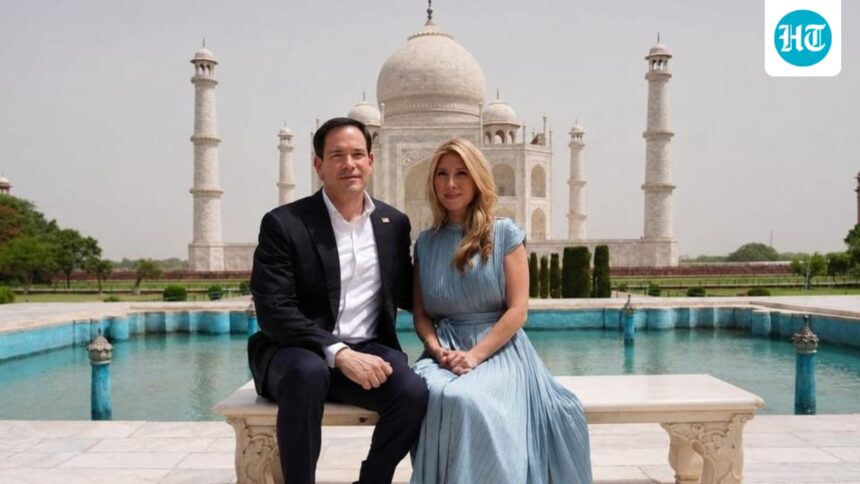
As US Secretary of State Marco Rubio continues his visit to India, the top diplomat visited the Taj Mahal in Agra. However, Rubio’s visit did not go unnoticed, especially with Iran intervening to mock the American official.

Turning to X, the Consulate General of Iran in Hyderabad was quick to criticize Rubio’s visit to the UNESCO World Heritage Site, amid the ongoing war between the US and Tehran.
In response to photos posted by Rubio and his wife in front of the Taj Mahal, the Iranian consulate drew Iranians to the monument and stated that if Rubio “knew the history or architecture, he would not take a photo here.”
The consulate further wrote: “This monument was built for the love of the Iranian emperor’s wife, and designed by the genius of Iranian architects – and at the same time his government today threatens to eliminate Iranian civilization and insult other civilizations.”
This publication comes at a time when delegations from Iran and the United States are still engaged in negotiations to reach a peace agreement to end the ongoing conflict.
Rubio’s quick scroll also highlights Persia’s influence on Mughal architecture in India.
The Taj Mahal was built by the Mughal Emperor Shah Jahan in memory of his third wife, Mumtaz Mahal, who was of Persian origin. This monument is widely considered one of the finest examples of Indo-Islamic architecture and includes strong Persian artistic influences.
According to Britannica, thousands of workers were employed from India, Persia, and elsewhere to complete the mausoleum, ancillary buildings, and decorative work for the Taj Mahal.
According to the official website run by the Uttar Pradesh government, passages from the Quran were also used as decorative elements throughout the complex.
Rubio, who is on a three-day visit to India, referred to the Taj Mahal as “one of the wonders of the world.”