The Supreme Court on Monday rejected the request for urgent hearing on the petition seeking action against the Cockroach Janta Party (CJP), saying it would be listed in “appropriate time”.

The bench headed by Chief Justice of India (CJI) Surya was hearing an application for extra hearing of the petition filed by advocate Raja Chaudhary seeking action against the CJP and all persons alleged to be involved in commercial exploitation of the Supreme Court’s observations.
The petition filed on Sunday also sought a probe by the Central Bureau of Investigation (CBI) into the case of fake lawyers, fraudulent law degrees, impersonation in legal practice and deteriorating professional standards in the legal profession.
Responding to what the lawyer representing Chaudhary said, the bench, also comprising Justices Joymalia Bagchi and Vipul M Pancholi, said: “There is no great urgency. We will consider the matter at the appropriate time.”
Advocate NK Goswami, appearing via video, referred to the same case and said it was very unfortunate that the comments made by the court were distorted despite the clarification issued by the ICJ. “Don’t take it seriously,” the bench told Goswami.
Read also:A petition has been filed in the Supreme Court seeking a CBI probe against the activities of the ‘Cockroach Janta Party’.
On May 15, the ICJ made comments referring to “such young people” who obtain fake degrees and enter targeted professions and institutions.
Chaudhary’s petition lamented how a digital political formation like the CJP could capitalize on such distorted statements for the purposes of gaining publicity, online engagement, circulation of merchandise, satirical branding and possible commercial exploitation.
“The selective extraction and inflammatory dissemination of oral exchanges increasingly distorts the administration of justice and turns judicial proceedings into a media spectacle… Constitutional morality cannot allow constitutional institutions or constitutional office holders to become vulnerable to organized digital humiliation, social gatekeeping, or commercially amplified outrage campaigns,” the petition said.
Regarding the CJP and persons allied with it, Chaudhary requested the court to direct “the appropriate authorities to examine and take action against persons or entities alleged to be involved in commercial exploitation, trademark appropriation, cash trading, or unauthorized commercial use of oral courtroom observations and symbolic expressions arising out of the proceedings before the Supreme Court of India, including activities associated with the Kukrush Janta Party.”
The petition said the judicial rulings recognized fair criticism, democratic dissent, satire and constitutionally protected freedom of expression. However, commercial and commercial exploitation of formal judicial processes and institutional expressions in a way that undermines public confidence in the judiciary and the administration of justice cannot be allowed, he added.
The petition raised concerns that if solemn courtroom interaction is continually reduced to pieces of entertainment, trolling, commercial branding, and a critical spectacle divorced from procedural context, the constitutional promise of justice itself risks gradual erosion within a culture of algorithmic outrage.
“The case is not just about maintaining institutional reputation, but about constitutional governance itself in the age of viral algorithmic media,” Chaudhary stated in his petition filed by advocate Rajesh Singh Chauhan.
“There are young people who are like cockroaches, who are not getting any work or have no place in the profession. Some of them become media persons, some of them become social media, RTI activists and other activists and start attacking everyone,” the CJI said on May 15.
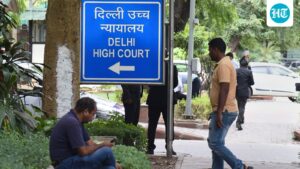
The comment came while hearing a petition filed by a lawyer seeking a senior position in the Delhi High Court.
A day later, the International Committee of Justice strongly objected to some media reports that linked his comments to comparing the country’s youth to cockroaches. He issued a clarification stating that his statements had been misquoted.
He said: “What I specifically criticized were those who entered professions such as law with fictitious and forged certificates.” The clarification also stated that “similar people have infiltrated the media, social media and other noble professions, and are therefore like parasites.”
Describing news reports linking his cockroach comment to youth as “completely baseless”, he said: “Not only am I proud of our current and future human resources, I am inspired by all the youth of India…I also see them as pillars of a developed India.”
The petition also cited a recent news report quoting Bar Council of India (BCI) president, Manan Kumar Mishra, claiming that “35 to 40% of those seen in courts wearing black coats and bangles are fake” and demanded an independent investigation in this regard.