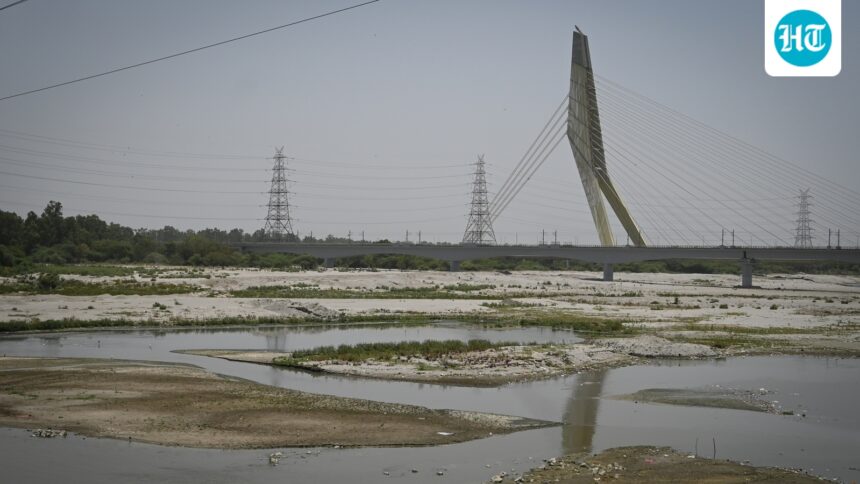
Adding to the misery for Delhiites already suffering from a heatwave, the falling water level in the Yamuna River has led to reduced water supply, especially in the backwaters.

Officials from the Delhi Jal Board (DJB) – the government agency responsible for the production and distribution of potable drinking water – said the decline in raw water in the Yamuna has disrupted operations at the Wazirabad and Chandwal Water Treatment Plants (WTPs).
Many residents complained that, unlike previous years, no advance warning or advice had been given about low water supplies.
The Wazirabad WTP supplies about 134 MGD (million gallons per day) of water to parts of north and central Delhi, while the Chandrawal WTP produces 98 million gallons per day (MGD), which is supplied to north, northwest and central Delhi.
DJB did not respond to HT’s requests for comment.
Wazirabad Barrage and Pond Area act as the main detention area for raw water obtained through the Yamuna River Canal and the water level in the pond has to be maintained at 674.5 feet (from sea level). Two of DJB’s largest water treatment plants draw raw water from this area.
A senior DJB official, requesting anonymity, said that due to shortage of raw water in the river channel, the water level has fallen below 670 feet. “Water levels in the Yamuna River are around 669.8 feet. Water supply from Wazirabad has fallen by 25%, while Chandrawal supply has fallen by about 10%,” the official said.
Another Jal Board official, who did not want to be named, said that due to the depletion of the pond level in Wazirabad, the city authorities are trying to divert raw water from the conveyor-lined canal (Monak) towards Wazirabad. “If the water level continues to fall, water production will be severely affected. We will have to deploy specialized pumps, besides boats, to suck water from the pond area,” the official said.
The government is in talks with Haryana to release additional water from Hathnikund source to prevent water supply crisis, the two officials said.
Delhi’s water demand is estimated at 1,250 million gallons per day, with DJB supplying 1,002 million gallons per day. The gap widens during the summer months (May-July), when demand increases while raw water availability decreases.
Delhi gets the majority of its raw water from neighboring UP, Haryana and Punjab.
Offer discounts
On the ground, the curtailment has translated into supply disruptions, especially in central Delhi, which is at the end of the network, where Patel Nagar J Block, West Patel Nagar, parts of Dwarka, Ambika Vihar Society, Paschim Vihar, Ramesh and Sudarshan Park areas were badly affected.
Tajinder Pal, who lives in Patel Nagar, said locals are struggling to get water.
“The Golf View Apartment in Sector 19B, which has over 1,000 families, has been facing irregular supply for the past week,” said Ashok Kumar, a resident of Dwarka.
No advisory has been issued this time for water storage, said Ashok Bhasin, president of North Delhi Residents Welfare Federation, an umbrella body representing various rural areas.
Political quarrel
Delhi government’s training gun Arvind Kejriwal, national coordinator of the Aam Aadmi Party (AAP), posted on X: “Who would have thought that the country’s capital would one day be in such a state?”
Delhi Water Minister Parvesh Verma replied: “The truth is that during those 11 years (under AAP), no real work has been done on water, sanitation and water storage – nothing compared to the hype they have created.”