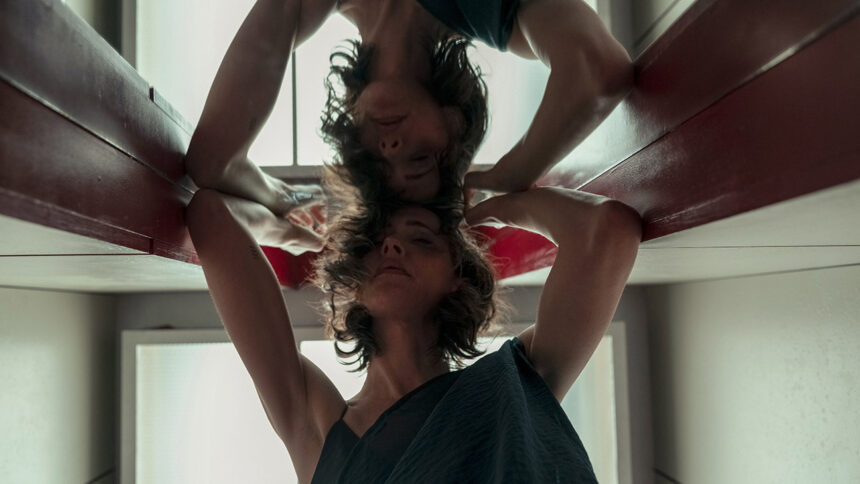
The always watchable Rebecca Hall (The man I lovetelevision beauty) are both anchors and buoys for an erratic but thoughtful and consistently compelling sci-fi comedy-drama The end of itthe first feature film by Catalan writer and director María Martínez Bayona.
Featuring an eerily plausible near-future, it resonates with recent headlines and is nicely understated by design, that posits Hall as Claire, a 250-year-old artist who’s kept looking like something chic in her 30s thanks to cutting-edge dialysis techniques and other kinds of high-tech, vaguely defined magic, available to very few people.
The end of it
Bottom line Heralds a potentially interesting career.
place: Cannes Film Festival (Premiere in Cannes)
ejaculate: Rebecca Hall, Gael Garcia Bernal, Noomi Rapace, Beanie Feldstein
Director/screenwriter: Maria Martinez Bayona
2 hours and 22 minutes
However, when Claire grows bored with the immortal life and chooses death, her husband Diego (Gael García Bernal), her 180-year-old daughter Martha (Noomi Rapace), and robotic personal assistant Sarah (Beanie Feldstein) react in different ways, ranging from supportive to angry. Running 142 minutes, this feels a bit flawed by a script that doesn’t quite know how to play out the endgame and explodes with jarring flashes of squishy, over-the-top cynicism. However, the displays and visuals consistently add value, and if this doesn’t sell many tickets IRL, it should attract clicks as a streaming entity.
Filmed mostly in the Canary Islands with the region’s searing, stark light abutting the Tropic of Cancer, eerie black volcanic soil and striking mid-century modern buildings, the film points to a future in which the worst of climate disasters have been averted. That, or the people we meet here are wealthy enough to find a comfortable little enclave to live in forever without a care in the world. They seem to be part of a select few, members of a vaguely hinted at world order that provides the means to live in a state of perpetual, hedonistic boredom.
But the only way to participate in this immortality party, or get permission to have a child, is for someone else to die. Since no one dies of cancer or other treatable diseases now, for example, and bones and organs can be replaced like car parts with artificial parts, people only die when they get involved in freak accidents…or commit suicide.
For her 250th birthday (she gets a cake with so many candles that she barely bothers to blow them out), Claire is a mess and isn’t enjoying any of it anymore. Having just replaced her last remaining normal bone, she took stock of the situation. Years ago, she was a famous artist and her work was avant-garde and a bit challenging. She now designs jewelry, a lucrative but not intellectually rewarding job. (This plot point is a bit bad for jewelry designers.) After suffering from a severe case of anhedonia, she decides that she will no longer have blood tests every day or any other type of life-prolonging therapy, and will instead let nature take its course.
As her hair turns gray and signs of aging appear, Claire faces a variety of reactions from her small social circle. She didn’t care much for the assorted acquaintances who attended her birthday party, a group dressed in an assortment of semi-simple clothes with funky little details and interesting textiles, as if they were wearing a mix of Comme des Garçons and Cos (costume designer Pau Auli’s work throughout is deft and oddly desirable with precise tailoring and a subtle color palette).
But what’s even more annoying is that Diego, her husband of many years, doesn’t understand her reasoning at all, or even sees it as a personal rejection. Likewise, Sarah, Claire’s relentlessly cheerful robot friend, can’t figure out why Claire would want to subvert Sarah’s primal directive, to keep Claire alive. But she will do whatever it takes to keep her lady happy, like some kind of human golden retriever.
Only her daughter Martha, who suddenly appears, having not seen her mother in 50 years, seems at peace with Claire’s decision. This seems to be because she thinks this might be her chance to take Claire’s place as the reproductive female in their society and has brought along a robot baby to train on, like some sort of 23rd century Tamagotchi that can be turned off and recharged when necessary.
Tend to wear clothes that suggest an overgrown teenager, all frills and flounces and bright colours, Martha does not seem great motherly material to Claire, although this judgmental attitude may be evidence of her maternal insufficiency. The violent sparring between the two gets a comedic boost from the fact that the actors are so close in age (Hal is three years younger than Rapace), but like many parents and children they remain stuck in a dynamic that was formed sometime in adolescence and never quite transcends.
The excavation of the artists’ claims, which is guided by Clare’s decision to make her death a public spectacle in order to secure some future fame, is less enjoyable here because the hits never seem entirely connected to their goals. One also begins to suspect that the small budget prevented the filmmakers from showing a broader vision of this society, which also discourages any satirical purpose. So Claire’s voluntary death remains a problematic choice for some viewers, an act of arrogant selfishness from a woman who wasn’t very nice to begin with.
Fortunately, she’s played by Hall, who imbues Claire with a sharp kind of intelligence and charisma, while her performance in the film’s final minutes carries a great deal of emotion and pathos. The shocking impact of this final scene is enough to leave viewers feeling exhausted after what was a very choppy final act. But even with these flaws, The end of it It looks to mark the beginning of an interesting career for the young writer-director, a talent with a strong visual sense and skills with actors.