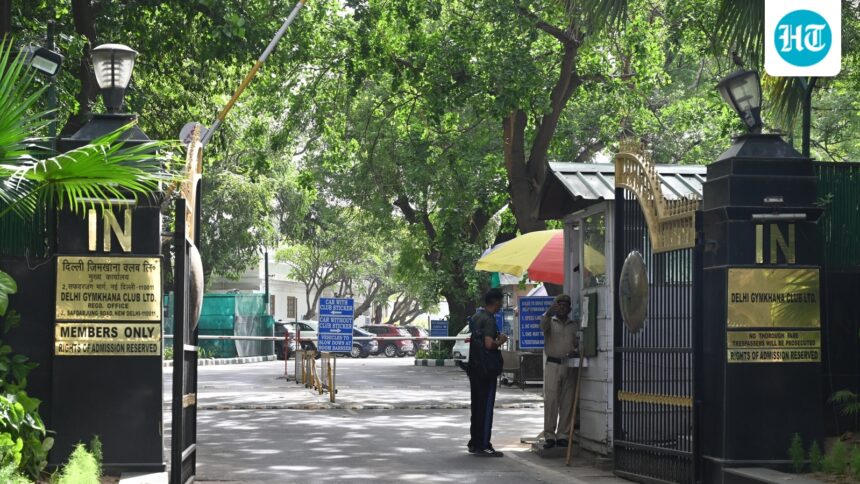
Delhi’s iconic Delhi Gymkhana club is heading towards one of the most dramatic corporate upheavals in recent memory. Many would say that the writing has long been on the wall.

The club has been involved in legal and administrative disputes, from proceedings before the National Company Law Tribunal to court interventions and controversies surrounding its management and elections.
But the lockdown order affects the state’s relationship with heritage institutions, urban heritage, quality of life, and even India’s global image.
Politically, this may seem like a safe and easy goal. It is unlikely that any political party will lose votes on the fate of Gymkhana. The left will not rise in protest, and neither will the right. the ““Allah” activists will celebrate this event as a symbolic strike against privilege. The thousands who could not obtain membership may secretly boast that the exclusive club has finally been subdued.
The scene is very tempting, as a powerful government cracks down on an elite region of the country Lutyens Delhi.
But beneath populist complacency lies an uncomfortable paradox and a harsh truth. He was neither a vote bank, nor a beneficiary of welfare policies nor a contributor to the party coffers.
It is true that the land was originally allocated 1913 during the colonial era. But if historical appropriations are now to become the basis for institutional dismantling, this principle must apply uniformly across Delhi.
Land leased by the government is occupied by countless educational institutions, cultural bodies, clubs, trusts and foundations. Selective scrutiny raises questions about consistency and fairness.
Official justification regarding defense and security requirements hardly exists. If the relocation of the Prime Minister’s residence is imminent, one is right to wonder why this piece of land has suddenly become indispensable from a defense point of view.
For generations, the Gymkhana has served as more than just a recreational club. It has become one of the rare urban spaces where retired civil servants, army officers, diplomats, academics, professionals and business leaders interact outside the strict quarters of officials.
The tennis courts, walkways, cottages, nursery and green spaces offered something increasingly rare in India’s crowded metros – breathing space and civic tranquility.
The temporary membership allowed visiting foreign CEOs, diplomats and professionals to engage informally with their Indian counterparts.
Such spaces matter more than governments often realize.
Diplomacy can only take place through embassies and conference tables. Nations are also understood through their social ecosystems, civic culture and informal networks. Around the world, historic clubs and civic institutions often become soft power platforms where ideas, investments and relationships quietly develop. When foreign investors and international executives evaluate a city, they don’t just look at GDP schemes or tax incentives. They evaluate quality of life, institutional continuity, urban culture, and the availability of civic spaces for meaningful interactions.
Reform and destruction are not synonymous
India today aspires to become a major economic and geopolitical power. However, there are concerns about foreign companies moving their regional bases elsewhere in Asia due to pressures on infrastructure, regulatory unpredictability, and issues related to quality of life in urban areas.
In this context, dismantling old institutions rather than shoring them up sends an unintended message about institutional insecurity.
None of this means that elite institutions should remain beyond accountability. Transparency, fair elections, financial viability and compliance with the law are essential. If violations occur, they must be dealt with firmly. But reform and destruction are not synonymous. Mature nations preserve heritage even while correcting errors.
India is home to the poor, the middle class and the rich. Governance cannot turn into a practice of pitting one group against another.
The aspirations of the disadvantaged deserve priority, but the quality of life of professionals, scholars, diplomats, businessmen and retired public servants is also important in the modern state. Cities derive their character from institutions built up over decades, and sometimes centuries.
Closing the Delhi Gymkhana may draw immediate applause in some quarters as an anti-elite gesture, earning short-term political points. But erasing a landmark in Delhi’s civic heritage threatens to disempower the city far more than empower the state.
Nations become great not only by building new monuments, but by preserving and repairing the institutions that gave their cities history and character.
—
Yashovardhan Jha Azad is a retired IPS officer who served as Central Information Commissioner. Security Secretary, Cabinet Secretariat; And the Special Director of the Intelligence Bureau. The opinions expressed here are his own.