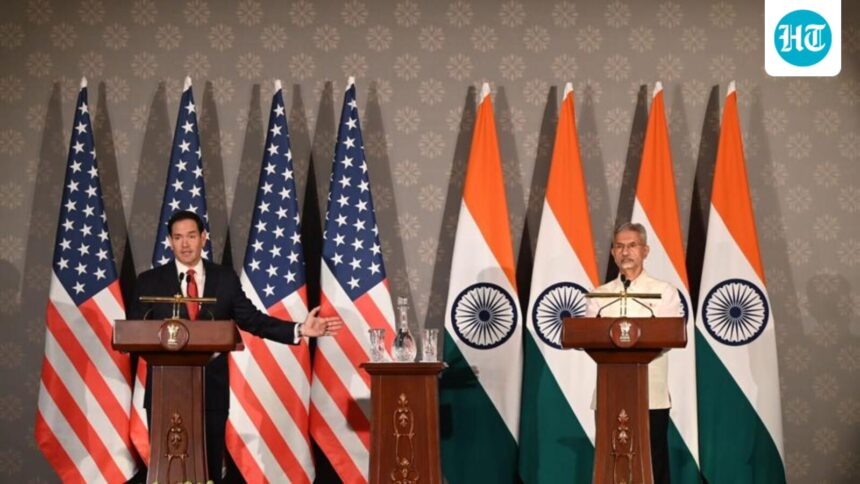
India and the US are looking forward to an early conclusion of an interim trade agreement, with a US delegation expected to travel to New Delhi soon to take the process forward and reach an understanding that serves the national interests of both sides, External Affairs Minister S Jaishankar and his US counterpart Marco Rubio said on Sunday.

There has been little sign of forward movement since Prime Minister Narendra Modi and US President Donald Trump announced on February 2 that the two sides were close to reaching a trade deal, including lowering US tariffs on Indian exports. Although the West Asia crisis was of concern to the Trump administration, India and the United States continued talks to conclude a trade agreement.
Jaishankar stressed the importance of reaching an early understanding on the trade agreement in a joint press conference with Rubio, and expressed hope that a US team would come to India soon to set the process in motion. “On the economic front, we talked about the value of finalizing, early, the final text of the interim agreement on mutually beneficial trade,” Jaishankar said.
He said this would be an important step towards reaching a comprehensive bilateral trade agreement, as envisaged during Modi’s talks with Trump during a visit to Washington in February 2025. “We had a team in Washington recently and we expect an American team to visit India soon for this purpose,” he said.
“We hope that our trade representative will be able to visit here very soon. We had an Indian delegation in the United States… We have made tremendous progress. I think we will end up with a trade agreement between the United States and India that will be lasting and will be beneficial to both sides. And sustainable in a way that addresses this national interest that we have,” Rubio added.
The two sides did not provide a specific timeline for finalizing the interim trade agreement, although Rubio sought to overcome differences created by Trump’s tariff policies. Indo-US relations deteriorated when Trump imposed 50% tariffs on Indian exports, including a 25% tax on Russian energy purchases.
Read also:India and US will continue to work together for global good: PM Modi to US Ambassador Rubio
“This is not about India, it’s about the United States in terms of trade. The president did not say, ‘Let’s figure out a way to create friction with India on trade,'” Rubio said, considering that Trump’s actions were aimed at addressing the imbalance in the United States’ trade balance “from a global perspective” and bringing manufacturing back to the United States. “There is a need to rebalance how we deal with global trade, not just with India, with the European Union, with countries around the world,” he said.
The difference in the case of India is the size of its economy and the huge volume of trade with the United States. “I think it’s stuck on that,” Rubio said. “The good news is that, through this rebalancing, we ultimately believe we will get to trade arrangements around the world that are good for the United States, but also good for our trading partners.” “We hope that India will be one of those countries. In fact, we are close to achieving that.”
Rubio pointed to India’s inclusion in PAX Celica, the US-led initiative for secure global supply chains for artificial intelligence and semiconductor technology, and Indian companies’ investments of more than $20 billion in the US, as signs of growing economic cooperation between the two sides. “I think the relationship remains strong… and I think by the end of this administration, it will be stronger than it has ever been,” he said.
Pointing out the scope of cooperation in the field of bio-minerals and artificial intelligence, Jaishankar said that India would encourage its companies dealing with artificial intelligence to explore opportunities in the United States. “As India advances in semiconductor and AI capabilities, this cooperation will be more prominent,” he said.
Meanwhile, Jaishankar said he and Rubio raised the Indian side’s “primary responsibility” to meet the energy needs of the country’s 1.4 billion people, including ensuring “access and affordability” of energy. “The Minister and I have welcomed the expansion of our energy trade in recent months. Diversified supplies are at the heart of India’s energy security,” he said.
The two sides also discussed cooperation in the field of nuclear energy, and Jaishankar said the passage of India’s Shanti Act opened up new possibilities in the sector. He added, “An American delegation recently visited India. We hope to realize the potential for cooperation in the nuclear field, and I raised with the minister some of the organizational issues that we have on the American side,” without going into details.