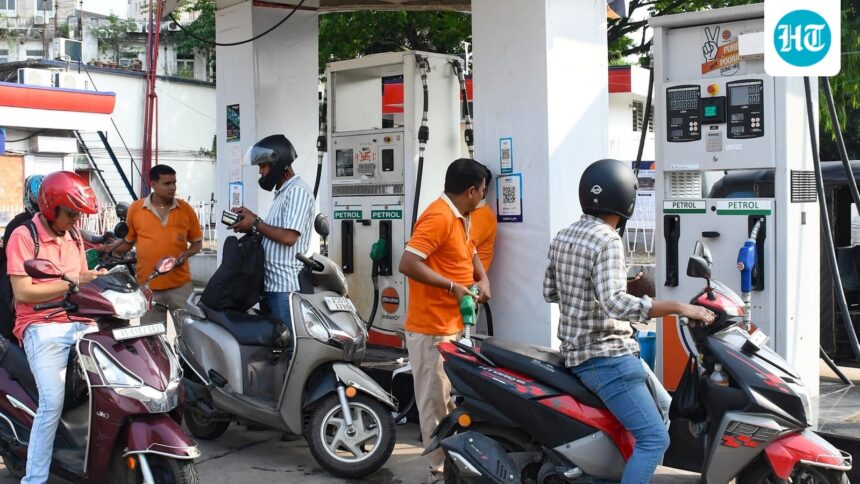
State-run oil companies raised gasoline and diesel prices by about $1 per liter on Saturday – the third increase in eight days – making the cumulative revision slightly lower $$5 per liter since May 15, even as global crude oil retreats from its peak. At the same time, Indraprastha Gas Ltd raised CNG prices by $1 per kilogram, which is the third increase since May 15, bringing the total rise in compressed natural gas to $4 per kilogram in less than 10 days.

Industry executives and sector analysts say the bullish cycle is unlikely to end soon. Despite the three adjustments, it is estimated that market management companies are still losing $8-10 per liter of petrol and diesel. The trajectory of insufficient recoveries illustrates the partial nature of each correction: daily losses across the three companies $1000 Crores before the first rise on May 15 to $750 crore after the second on May 19, and is now estimated to have fallen below that $500 crores after Saturday’s review. A fourth surge is expected unless Brent settles below $100 a barrel – and in the best-case scenario analysts suggest, closer to $70.
Benchmark Brent crude closed at $103.54 on Friday, up 0.9% on the day but down from levels above $108 seen at the time of the first spike on May 15 — a decline that makes ongoing corrections difficult to defend politically. Since the outbreak of the conflict on February 28, Brent crude has risen nearly 42% from $72.87. The rupee rose for the second straight session on Friday, closing at $95.60 to the dollar, supported by easing crude oil prices and expectations of monetary policy intervention.
Read also | Panic buying leads to 20% increase in petrol and diesel sales in Maharashtra, Finance Minister orders restrictions to prevent hoarding
This rise comes against an amazing financial backdrop. Although the full impact of the conflict in West Asia was absorbed in the January-March 2026 quarter (the crisis began on March 1), the three market management companies recorded combined net profits of $19,470 crore – an increase of 40.74% compared to the same period last year.
For the full year 2025-2026, their combined net profits rose 130% to $77,280.65 Crores, from $33,601.57 lakh crore in 2024-25, on the back of stable crude oil prices and healthy refining margins during most of the year before the outbreak of conflict. IOC and HPCL reported strong quarterly earnings; BPCL stock remained flat. The increases follow the same increasing pattern that occurred in April 2022, when pump prices rose roughly $9 pounds per liter per day (80 paise) following the Russian invasion of Ukraine. This review took just over a week. The current session has moved at a similar pace, although the short-recovery gap is larger and the crude oil price environment remains more volatile.
Petrol in Delhi now stands at $99.51 per liter – an increase of 87 paise – and diesel at a price $92.49 with a height of 91 paise. Across the metro, the price of gasoline rose to $110.64 in Kolkata (up 94 paise), $108.49 in Mumbai (up 90 pesos) and $105.31 in Chennai (up 82 paise). Diesel is $97.02 in Calcutta, $95.02 in Mumbai, and $96.98 in Chennai, increments of 95, 94 and 87 paise respectively.
CNG in Delhi now $81.09 per kilogram; IGL, promoted by BPCL and Gail India, also retails across cities in Haryana, Uttar Pradesh and Rajasthan. Differences in local fees represent differences from one city to another.
Congress called on the government to absorb increases in fuel prices instead of passing them on to consumers, arguing that citizens were deprived of benefiting from lower crude oil prices over the past decade and could not now be asked to bear the cost of higher prices. “In good times, if you do not pass on the benefit to the people, why do you burden the people of India at such a time, when we cannot pay this extra amount?” National spokesman Rajeev Gowda said at a press conference at the party headquarters in New Delhi.
Gowda accused the government of extracting “excess revenue” from citizens through surcharges and taxes on petrol and diesel over 12 years of low crude oil prices – revenue which he said was never returned to consumers in the form of lower fertilizer or food costs. “In the last 12 years, have the people of India benefited in any way from the decline in oil prices that the Modi government has benefited from?” he asked. he asked. Cumulative $He said the increase of £5 per liter over a week was a “blow” to ordinary people.