

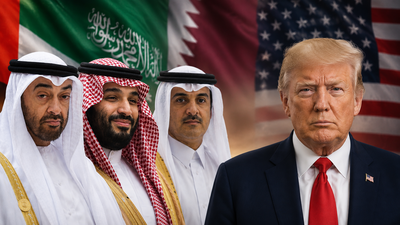
The United Arab Emirates has joined Saudi Arabia and Qatar in urging US President Donald Trump to avoid resuming military action against Iran and give diplomacy a chance instead, according to people familiar with the matter.This outreach reflects growing fears among Gulf states that renewed hostilities could lead to new retaliation against Tehran and plunge regional economies into turmoil. In separate talks with Trump, the leaders of the three US allies argued that military action would not achieve Washington’s long-term goals with Iran, the sources said.The White House did not immediately respond to requests for comment.The UAE’s position represents a notable shift for a country that adopted a tougher stance towards Tehran after it suffered severe damage during the recent conflict. Sources said that the UAE, Saudi Arabia and Qatar disagree on the type of diplomatic arrangement the United States should follow with Iran and the extent of force Washington should exercise over Tehran. However, the three Gulf states remain concerned about a repeat of the conflict that erupted in late February and lasted until a ceasefire was reached in early April.
During the war, Iran and Tehran-backed militias in Iraq launched thousands of drones and missiles across the Gulf, killing dozens and causing billions of dollars in damage to ports and energy infrastructure.“Gulf Arab states have seen their worst fears come true,” said Dina Esfandiari, an analyst at Bloomberg Economics. “They have been caught in the middle of a war between the United States and Iran and have suffered many of the repercussions. They now face the prospect of renewed confrontation if the ceasefire cannot be translated into a permanent agreement, putting their image as stable regional havens at risk.”Bloomberg News previously reported that the UAE was frustrated by the reluctance of Saudi Arabia and other Gulf states to respond collectively with force against Iran. Abu Dhabi reportedly carried out limited strikes on Iran in coordination with the United States and Israel, while Saudi Arabia carried out separate operations.Iran and the United States agreed to a truce on April 8, and are currently exchanging messages through Pakistan about a possible peace agreement.
But both sides warned that they were prepared to resume hostilities if negotiations failed.US Secretary of State Marco Rubio said on Friday that “slight progress” had been made in negotiations, while Iranian media also indicated movement toward a possible agreement. Pakistani Army Chief Asim Munir is expected to visit Iran on the same day, in what analysts saw as another indication that the talks are progressing.Tensions between the UAE and other Gulf states escalated earlier this year when Abu Dhabi decided to leave OPEC, the oil cartel led by Saudi Arabia.
Relations between the six Gulf Cooperation Council countries have improved since then.The UAE Ministry of Foreign Affairs said in a statement to Bloomberg that the UAE continues close coordination and consultation with member states of the Gulf Cooperation Council, along with regional and international partners.On the same day, all members of the Gulf Cooperation Council, except Oman, reportedly sent a letter to the global shipping watchdog rejecting Iran’s attempts to permanently control maritime traffic through the Strait of Hormuz.
Tehran effectively closed the strategic waterway at the beginning of the conflict, disrupting oil and natural gas exports from the Gulf states.Analysts say that despite military setbacks and the assassination of several senior leaders, Iran and its allies maintain significant offensive capabilities. Concerns worsened after a drone attack on a nuclear power plant in the UAE on Sunday, which Abu Dhabi blamed on Iranian-backed militias operating from Iraq.A day later, Trump said he spoke with Saudi Crown Prince Mohammed bin Salman, UAE President Mohammed bin Zayed Al Nahyan, and Qatari Prince Tamim bin Hamad Al Thani, adding that they convinced him not to strike Iran again.One of the sources said that some Gulf leaders are still unsure whether their appeals will ultimately sway Washington and fear that Israel may still be able to persuade Trump to resume attacks on Iran.Israel, which has deepened its defense cooperation with the United Arab Emirates since the conflict began, continues to view Iran as an existential threat.
Israeli Prime Minister Benjamin Netanyahu has repeatedly indicated that further military strikes may be necessary to weaken Tehran’s capabilities.“There is a 50-50 chance of reaching an agreement” with Iran, Anwar Gargash, a senior adviser to the UAE president, said on Friday. “What worries me is that the Iranians always over-negotiate. I hope they will not do that this time because the region needs a political solution.
The second round of military confrontation will only complicate matters.”Trump now faces mounting pressure as the conflict continues to strain the US economy and push global energy prices higher in the wake of unrest in the Strait of Hormuz. While he initially pledged to destroy Iran’s ballistic missile program and hinted at regime change, the war has cost Washington tens of billions of dollars and has become increasingly unpopular domestically.Saudi Arabia supports Pakistan-led mediation efforts and believes any solution to Iran’s nuclear and ballistic missile programs must come through negotiations, according to people familiar with the discussions.Saudi Arabia and the UAE are also said to prefer to maintain pressure on Tehran through maritime restrictions and ensuring the Strait of Hormuz remains open to commercial traffic.Qatar continued to support mediation efforts led by Pakistan, with a Qatari diplomat saying that Doha constantly calls for a halt to the escalation “for the sake of the region and its people.”In its statement to Bloomberg, the UAE Foreign Ministry reiterated that any future agreement must address “the full range of threats” facing Iran, including its nuclear program, ballistic missiles, drones, and “its proxies and terrorist groups.”A Saudi Foreign Ministry official referred Bloomberg to statements made by Foreign Minister Faisal bin Farhan Al Saud earlier this week, in which he said the kingdom “highly appreciates” Trump’s decision “to give diplomacy an opportunity to reach an acceptable agreement to end the war.”