Beneath the turbulent waters of southern China, something huge is slowly taking shape, out of public view but soon reshaping how entire cities communicate. It is not visible from the ships passing over the mouth of the Pearl River, nor from the coast where ferries ply the busy roads every hour.
But deep below the seabed, machines are digging through unstable ground that was once impossible to tame. Engineers are now reportedly pushing a high-speed rail tunnel to depths that previous generations of tunneling experts might have dismissed as unrealistic. More than 100 meters below the seafloor, the work carries an uncanny combination of precision and pressure, where even a slight miscalculation can affect kilometers of construction.
This measure is difficult to envision, yet it is already underway.
Inside the 13-kilometre-long tunnel beneath China’s dynamic waterway system
The drilling site is located within one of southern China’s busiest waterways, the Pearl River Estuary, where shipping lanes, sediment flows and shifting ground conditions intertwine in constant motion. The Shenzhen-Jiangmen high-speed rail project is being implemented through this corridor, connecting industrial centers that already rely heavily on rapid transit lines.
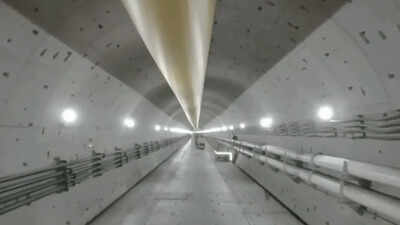
The tunnel itself extends more than 13 kilometers under water-bound terrain between major urban areas. On the surface, it’s just another infrastructure upgrade in a region known for rapid expansion. Underground, the matter is much more complicated. Engineers seem to be dealing with layers of Earth whose character changes without warning, shifting from soft sediments to harder, fractured formations in short distances.
Unpredictability has shaped almost every stage of excavation.
How tunnel boring maintains stability under the seafloor
At the center of the operation is a large tunnel boring machine, said to be specially designed for deep undersea conditions. Their role is simple in theory: dig forward, stabilize the walls, and allow a tunnel to form behind them. In practice, every meter forward requires constant adjustment.The machine works by equalizing pressure with circular mortar systems that help keep the tunnel face stable.
One system supports the cutting head, reducing friction as it advances. Another carries the excavated material to the surface for processing. It is a continuous, almost rhythmic cycle, but under conditions of extreme pressure that change with every geological change.Behind the vanguard, workers install strips of reinforced concrete. They form a ring structure within the tunnel, holding each section in place.
It’s an iterative process, but each episode builds on the accuracy of the one before it. There is not much room for deflection when the structure is formed so far below the seafloor.
The tunnel is 113 meters deep under the seabed
At its deepest point to date, the tunnel reached about 113 meters below the sea floor, with expectations that it may reach a little further as construction continues. This depth introduces a completely different set of geometric stresses.
Water pressure alone becomes a major factor, increasing the risk of deformation or instability if not carefully controlled.Experts point out that working at such levels under a marine environment is not about speed as much as it is about maintaining balance. As the depth of excavation increases, the system becomes more sensitive to changes in soil composition and external pressure. Machine performance is constantly monitored, and even small fluctuations may require immediate adjustments.The route passes through multiple geological layers and fault zones, making progress uneven. Some sections allow for relatively constant boredom, while others slow the process down significantly. It is not a straight line of progress, but a careful negotiation with the land itself.
A new railway corridor to connect manufacturing centres, ports and major cities
The tunnel forms a key section of the high-speed rail line between Shenzhen and Jiangmen, which is expected to extend about 116 kilometers once completed.
This route is designed to shorten travel times through one of China’s most economically active regions, connecting manufacturing hubs, coastal cities and major transportation hubs.Once operational, the journey between the two cities is expected to take less than an hour. This alone is likely to change mobility and business travel patterns across the Pearl River Delta. The railway line is also being developed as part of a larger coastal transport corridor, linking to an already extensive high-speed network across the country.China’s railway system already covers tens of thousands of kilometres, but such projects appear to be pushing the border into more difficult terrain, especially underwater areas that once required ferries or long routes.