

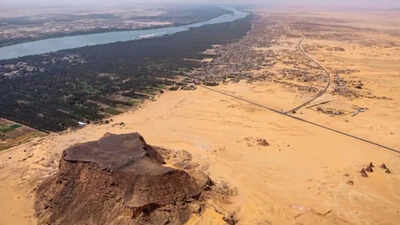
For a city that stood at the heart of an ancient African empire, Napata has long carried an unusual silence around it. Ruins still lie scattered beneath the shadows of the sandstone cliffs of modern-day Sudan, and the Nile River still curves through the same parched landscape it crossed thousands of years ago.
However, archaeologists have spent decades trying to understand why this particular place persists while many settlements have faded or fallen apart over time. It now appears that the answer may have less to do with kings or armies than with the river itself. Beneath the layers of clay and silt, researchers say the Nile quietly formed a stable realm that allowed one of Nubia’s most important cities to survive for centuries.
The hidden conditions of the Nile that helped Napata to persist for centuries
The city of Napata, located near today’s Jebel Barkal in northern Sudan, was once the political and religious center of the Kingdom of Kush. From about 800 BC onwards, Kush emerged as a major regional power with links extending through Egypt and deeper into the Mediterranean world.Its rulers built temples, pyramids and palaces along the Nile River, leaving behind traces of a civilization that interacted with empires including the Assyrians, Persians and later the Romans.
However, while the ruins have attracted attention for years, the ground beneath them has remained far less understood.According to a PNAS paper titled “Holocene Nile Dynamics Shaped the Physical and Cultural Landscape of Ancient Nubia,” a team including archaeologists and geoscientists from the University of Michigan is said to have set out to change that. Rather than focusing solely on the architecture or artefacts, they examined the landscape itself: the floodplains, the sediments, and the changing movement of the Nile River over thousands of years.
How the slowly changing Nile created fertile ground for a plant
Northern Sudan is not always a friendly area for permanent settlement. The Nile River behaves differently from the better-studied stretches northward in Egypt. Cliffs, rocky outcroppings, and island-filled channels cut off the river in several places, making travel and farming more difficult. But near Napata, the river appears to have receded over time.To understand how the landscape evolved, researchers drilled dozens of sediment samples across the valley surrounding the ancient city.
Some of them reached more than 10 meters below the surface. Within those layers were traces of environmental history extending back approximately 12,500 years.Experts involved in the project point out that the Nile River initially cut deep into the valley before conditions gradually changed about 4,000 years ago. As the river slowed, it began depositing thick layers of fertile clay and silt instead of aggressively eroding the landscape.The accumulated sediments reportedly created extensive floodplains, reducing devastating floods while keeping the water close enough for agriculture and daily life. Over generations, this may have created unusually reliable conditions for the survival of a large settlement.
The hidden role of the Nile River rapids in the survival of the plant
Part of the story seems to be linked to one of the Nile River’s waterfalls, stretches of rough water filled with rocky islands and rapids. The fourth waterfall is located just upstream of Napata, a difficult section of the river that may have served almost as a natural brake.
Researchers believe that much of the Nile’s power was dissipated there before reaching the city’s vicinity.By losing energy upstream, the river is said to have slowed enough to release sediment into the valley surrounding Jebel Barkal. Over centuries, those sediments built fertile land and created a more manageable river system.The effect was gradual rather than dramatic. No flooding changed the area overnight.
Instead, layer after layer quietly accumulated over thousands of years, forming the place where crops could grow and where people could safely settle.This slow environmental transformation may help explain why Napata persisted while other settlements struggled with the river’s harsher behavior.
The hidden environmental factors behind Kush’s expansion
The Kingdom of Kush remains less studied than ancient Egypt, although it played a major role in regional history. Researchers have often pointed out that Sudanese archeology has received far less international attention for decades, leaving many fundamental environmental and historical questions unresolved.Napata itself became particularly important after the collapse of Egyptian power around 1200 BC. Eventually, Kushite rulers rose to control parts of Egypt as well, creating a dynasty that had influence beyond Nubia.