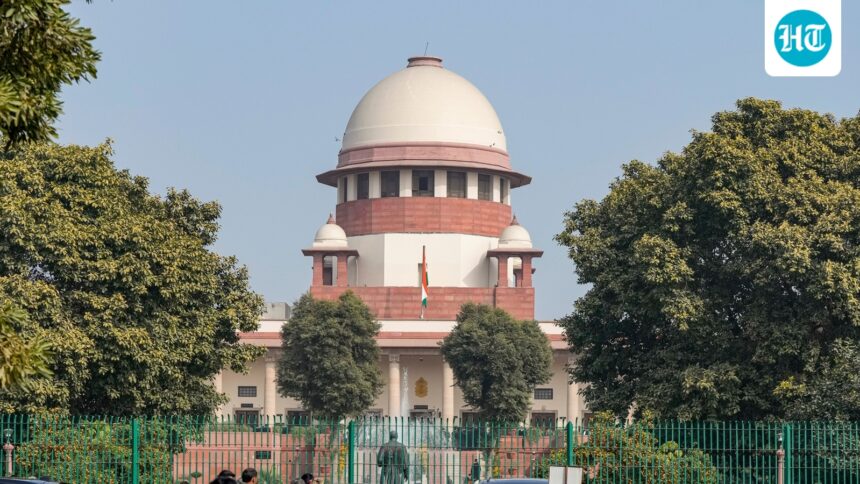
The Supreme Court on Friday grappled with a question that has increasingly been at the center of the debate over reservations in India: Should the benefits of affirmative action continue to flow, generation after generation, to families who have already achieved significant social and economic progress through reservations?

A bench of Justices B V Nagarathna and Ujjal Bhuiyan repeatedly questioned whether children of socially mobile, professionally privileged and financially secure parents should continue to claim reservation benefits under the Other Backward Classes (OBC) category, indicating judicial concern over what the court saw as a permanent continuation of quota benefits among already upwardly mobile sections.
“If both parents are IAS officers, why should they have reservations? With education and economic empowerment, there is social mobility,” Justice Nagaratna observed during the hearing.
Read also | Supreme Court drops negative observations against 3 NCERT book experts
“So, again, to ask for detention for children, we will never get out of it. That’s something we have to worry about. Also, what’s the point then? You’re making the reservation. The parents have studied, they have good jobs, they have a good income, and the kids want the reservation again. Look, they have to get out of the reservation.”
The remarks came as the bench was hearing a petition challenging the Karnataka High Court ruling that upheld exclusion of a candidate from reservation benefits on the grounds that he fell within the “creamy layer”.
The case relates to a candidate from the Kuruba community, classified under Category II (A) among Backward Classes in Karnataka, who got selection as Assistant Engineer (Electrical) in Karnataka Power Transmission Corporation Limited under reserved category. However, the District Caste and Income Verification Committee refused to grant him a caste validity certificate after concluding that his family fell within the creamy layer.
The authorities found that the candidate’s family income was approximately $19.48 lakh per annum and pointed out that both the parents were government employees whose combined income exceeded the specified minimum.
During Friday’s hearing, the court stressed that reservation is intended as a tool for social upward mobility and that once families achieve significant educational and economic progress, the rationale for continuing the benefits of reservation for the next generation requires scrutiny.
“There has to be some balance. Socially and educationally backward, yes, but once the parents reach the level because of the benefit of reservation, if they are both IAS officers, both are in government service, they are very well off, the social mobility is there. Now they are questioning exclusion. This should also be taken into account,” he said.
The court’s observations reflect a broader judicial conversation that has gained momentum in recent years on whether the benefits of reservation are increasingly being cornered by more progressive sections within backward communities.
This debate received perhaps its strongest expression in August 2024 from a seven-judge Constitution Bench of the Supreme Court, where Justice B.R. Gavai (who later took over as a Judicial Magistrate), in his separate opinion in the SC/ST sub-classification case, sought to identify and exclude the “creamy layer” even among the Scheduled Castes and Scheduled Tribes to bring them out of the fold of affirmative action or reservation.
However, the Union government later clarified that the Supreme Court’s opinion was a non-binding recommendation and that the concept of creamy layer would not be applied to SC and ST categories, as there is no provision for the same in the Constitution.
At the hearing on Friday, advocate Shashank Ratno, representing the petitioner, said salary income alone cannot determine the creamy layer status of government employees. He emphasized that the test under current case law focuses on the parents’ status, such as whether they belong to Group A or Group B services, rather than their salary income.
Ratno asserted that if salary income alone becomes a deciding factor, even lower-ranking government employees such as clerks, drivers and laborers could be excluded from reservation benefits simply because of inflationary salary structures.
The lawyer also warned that if all forms of income are aggregated to determine the creamy layer, the distinction between OBC reservation and Economically Weaker Sections (EWS) reservation will virtually disappear.
However, the Council seemed unconvinced by the broader argument that social backwardness was not affected by educational and economic progress.
Justice Nagarathna specifically referred to the salaries of the petitioner’s parents, noting that the father received a basic salary of Rs $53,900 per month while the mother was earning $52,650 per month, even after I agreed to look into the matter and issued notice.