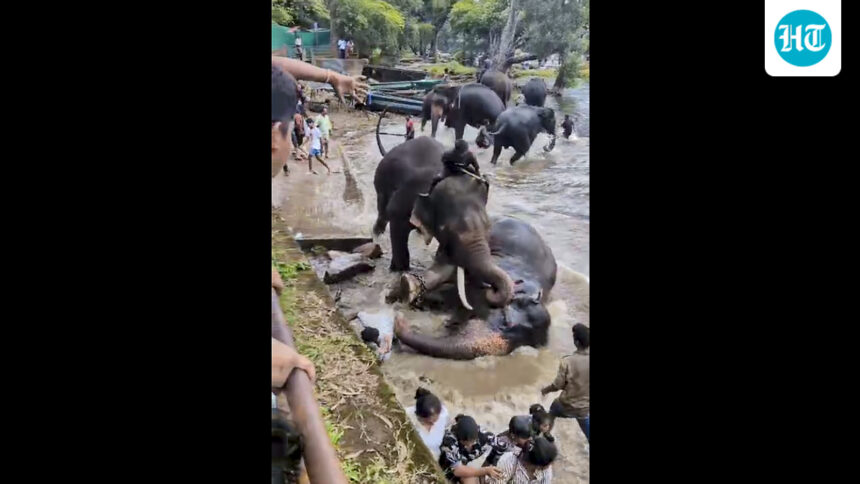
The Karnataka Upa Lokayukta has initiated suo motu proceedings against two forest officials over the death of a tourist and a captive elephant at the Dubari elephant camp in Kodagu district, holding them prima facie liable for negligence and administrative lapses.

Upa Lokayukta Magistrate KN Phaneendra registered the case against A Gopal, assistant conservator of forests, Somwarpet district, and BK Rakshit, forest officer, Kushalnagar, following the May 18 incident at the popular tourist camp.
The action came after media reports and public concern surrounding the tragedy in which a 33-year-old tourist from Tamil Nadu was killed during a violent clash between two elephants inside the camp premises. A captive elephant named Marthanda, injured in the same accident, later died.
In his order, Justice Vanendra observed that the incident appeared to involve negligence and failure on the part of the forest authorities responsible for running the camp. He said that many issues related to safety and management in Dubari require urgent attention to prevent similar accidents.
The matter raised concerns related to Article 21 of the Constitution, which guarantees the right to life and safety, Upa Lokayukta reported. The order also referred to observations of the Supreme Court that places the onus on government agencies and public authorities to ensure safety at places visited by the public.
Two forest officials have been directed to submit their explanations in person before the Upa Lokayukta by June 24.
The case has raised questions about safety arrangements at elephant camps in Karnataka state, which attract large numbers of tourists every year. Environmentalists and wildlife activists said many recommendations made years ago regarding elephant camp management and visitor safety have not been fully implemented.
Many of these recommendations were contained in a report prepared by an expert committee headed by forest officer KM Chinnappa. The committee was formed on the directions of the Karnataka High Court following a public interest litigation in 2019 linked to the death of an elephant at Mathigudu camp in Nagarhole Tiger Reserve.
The committee examined elephant camps across Karnataka and identified deficiencies in elephant welfare, veterinary care and camp management. Among its recommendations was restrictions on tourists approaching elephants at public campsites, a measure conservationists say has not been implemented consistently.
The committee also recommended restructuring camp operations and limiting camps to about 15 elephants in order to reduce pressure on staff, infrastructure and forest resources.
According to the report, the increasing numbers of captive elephants have strained the workforce, hygiene systems and plants in and around the camps. The committee also recommended that camps within protected areas and tiger reserves only maintain the minimum number of elephants required for patrolling and safari activities.
It also suggested that Kumki elephants used in conflict management operations should be stationed outside core forest areas.
The report suggested shifting the Rampura, Mathigudu and Bali elephant camps from essential and critical tiger habitats within the Bandipur and Nagarhole Tiger Reserves. She also cited infrastructural concerns in Mathigodu camp, including the lack of a permanent water source, which affected hygiene conditions during the summer months.
In addition, the committee proposed moving the Sakripil Elephant Camp, which has been operating since the 1960s, to a location outside the network of protected areas.