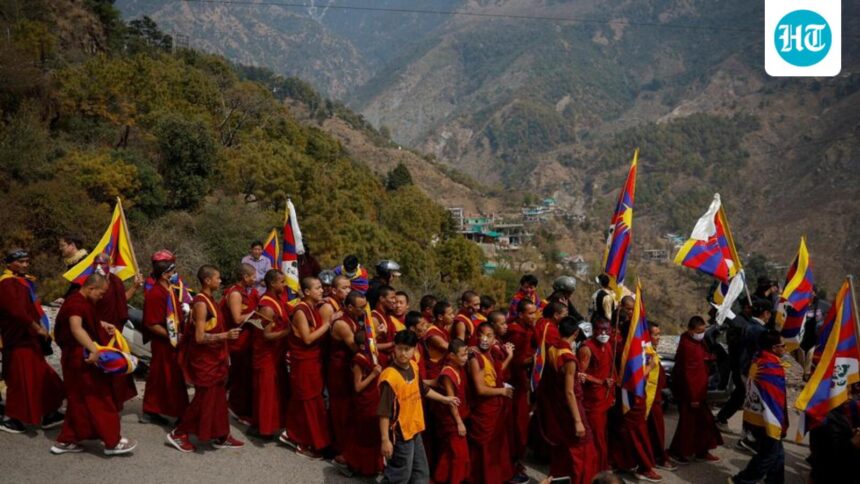
Tenzin Pasang was not born when China officially annexed her former homeland 75 years ago, but she grew up in Dharamsala, surrounded by myths and stories about Tibet. She heard stories from her parents about her grandfather. Reading through every story she was told as a child, there was a regret about statelessness and a dream of one day returning.

“Even though most of us were born in exile and have only seen Tibet through the memories and stories of our parents, our connection to our roots is unbreakable,” said Pasang, 29, national director of Students for a Free Tibet in India, a global grassroots network of students and activists working in solidarity with Tibetans. “In our communities, we often say that every Tibetan carries an invisible ‘R’ on his forehead. It symbolizes three things: refugee, resistance, and the ability to withstand.” the people.
May 23 marks 75 years since the so-called Seventeen Point Agreement was formalized between China and the then local government of Tibet. In Dharamsala, the seat of the 14th Dalai Lama and Tibet’s government-in-exile after he fled to India in 1959 with thousands of his followers, the agreement is seen as a coercive treaty that they do not recognize.
Among the local population – which has dwindled to roughly 7,000 – memory of the history is becoming more tenuous, but many say they still cling to hope of eventually returning to their former homeland, even as China has tightened its grip on the region in recent years.
Pasang agreed. “Our hope comes from our endurance. The Tibetan resistance has endured for 75 years. If Beijing thinks that time will make the younger generation forget, it has miscalculated. Our resolve is not fading,” she said.
Chinese annexation and government-in-exile
In 1949, the People’s Liberation Army crossed into Tibet for the first time. Formal annexation by the People’s Republic of China occurred on 23 May 1951 through the controversial treaty that Tibetan leaders later claimed was forced upon them by the Chinese Communist Party.
The Tibetan government in exile maintains that the agreement had no validity at all, as it was obtained through the use and threat of armed force.
Later, the Dalai Lama, after coming into exile, backed out of the 17-point agreement.
China’s annexation of Tibet raised tensions within the region and ultimately led to the failed uprising in Lhasa against communist rule, which forced the then 23-year-old Tibetan spiritual leader, the Dalai Lama After his escape to India, China tightened its control over the region.
“Through decades of displacement, loss and struggle, we have remained a people defined by hope and driven by unbreakable determination,” said Karma Phuntsok Namgyal, 33, a Tibetan activist. “Our people are not passive waiters; they are an active, unwavering struggle to reclaim the freedom that was stolen from the previous generation.”
The Dalai Lama established an administration in exile on April 29, 1959 in Mussoorie. It was called the Central Tibetan Administration (CTA), and was viewed by exiled Tibetans as a continuation of the previously independent government of Tibet. In May 1960, the CTA was moved to Dharamsala, where it is now.
The Dalai Lama formally relinquished his political and administrative role in 2011 by signing amendments to the constitution of the Tibetan government-in-exile. He has chosen to remain only the spiritual head, transferring political power to the CTA and its Democratic leadership.
“May 23, the anniversary of the so-called 17-Point Agreement, remains a brutal reminder of the occupation of Tibet,” said Dorji Tseten, a member of the Tibetan Parliament in exile and program director of the Tibetan Action Institute. “The agreement was signed under military pressure and was never accepted by the Tibetan people as a legitimate expression of our national will.”
Simply forcing Tibet to sign such an agreement proves that Tibet has historically been a separate nation.
Growing anxiety and decreasing population
In recent years, the number of Tibetan exiles in Dharamshala has dwindled. According to a rough estimate shared by officials, a population of about 10,000 in the early 2000s has declined to approximately 7,000.
The arrival of Tibetans from Tibet has also declined in recent years. In the early 2000s, thousands were arriving annually in India via Nepal, but the number has now fallen considerably. This is mainly due to the Chinese government’s increasing control within Tibet.
There are other concerns. As the Dalai Lama, a central figure in Tibetan Buddhism, grows older, exiled residents worry about the process of reincarnation.
They say that the process of recognizing the reincarnations of lamas in Tibetan Buddhism is only a religious tradition and is unique. On the other hand, Beijing asserts that the process of selecting his successor must adhere to Chinese law, asserts its control over Tibetan Buddhism and rejects any succession outside its authority.
In Tibetan tradition, it is believed that when a senior Buddhist monk dies, his soul is reincarnated into the body of a child. Tenzin Gyatso, the 14th Dalai Lama, was identified as the reincarnation of his predecessor at the age of two.
Beijing has already appointed the Panchen Lama, who is unpopular among exiled Tibetans. The Dalai Lama said that only the Jaden Phodrang Fund had the legitimate authority to determine and recognize his reincarnation.
The main question remains: How will the international community respond to the pressures and interventions exerted by China? said Tenzin Lobsang, Secretary-General of the Tibetan Youth Congress (TYC), the oldest and largest Tibetan NGO with more than 38,000 active members worldwide.