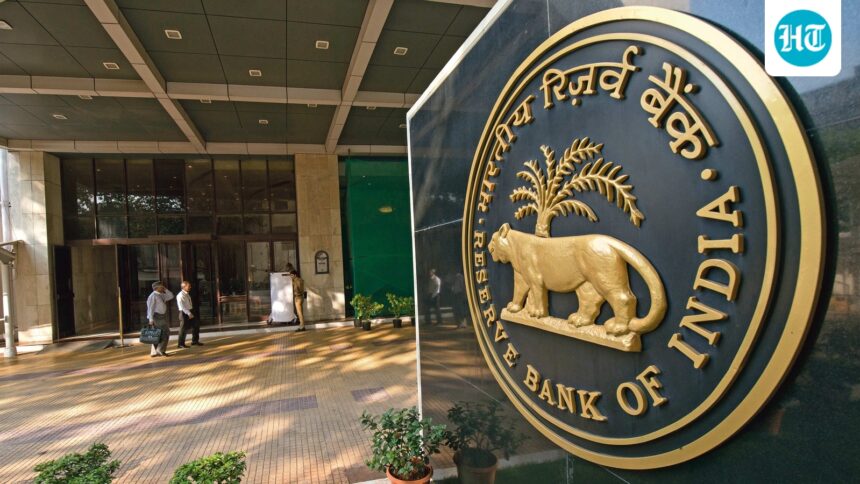
The Reserve Bank of India (RBI) on Friday approved a record transfer of dividends $2.87 lakh crore to the central government for the financial year 2026 (FY26) with a sharp increase in the Contingency Risk Response (CRB) allocation, indicating a balance between fiscal support and preparedness for rising global economic risks.

Dividend distribution is higher than last year $The transfer of Rs 2.68 lakh crore, but slightly below expectations, is expected to provide a major boost to the Centre’s finances at a time of mounting pressure from volatile crude oil prices, potential subsidy burdens and slowing economic growth.
Financial concerns remain
However, economists remained divided on whether the transfer would be enough to prevent the fiscal deficit from widening amid escalating geopolitical tensions linked to the US war on Iran.
The decisions were taken at a RBI board meeting chaired by Governor Sanjay Malhotra. The meeting, which was attended by Deputy Governors Swaminathan J, Poonam Gupta, Shirish Chandra Murmu and Rohit Jain along with other board members, reviewed the global and domestic economic outlook as well as risks to growth.
Economists are divided over the impact
The transfer – equivalent to 90.8% of the government’s budgeted non-tax revenue projections – will help ease pressure on the fiscal deficit amid geopolitical uncertainty, said Devendra Kumar Pant, chief economist at India Ratings & Research.
However, Aditi Nayar, chief economist at Icra Ltd, said the fiscal deficit may remain under pressure due to expectations of increased fertilizer and fuel subsidies, coupled with weak tax collections and lower dividends from oil marketing companies.
“While the Economic Stabilization Fund and increased customs duties on gold and silver imports are likely to provide some support, we expect the GoI to exceed the FY27 budgeted fiscal deficit target of 4.3% of GDP by 40 basis points, assuming an average crude oil price of $95 per barrel,” Nayar said.
“The RBI surplus transfer is marginally lower than expected, limiting the government’s levers in terms of managing financial slippage risks,” said Upasna Bhardwaj, chief economist at Kotak Mahindra Bank. “While we do not see additional borrowing risks at this time, we continue to monitor the extent to which support and tax growth slow.”
Budget assumptions under control
The Ministry of Finance allocated a total dividend distribution of $3.15 lakh crore in FY26 from RBI and other public sector institutions. In the Union Budget for FY27, the ministry linked gross profit receipts to $3.16 million crores.
Higher allocation of buffer risks
The council also decided on the transfer $1.09 lakh crore towards the Contingent Risk Reserve (CRB) of the Reserve Bank of India (RBI), which is higher than $44,862 crore in FY25, taking into account current macroeconomic factors, financial performance of the bank and maintaining appropriate risk buffers, it said.
“Transmitting a higher amount to the RBI will help the RBI intervene in the financial markets as per the evolving domestic and global macroeconomic conditions,” RBI’s Pant said.
The balance sheet is expanding
However, CRB’s share of the balance sheet fell to 6.5% from 7.5% last year. The Economic Capital Framework (ECF) allows the Reserve Bank of India (RBI) to maintain a CRB of 4.5-7.5% of the balance sheet size. RBI’s balance sheet expanded 20.6% year-on-year to $91.97 crore at the end of March 2026.