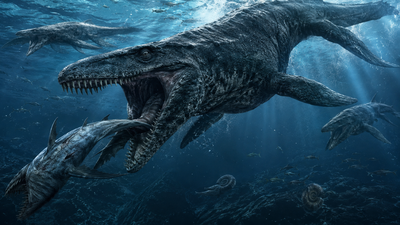
Long before humans existed, giant marine predators dominated the warm prehistoric seas that covered much of North America. Among them was a newly identified species called Tylosaurus rex, a massive mosasaur that stretched about 43 feet long and lived more than 80 million years ago.
Armed with serrated teeth, a powerful jaw, and powerful neck muscles, this massive reptile may have been one of the most powerful hunters of the Late Cretaceous. Scientists identified this species after re-examining fossils discovered in North Texas that had previously been assigned to another type of tylosaurus. Researchers say the results indicate that the predator displayed unusual aggressive behavior compared to previously known tylosaurs.
The study was published in the Bulletin of the American Museum of Natural History.
What made 43 ft ‘Navy T-Rex.’ “Such a dangerous predator
Despite the dramatic moniker, Tylosaurus rex was not closely related to Tyrannosaurus rex. Tyrannosaurus rex was a land-dwelling dinosaur, while Tylosaurus rex belonged to a separate group of giant marine reptiles known as mosasaurs.Researchers say the comparison mainly reflects the animal’s massive size and terrifying predatory behavior.
The name Tylosaurus rex roughly translates to “king of the tylosaurs.”Scientists also say that this species may have been more aggressive than previously known tylosaurs. Study author Ron Tykoski described the creature as looking “more sinister” than related mosasaurs due to fossil evidence suggesting unusually violent injuries.Researchers began to suspect that the fossils represented a different species after identifying unusual features not usually seen in other tylosaurs.One of the most important clues relates to teeth. Unlike many other mosasaurs, T. rex had finely serrated teeth adapted for cutting meat. The researchers also found that the fossils were about four million years younger than the species they were originally assigned to, which helped confirm that they belonged to a separate species.Scientists say this reptile also had exceptionally strong jaw and neck muscles, suggesting it was capable of overpowering large prey in prehistoric oceans.
Excavations showed signs of violent injuries
A fossil specimen nicknamed the “Black Knight,” housed at the Peru Museum of Nature and Science, provided some of the most dramatic evidence.The fossil is missing part of its snout and contains a broken lower jaw. Researchers believe the injuries were likely caused by another T. rex during violent interactions between members of the species.Scientists say this level of apparent aggression has rarely been documented in tylosaurus fossils before.
The injuries indicate that the animals may have fought over territory, food, or mating opportunities.
The ancient sea that covered Texas
More than 80 million years ago, much of central North America was submerged under a massive inland sea known as the Western Interior Seaway.The warm, prehistoric ocean stretched from the Gulf of Mexico to the Arctic Ocean and supported a rich ecosystem filled with giant marine predators. Tylosaurus rex likely shared these waters with ancient sharks, plesiosaurs, sea turtles, ammonites, and other mosasaurs.Mosasaurs were among the dominant marine predators of the Late Cretaceous, occupying the upper levels of prehistoric ocean food chains.Researchers say this discovery could reshape scientific understanding of the evolution of mosasaurs. For decades, many studies have relied on paleontological classification systems that grouped many similar species together. Scientists have now compiled a revised fossil dataset that may reorganize the tylosaurus family tree.Co-author Amelia Zietlow said the findings highlight the need to reconsider long-standing assumptions about the evolution of mosasaurs and update methods used to study ancient marine reptiles.Another study author, Michael Paulsen, said Texas remains one of the world’s most important regions for understanding prehistoric marine ecosystems.
Not technically a dinosaur
Although many titles describe Tylosaurus rex as a “marine dinosaur,” mosasaurs were technically marine reptiles and not true dinosaurs.Mosasaurs were part of the squamate lineage that also includes modern lizards and snakes, although they were not direct ancestors of either group. They developed streamlined bodies, paddle-like limbs, and powerful tails that made them highly effective ocean hunters.Mosasaurs eventually disappeared during the same mass extinction event that wiped out the non-avian dinosaurs about 66 million years ago.To paleontologists, T. rex represents more than just another giant predator. These species may provide important new insights into how large marine reptiles evolved, competed for, and dominated ancient Earth’s oceans millions of years before humans existed.