SpaceX is preparing perhaps one of the most extraordinary executive bonus packages ever, tied to an ambition that sounds more like science fiction than corporate strategy.
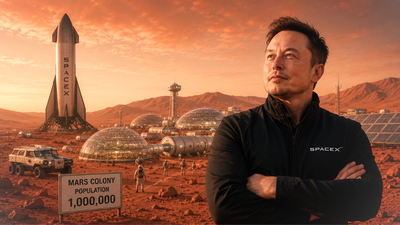
According to reports surrounding the company’s long-term compensation structure, Elon Musk could eventually receive the largest bonus in history if he succeeds in helping create a permanent human civilization on Mars, which has a population of 1 million. The proposal reportedly ties Musk’s future stock bonuses not only to SpaceX’s market value but also to progress on colonizing Mars, reflecting the company’s ultimate mission of making humanity a multiplanetary species.
Reports associated with filings related to SpaceX’s IPO suggest that the package could become one of the most valuable executive compensation plans ever discussed.
SpaceX’s huge payments are linked to Elon Musk’s dream of Mars
According to reports, Musk has been awarded a performance-based package that includes approximately 1 billion restricted shares of SpaceX. However, the reward will only be fully awarded if two main conditions are met: SpaceX must achieve huge market valuation benchmarks, and a permanent colony on Mars with at least one million people must eventually be established.
The reported package is split into 15 separate tranches, meaning parts of the bonus are gradually unlocked as the company achieves increasingly ambitious targets. At the highest level, SpaceX would reportedly need to reach a staggering valuation of nearly $7.5 trillion. Reuters previously reported on a related version of the plan that includes 200 million super-voting shares tied to similar goals of colonizing Mars.The exact future value remains uncertain as it depends on SpaceX’s ultimate market valuation and its stock structure. However, several reports indicate that the compensation could become the largest executive compensation package in the company’s history.Business Insider estimated that Mars-related stocks alone could be worth about $583 billion if SpaceX reaches its expected valuation targets. Additional incentives tied to artificial intelligence and orbital data center companies could reportedly push the combined value to approximately $737 billion.
If this package materializes, it will exceed every previous corporate bonus structure by a huge margin.
Why does SpaceX tie rewards to Mars?
The compensation structure reflects Musk’s long-term goal of transforming humanity into a “multi-planetary species.” For years, Musk has argued that humanity should create self-sustaining off-Earth settlements to protect civilization from potential global catastrophes.SpaceX has repeatedly stated that its ultimate mission is to create a permanent civilization on Mars.
The company’s long-term vision is said to include future industries that could emerge beyond Earth, such as space manufacturing, lunar and Martian cargo transportation, orbital AI data centers, extraterrestrial energy production, and infrastructure for human settlements.Rather than treating Mars colonization as a symbolic dream, the proposed reward structure signals that SpaceX is increasingly integrating the idea directly into its business strategy.
The vision behind a million-person Mars colony
Musk has stated that SpaceX’s long-term goal is not just to launch rockets or satellites. His broader goal is to ensure that humanity becomes able to survive catastrophic events on Earth by expanding civilization to other planets.The idea of a million-person colony goes far beyond a small scientific base. It will require permanent housing, food production systems, water extraction facilities, hospitals, schools, power generation infrastructure, transportation systems, and industrial manufacturing capabilities.
In practical terms, Musk envisions a fully functioning, self-sufficient city on Mars.
How the spacecraft fits into the plan
The foundation of this vision is SpaceX Starship, the fully reusable spacecraft being developed to transport humans and cargo across deep space.Starship is designed to carry out missions to the Moon and Mars. Musk has previously stated that thousands of spacecraft launches may eventually be necessary to transport enough people, supplies and machinery to create a permanent Martian civilization.
SpaceX materials have also acknowledged that building such a colony would require delivering millions of tons of cargo to Mars over many years.The company hopes that reusable rockets will dramatically reduce the cost of space transportation in the same way that reusable aircraft have revolutionized commercial air travel.
No official timetable has been confirmed
Timing remains one of the biggest unanswered questions.Reports discussing the compensation structure do not clearly explain when the million-person goal must be met, how SpaceX will officially certify a colony on Mars, whether the settlement must become completely self-sufficient, or how long residents will need to remain permanently on Mars.There is also no public roadmap detailing how SpaceX could realistically transport a million people to Mars within a specific time frame.
Doubts surrounding Elon Musk’s plans for a Mars colony
Despite the excitement surrounding this proposal, many scientists and engineers remain skeptical that a self-sustaining Martian city of 1 million people can realistically be achieved in this century.Mars presents enormous challenges to survival, including radiation exposure, difficulties in food production, reliability of the life support system, psychological effects of isolation, huge transportation costs, reliable power generation, and limitations of terraforming.
Even supporters of Mars colonization admit that such a project would require technological breakthroughs far beyond current capabilities.Even if the million-person vision remains decades away, the reported compensation structure reveals how seriously SpaceX takes interplanetary civilization as a long-term goal.Traditional executive compensation packages are usually tied to metrics such as revenue, stock price, or production targets.
SpaceX’s proposal goes beyond traditional corporate incentives by directly linking executive bonuses to the creation of an extraterrestrial human civilization.Analysts have called it a real compensation package, the first executive bonus directly tied to off-world civilization, and a sign that SpaceX increasingly sees colonizing Mars as a serious business goal rather than science fiction.If the plan is ever implemented, it could become the largest bounty ever paid tied to a single long-term mission in human history.