

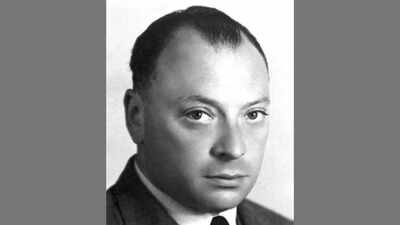
Wolfgang Pauli (Photo: Wikipedia)
There is something interesting about some of the quotes. It starts out as a small sentence but somehow ends up sounding larger than the number of words it contains. Wolfgang Pauli’s remark is one of those lines.
At first, it seems almost playful, maybe a little sarcastic. It sounds like the kind of thing someone says during a discussion that causes a few people in the room to laugh. But then the humor subsides, and the true meaning begins to become clearer.“I don’t mind if you think slowly, but I do object when you post faster than you think.”The sentence may have left the world of science, but it does not remain there. In many ways, it seems strangely relevant to modern life. People live in a world where speed has become almost automatic.
Messages arrive instantly, opinions emerge instantly, and reactions often occur before understanding has a chance to develop properly. Sometimes it feels as if the pressure to respond quickly becomes stronger than the need to think carefully.Paulie seems to challenge this habit. Don’t criticize people for taking time. He does not laugh at slow thinkers. Instead, his criticism only begins when expression begins to move faster than thought itself.
This small distinction changes everything.
Quote of the day By Wolfgang Pauli
“I don’t mind if you think slowly, but I do object when you post faster than you think.”
What is the meaning behind Wolfgang Pauli’s quote
The essence of this quote seems to be about patience and being honest with oneself. Pauli seems to be saying that there is nothing wrong with taking longer to understand something. Some ideas are complex. Some questions do not reveal clear answers immediately. Real thinking often takes time, because understanding is rarely a straight line.People sometimes imagine intelligence as instant clarity.
Someone asks a question and a great answer appears instantly. Reality usually seems messier than that. Understanding often comes in stages. People become confused, question themselves, change their views, and sometimes return to ideas they thought they already understood.This process is normal.The problem, according to the quote, begins when people become impatient with the process and try to skip parts of it.
They rush to conclusions because the conclusions seem satisfactory. Certainty feels good. It’s often easier to say “I know” than “I still need to think about this.”Today, this idea seems more important because everyone is constantly posting things. Publishing is no longer limited to scholars and writers only. Social media has turned almost everyone into publishers. Every day, people post reactions, opinions, and explanations about events happening around them.Sometimes these reactions occur before thinking.Someone reads a headline and immediately forms an opinion. Someone watches part of the story and assumes they understand the whole situation. Another person shares information without stopping to ask whether it has been carefully examined.Paulie seems to be warning against exactly this habit.
Why do fast reactions sometimes create slow problems?
Speed in itself is not necessarily bad. Sometimes quick decisions are important.
Some situations require immediate action. The problem arises when speed becomes automatic and begins to completely replace thought.Many people have been in situations where they reacted too quickly and later regretted it. Someone sends an emotional message during an argument and wishes they had waited another ten minutes. Someone says something confidently and later realizes that important details were missing.
Someone makes assumptions about another person before fully understanding what happened.These moments are common because humans naturally react before they sometimes think.Interestingly, people rarely regret thinking too carefully. Often times, they regret speaking too quickly.Immediate feedback creates temporary satisfaction because it removes uncertainty. Waiting is uncomfortable because uncertainty still exists.
People generally prefer to feel certain rather than confused.However, certainty itself can sometimes become misleading.The answer that arrives immediately is not always better than the one that arrives later.
Looking beyond physicist Wolfgang Pauli
Wolfgang Pauli became one of the important figures in modern physics through his contributions to quantum theory and scientific understanding. He has gained a reputation not only for intelligence but also for directness.
Stories about him often describe someone who expects ideas to be seriously examined.Pauli seems to have had little patience for weak arguments or weak reasoning. He cared deeply about accuracy because scientific ideas influence future work. An unsupported assumption can lead to confusion, while a carefully considered idea can become useful for many generations.Perhaps this position explains the quote itself.Paulie doesn’t seem to care about appearances. He doesn’t seem to care if someone looks cool or appears confident. He seems more concerned with whether real thinking actually occurred beneath the words.This perspective seems surprisingly refreshing today because confidence often receives more attention than careful thought.
The calm value of thinking slowly
Modern culture sometimes treats slowness unfairly. Fast responses often look impressive.
People who answer immediately may seem decisive and knowledgeable. At the same time, a person who stops to think may seem unsure.But sometimes pauses mean something different.Sometimes, pauses mean a person is taking an idea seriously.Some questions are worth your time because they are complex. Human relationships are complex. Scientific questions are complex. Decisions that affect people are complex.Thinking carefully does not always produce immediate answers because reality itself does not always provide simple answers.Many thinking people throughout history have spent an inordinate amount of time questioning ideas rather than jumping to conclusions. They examined possibilities, changed opinions, and accepted uncertainty while searching for understanding.Maybe intelligence isn’t just about arriving quickly.Perhaps part of intelligence involves recognizing when further thinking is still needed.
Other famous quotes by Wolfgang Pauli
- “God made the bulk, but the roofs were invented by Satan.”
- “God not only plays dice, but also throws them where they cannot be seen.”
- “The best that most of us can hope to achieve in physics is simply misunderstanding at a deeper level.”
- “Everything that is difficult you should try, and everything that is dangerous you should avoid.”
Why does this quote still seem surprisingly modern?
Some quotes survive because they seem inspirational. Others survive because people keep proving them right.Pauli’s words still seem relevant because humans still suffer from the same lure of speed. Tools have changed, technology has changed, communication has become faster, but the basic habit has remained surprisingly familiar.People still jump to conclusions. People still feel pressure to respond immediately. People still confuse quick certainty with true understanding.This quote quietly reminds readers that there is no shame in taking time to think. Thinking slowly is not necessarily a weakness. Sometimes it simply means respecting the fact that understanding is worth patience.And perhaps in a world that constantly asks people to respond faster, there is something unexpectedly valuable about remembering that not every idea has to arrive at full speed.