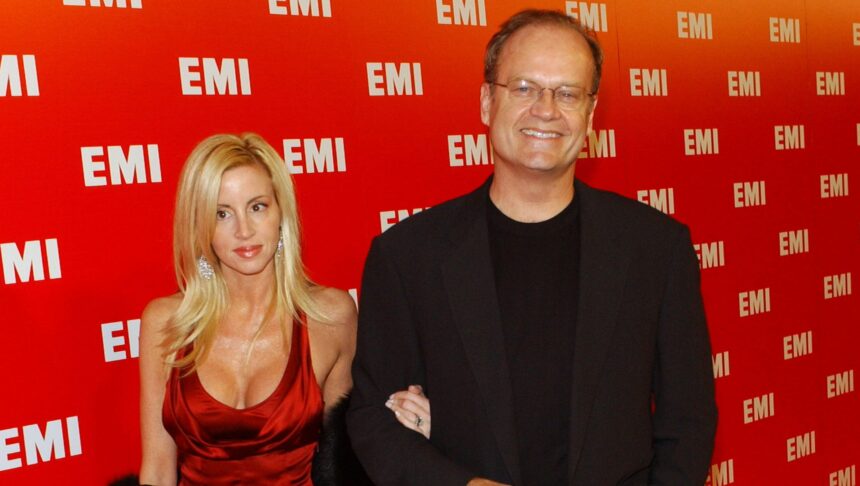

Camille Grammer He’s back in the news again, and it’s about a text message. Fourteen years after her breakup Kelsey Grammerthe The Real Housewives of Beverly Hills alum is finally speaking out about the “cruel” letter she received from Freezer star after their nearly 15-year marriage in 2011.
The Internet does what the Internet does. Choose sides. Pull out old clips. Advertisement Kelsey is evil again. Camille is the victim again. entire His robe Random access to popcorn.
But if you and I were sitting at a table somewhere quiet drinking a glass of wine, I’d tell you there’s something else going on here. Something that gossip takes is completely missing. Something that explains why a 14-year-old text is still painful enough to talk about on camera.
The biology behind the harsh text
What we are actually watching are two human nervous systems trying to survive the breaking of their basic bond of attachment, in front of millions of strangers.
We are an interconnected species. We are born needing a primary attachment figure, from cradle to grave. When a 15-year marriage breaks down, the body doesn’t read the divorce papers and politely move on. At a basic evolutionary level, the body reacts as if it might die.
The harsh text, unleashed amidst the wreckage of a breakup, is never the truth of who the person is. It’s a shield. When someone feels unaccepted or essentially abandoned, the nervous system looks for any protection strategy it can find. contempt. Cruelty. distance. Cruelty is the bandaid. The wound is underneath.
And this is the part that makes celebrity splits so brutal. The human body is the original distributed ledger. It records every important moment, every moment of safety, every moment of abandonment. You cannot delete those entries. Years later, when Camille looks at that text, the file is still open in her body.
I call the dynamic underneath this the Waltz of Pain. One person protests because he is in pain. As for the other protests, they are because they were not met. They step on each other’s toes over and over again. The bittersweet post-breakup text is a classic waltz, not a judgment on character.
Why is “who’s the bad guy” the wrong question?
Every Tuesday in my office in San Francisco, I see the ghosts of this delicate dynamic. CEOs, founders, people who run huge companies, they’re all sitting on my couch acting like terrified children trying to survive in a changing nexus.
Each of them enters as a world-renowned expert on their partner’s problems. If you host a conference next week about what’s wrong with your spouse, you’ll be the keynote speaker. They pull out their phones. They read me the harsh text. They want me to agree that their ex is a monster.
But the text is a red herring. It’s easier to talk about the message than to feel unloved. It’s easier to litigate over the schedule than to feel alone. Content is never the problem. The root cause is the unbearable sadness when you realize that the person you chose to be your safe haven has become the source of the storm.
This is where the algorithm comes to us. Scroll for ten minutes and you’ll walk away certain your ex is a narcissist, borderline, or psychopath. The diagnosis seems like clarity. He turns pain into a story with a villain. It validates the cold shoulder, the procrastination, and the harsh text you fired off at 1 a.m., and the algorithm keeps feeding you clues until you stop seeing a human and start seeing a category.
If any of this hits too close to home, you can figure out your relationship style before the next fight tells you who you are.
The part that gossip always misses
There are two truths in every struggle. Camille’s pain upon receiving this text makes perfect sense. Her shock, her heartbreak, and her need to name it years later are all valid.
Kelsey’s defensiveness in that moment also makes sense, when you understand that behind every terrible behavior you can see is a human being in pain. When someone behaves inappropriately, they are usually protesting against the unbearable feeling of being disappointed, unloved, and failing at the one thing they wanted to get right.
I use what I call the 1-4 rule to map this. If one of the four things exists, then all four exist. I’m in pain. I react. You are in pain. You react. The audience only saw Kelsey’s harsh reaction. The biological fact is that if one of them was sending a bitter text message, they were both in agony.
This is the line I want you to photograph. Disconnecting is a feature, not a bug. The only reason the script still hurts 14 years later is because the bond was so important in the first place. Conflict is evidence of love, not failure. People who don’t care simply walk away. They don’t send harsh text messages. They haven’t talked about them on camera a decade and a half later.
What would I tell them if they came into my office?
If Camille and Kelsey sat on my couch tomorrow, the first thing I’d turn off is the keynote. You cannot solve the limbic problem using a cognitive argument. They both charge old texts and it’s the lab rat running down the hallway without food at the end.
I will apply the one frame rule, not the entire film. We work in the present moment, the moment when both bodies are activated, rather than replaying a 15-year highlight reel. I would look at them and say, I’m not here to help you feel better. I’m here to help you feel your feelings better. Then we love each other there.
My first task is to bring them out of isolation. When couples fight, they are trapped in two separate bubbles of suffering. I want one shared bubble. I want empathy cube. Mercy is mine, mercy is yours, mercy is ours.
This is also the work that built the scientific knowledge behind the AI relationship coach my wife and I created. Same chat, available at 2am when the harsh text was written but not yet sent.
Real address
Camille and Kelsey are not the story. The story is that two people who chose each other for almost 15 years still bear, in their own way, the imprint of that bond. This is not toxic. This is not satisfactory. This is human attachment doing exactly what human attachment does when something stops breaking.
The cruel script was never the villain. And they weren’t.
_______________________________________________________
Figs O’Sullivan and his wife, Till, are San Francisco couples therapists, relationship experts at Stars and Silicon Valley, and founders of Empathi, who built Figlet, an AI-powered relationship coach trained in their clinical work.