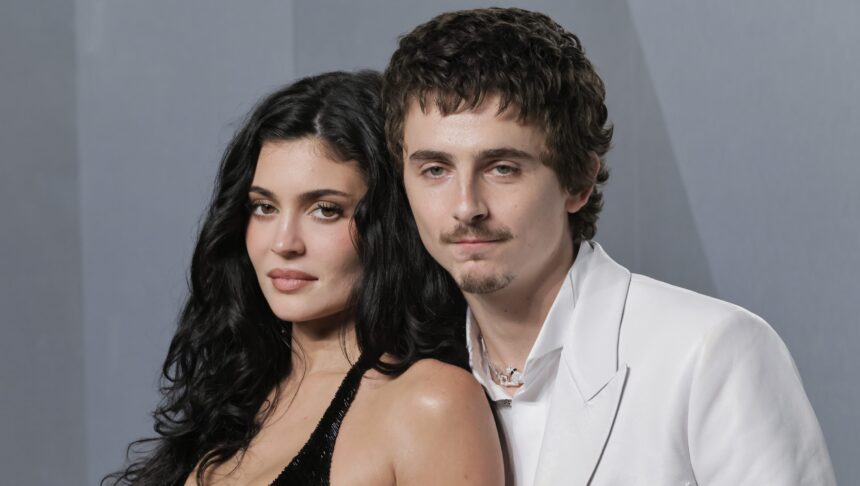
Kylie Jenner implicate Page six Thirsty TikTok comment on her boyfriend. publicly. With emojis.
Timothée Chalametthe man she finally walked the red carpet with in May, got a little drop of public affection from Kylie in front of the entire internet. The Internet did what the Internet does. Eye rolls. “PR stunt.” “Shrink.” “She’s trying hard.”
Put the judgment aside for a second.
Because if you read this comment through the lens of how human connection actually works, you’re not watching a tabloid newspaper. You are watching a nervous system publicly announce that it has found its person. This is a much bigger deal than the algorithm wants you to think.
Digital moonwalk
In my opinion, we are interconnected beings. We were born to need connection, and we were born to need a primary person to whom we are emotionally attached, from cradle to grave.
When two people fall in love with each other, the nervous system does an ancient little dance to stabilize the bond. I joke about this in my office. You see someone across the room, and you dance a little. They are back to the moon. Anyone can complement my amazing breakdancing skills by moonwalking.
That sweet TikTok comment from Kylie? This is a digital moonwalk. This is the nervous system publicly signaling, and this is how I hope my emotional love needs are met.
But there’s a doubling factor with someone like Kylie. She lives in a goldfish bowl. Every step is seen by the village. Both villages. Watched, screenshot, archived, saved, shared.
When you grow up within this level of exposure, where every relationship is public content, you develop a protective part just to survive its vulnerability. I know this from my life before I met my wife, Teal. I became the seducer. My worth in love was determined entirely by whether I could be a seducer. Whether someone wants me. Whether I could perform the version of myself, I thought I needed to be chosen.
When we see a celebrity getting “thirsty” online, this protective part comes into play. Desire becomes a shield. Public affection becomes evidence of a bond. Beneath this brilliant, exciting performance, the limbic system is asking the only two questions that ever matter: Are you there for me? Am I enough for you?
What does the honeymoon phase actually do?
I see this exact dynamic every Tuesday on the couch in my office in San Francisco. High-achieving founders, CEOs, and innovators. People who built their entire early relationship on intoxicating, seductive validation.
Here’s what no one tells you about the thirst phase. The brain is filled with dopamine. You feel chosen. Feel safe. You feel as if a miracle is happening.
Then it ends. Your sexy self has met your partner. Now your weak self must make love to them.
When the constant checking fades, when he doesn’t text in three minutes, when she’s too tired to flirt, the nervous system that built its safety on desire goes into a state of absolute panic. The absence of desire registers as an existential threat. Curious where you fall on this spectrum? You can find out your relationship style in about three minutes.
The same person who left snide comments suddenly became angry about the dishwasher. Everyone comes to my office first as a world-renowned expert on their partner’s problems. I tell them, if I were to hold a conference next week about your partner’s problems, the other spouse would be the keynote speaker.
They think they’re fighting over likes on Instagram, working late, and who texted whom. I call it all a bucket of doing what and when. The real reason is always the same sadness: the person I chose to be my safe haven suddenly feels like a danger.
This is where the honeymoon goes to die. Or convert.
Stop making people sick of falling in love
The algorithm will ask you to classify Kylie as “trying hard.” Diagnosed as codependent. Performative. Doomed to fail. The algorithm is the mother of fiat. It gives you sugar when you need protein. It mines your nervous system in order to engage.
The diagnosis gives a kind of certainty when the bond feels threatened. He turns pain into a story with a villain. This is a trap. I see a related version of it in the science behind unrequited love, where people prefer to view longing as a disease rather than feel it.
I won’t hear you call yourself codependent. I won’t hear it. You are two people who love each other because love is basic.
Kylie’s thirst for Timothy in the public comment section is not a disease. It is the attached adaptation. Beneath him I hear the same hurt I hear in everyone. I want to be chosen. I want to feel safe. I want to build a life with someone.
In a culture that always makes you feel left behind, like you’re not enough, finding someone you really want to yearn for is a small miracle. It doesn’t matter how much you grow. When it comes to love, you are still a little kid.
This TikTok comment doesn’t bother me. He is a human being brave enough to say: I want you. Go to the grocery store, buy a cheap bottle of champagne, and celebrate the fact that we are so important to each other.
What do I tell them on my couch?
If Kylie and Timothy were on my couch right now, glowering from an early climax, I’d check the absolute hell out of it first. Drink champagne. Comment. Let your nervous system have its moment.
Then I’ll say the thing they don’t want to hear yet.
Don’t waste your energy trying to make sure you never fight, because you will. You are now running on your chosen fuel. True love, the kind that lingers after the goldfish bowl, requires a different kind of proof of action. The kind where I looked into the science behind an AI relationship coach.
One of you will feel misunderstood. One of you will withdraw. The other will panic. That moment is not the end of love. This is where true love begins.
The line that deserves a screenshot
We watch celebrities and forget that they have a nervous system too. Under the red carpets, followers and brand deals, there are two young children inside, holding out their hands, hoping not to be dropped this time.
That’s all any of us do.
The flirtatious comment is not the story. The courage to desire someone in public is.
________________________________________________________________________________
Figs O’Sullivan and his wife, Till, are San Francisco couples therapists, relationship experts at Stars and Silicon Valley, and founders of Empathi, who built Figlet, an AI-powered relationship coach trained in their clinical work.