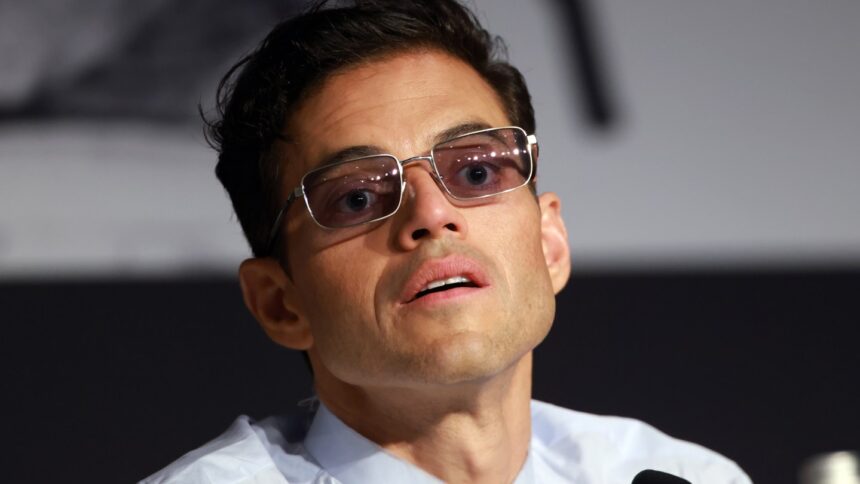
Rami Malek almost turned down his role in the Ira Sach film The man I loveas a gay singing performance artist in 1980s New York at the height of the AIDS crisis, because he was concerned that he would be accused of stealing his Oscar-winning role as Freddie Mercury in 2018. bohemian rhapsody.
“At first when I read [Sachs’s] I said: No, I can’t do this. There are a lot of similarities. “It could be a problem,” Malek said Thursday at the Cannes Film Festival press conference about the film, which received a 7-minute standing ovation at its world premiere on Wednesday night and is now being talked about as a potential Palme d’Or winner.
He continued: “There was a certain feeling of fear, and I started to really think about what I was afraid of. Was it the similarities? Was it the singing? Was it clear what was happening at that time? … And I knew I had to process the fear. If there was anything Freddie taught me, it was ‘process the fear.'”
Malek has already garnered buzz at the Oscars for his performance as Jimmy, a mysterious and charismatic performance artist preparing for what he knows may be his last appearance on stage.
Malik said he soon realized that Jimmy and Freddie were not nearly as similar as they appeared on paper. Freddie Mercury was an icon, and Jimmy, his character in Sax, was a talented but struggling artist who recreates an experimental downtown theater for a French film no one had heard of, in what he knew might be his last time on stage.
Malek explained, “Jimmy is just looking for creativity, love, intimacy, joy and pleasure in every moment, and he can sing.” “Does he sing like Freddie? No….Will it ever be perfect? It didn’t have to be. It was just about the element of creativity and living in joy.”
Jimmie, like a lot of artists in New York at the time, just wanted to impress the people who lived next door, Sachs explained.
“There are a lot of people who aspire to be someone like Freddie Mercury,” Malek continued, “and there are a lot of artists in the world who don’t quite reach that level, but who still have an abundance of talent and skill and a world to offer that maybe the masses don’t see, but they get some recognition collectively, or they find a way to acknowledge it among themselves, and it’s probably almost satisfying.”
He said that he and Jimmy wanted to paint a picture of these people, whose work was beloved by some, and who died too young, but who nonetheless should not be forgotten.
Malek said he also feared Sachs would not want to work with him, after he asked to meet the director, whose work he has admired for years. “People often say, after the Oscars, you only get a few things,” Malek said. “It’s not like that.”
But the two agreed and Sachs said he chose Malik because Jimmy needed to have a certain star quality that everyone around him would be drawn to. I think there’s suspense about what’s going to happen? “Within a second,” Sachs told Malik at the press conference. “With Ramy, you never know if he’s going to jump over the table… There’s danger there, and I think that’s very important for acting.”
Danger is an important element in the film, which Sachs said is based on the “rage” and “rage” of living through the AIDS crisis in the 1980s at a time when gay men were largely abandoned by the US government.
Sachs noted that at the time he was a member of ACT UP, the AIDS Coalition to Unleash Power — a group of activists who organized protests such as chaining themselves to the New York Stock Exchange to protest the high price of the only FDA-approved HIV/AIDS drug, AZT.
“ACT UP’s slogan is ‘Silence equals death,’” Sachs said.
Telling stories like this (and selling movies like this) “is a fight, but we hope the fight goes away in some ways,” Sachs said. But the anger is in this film.”
Sachs added that it was important for him and his writing partner Mauricio Zacarias to write this film, “because we lived through it…we were both, I think, survivors of that time, and also remembered a lot about it that maybe other people didn’t feel.”
Sachs said it took them 15 years and six films to get to this one. They wanted to convey that it was a dark time, but it was also a time of light and creativity. “It was a time of great loss and sadness, but there was also this togetherness that was full of art, full of joy, full of pain,” Sachs said. “We had a lot that we wanted to convey in this struggle between what we lost and what was there, but it took a long time for us to be ready and have perspective on the story we wanted to tell.”