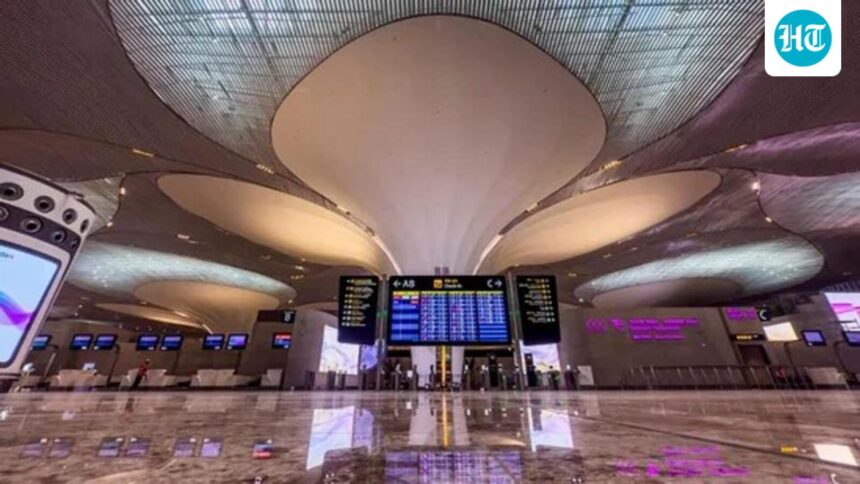
The Airport Economic Regulatory Authority of India (AERA) on Wednesday set the domestic user development fee (UDF) at $620 for Navi Mumbai International Airport (NMIA) Vs $742 required through airport operation and proposed airport revenue recovery reduction for 2025-30.

The new airport, which opened in October 2025, began commercial operations on December 25 last year.
In its tariff order for 2025-2030, the airport’s first monitoring period, the regulator also reduced the airport operator’s gross revenue requirement (ARR) to $14,087 crore from $28,290 crore earlier and deferring part of the recovery to the next tariff cycle, saying “the move is aimed at easing airport charges for passengers and airlines”.
I kept the local departure UDF at $$620 per passenger for 2026-27, the same level previously set under the ad hoc tariff order while the international departure UDF was fixed at $1225 v $1,467 proposed by the airport operator.
It said it had conducted a “comprehensive analysis, prudent examination and due diligence” on the airport operator’s multi-year tariff proposal (MYTP), including capital expenditure, operating expenditure, rate of return and non-aeronautical revenue, before finalizing the tariff order.
It also said that all stakeholders, including airlines, aviation bodies, passenger groups and airport operators, participated in the consultations held on April 2.
The regulator’s order said it would defer 11.32% of the annual yield rate to the next tariff cycle between 2030 and 2035 to ease the tariff burden during the first years of the airport’s operation, when traffic volumes are still expected to increase.
Domestic passengers account for about 73% of the airport’s expected traffic and would benefit most from moderate charges, Era said.
Read also:27.2 hectares of mangroves will be destroyed for the metro line between Navi Mumbai and Mumbai airports
It also rationalized local landing fees at $1,400 per metric ton for the period 2026-27, with an increase to $1,484 per metric ton in 2027-28 vs $1,676 proposed by the airport operator.
“Reasonable and relaxed UDF charges will greatly benefit domestic passengers, who constitute around 73% of the total passenger traffic. Moreover, domestic landing charges for the monitoring period have also been rationalized and are set on the basis of $1,400 per metric ton for 2026-27, with only a modest increase to $1484 per metric ton for 2027-28, vs $“1,676 per metric ton proposed by the airport operator for the period 2027-2028,” the order read.
AERA also said that to encourage airlines to start new routes from the newly opened new airport and increase flights and expand the airline network during the initial years when passenger traffic grows, it has allowed the Navi Mumbai airport a variable tariff plan (VTP) for landing charges to cover the initial years of the airport’s operations there.
She added: “This will provide the required incentives for airlines to gradually increase traffic at this new airport.”
Explaining the higher tariff structure at new airports, a government official said: “Such projects require significant upfront capital investment and initially operate with lower traffic volumes, unlike existing airports which already benefit from economies of scale and stable passenger movement.”