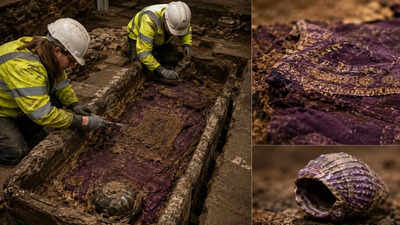
Archaeologists studying ancient Roman cemeteries in England have made a discovery that changes what experts know about wealth and burial traditions in Roman Britain. While examining child burials at Roman York, researchers identified traces of Tyrian purple, one of the rarest and most expensive dyes in the ancient world.
As reported in the journal BioScience, this remarkable discovery was hidden inside burial remains dating back nearly 1,700 years. The researchers also discovered fine gold threads woven into parts of the cloth, indicating that the children buried there belonged to families of very high social status. Experts say this discovery is particularly important because ancient textiles rarely survive long enough to be studied. In this case, unusual burial conditions appear to have protected small traces of cloth and dye for centuries beneath York’s soil.
Ancient Roman burials reveal a rare pigment worth more than gold
The discovery was made during research conducted on two Roman-era tombs dating back to the late third or early fourth century AD. One of the tombs contained a child believed to be around two years old, who was placed inside a stone coffin alongside two adults. The second burial was of a baby boy, only a few months old, inside a lead coffin.Researchers from York University examined preserved material from the graves and identified traces of luxurious textiles that once covered the bodies.
According to archaeologists, the fabrics were decorated with gold threads and dyed using Tyrian purple, a color strongly associated with wealth, power, and imperial power in the Roman Empire.Project manager Maureen Carroll explained that this is the first confirmed evidence of the presence of purple in images ever at Roman York. The researchers reportedly did not expect such rare materials to remain inside the burials.
What made purple Tire more valuable than gold?
The purple color of Tire was one of the most valuable pigments in the ancient world. The color was produced using Murex sea snails collected mainly near the ancient Phoenician city of Tire, located in present-day Lebanon.The process of making the dye was very difficult and time consuming. Thousands of sea snails had to be crushed to produce a very small amount of the dye. Because production requires enormous effort and resources, the dye has become incredibly expensive.
Historians say that the price of purple in Tire was several times higher than gold by weight during certain periods of Roman history.As a result, purple clothing became a status symbol for the elite throughout the Roman Empire. Emperors, aristocrats, and wealthy officials often wore purple clothing to show their power and importance. Experts believe that the discovery of purple in the Roman city of York indicates that the families associated with these burials were among the wealthiest people living in Britain at the time.
How gypsum helped preserve rare purple textiles for 1,700 years
Ancient textiles are rarely preserved because the fabric usually decomposes quickly underground. However, archaeologists in these tombs believe that the unusual plaster burial method helped protect the remains for centuries.Liquid plaster was poured around the bodies during the burial ceremony. Over time, the material hardens into a protective coating that preserves traces of clothing and microscopic traces of fabric.
In some areas, a faint purple color can still be seen on the plaster surface during inspection. Many traces of the dye were invisible to the naked eye and were discovered only after scientific testing. Research specialist Jennifer Wakefield led the laboratory analysis using liquid chromatography-tandem mass spectrometry, also known as LC-MS/MS. Tests confirmed that the dye found inside the graves was true Tyrian purple and not another red or violet dye sometimes used in Roman textiles. The researchers described the results as surprising and of great importance to the study of Roman Britain.