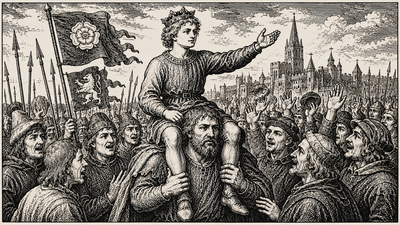
For a brief moment in medieval England, a poor boy stood at the heart of a royal rebellion and wore a crown reserved for royalty. Lambert Simnel was only about 10 years old when Yorkshire supporters presented him as a claimant to the English throne during the turbulent years following the War of the Roses.
In 1487, he was crowned in Dublin in a dramatic challenge to the rule of King Henry VII. But the glory only lasted months. After the rebellion collapses in battle, the boy who was once treated like a king is spared execution and quietly sent to work in the royal kitchens. His extraordinary rise and fall remains one of the strangest stories in English history.
How the poor English boy became King of the child
It is likely that Lambert Simmel was the son of Thomas Simmel, an Oxford carpenter or carpenter, although much about his early life remains uncertain.
England at the time was still recovering from the War of the Roses, the bitter conflict between the rival houses of Lancaster and York.A priest named Richard Symonds reportedly noticed the young boy because of his appearance and manners. Symonds believed that Simnel could be used by Yorkist loyalists who still opposed Henry VII, the first Tudor king.The conspirators initially discovered various royal identities for the child before eventually presenting him as Edward, Earl of Warwick, a Yorkist claimant with a strong connection to the throne.
Since few people outside royal circles knew what the real Warwick looked like, the deception gained support surprisingly quickly.The rebellion gained momentum in Ireland, where Yorkist loyalty remained strong. In May 1487, Simile was crowned in Dublin as “King Edward VI” in a lavish ceremony that transformed the poor child into a symbolic king.For the powerful figures behind it, the coronation was more than just a show.
They hoped to remove Henry VII and restore York’s control over England. Foreign mercenaries and English nobles joined the cause, and soon an invading force crossed into England to challenge the Tudor king directly.
The battle that ended his rule
Simile’s short-lived claim collapsed at the Battle of Stokefield in June 1487. Henry VII’s forces defeated the rebels in what historians often describe as the last major battle of the Wars of the Roses.Many of the leaders of the rebellion were killed, but Henry VII made an unusual decision regarding the child who was the focus of the plot. Instead of ordering Semele’s execution, the king reportedly viewed him as a pawn to be manipulated by ambitious elders.This decision changed the boy’s life forever.
From a crowned king to a kitchen worker
After the end of the rebellion, Semele was brought into the royal household and assigned to work in the royal kitchens as a spit boy or low-ranking kitchen servant responsible for difficult and exhausting tasks.The contrast was extraordinary. The boy who had once been dressed as a king and paraded before cheering crowds was now working behind the palace walls performing kitchen duties for the very dynasty he had been used against.Historical accounts indicate that Simile later passed into the service of Sir Thomas Lovell, one of Henry VII’s trusted officials. Some later summaries also claim that he eventually became a royal falconer, although details of his later life remain less clearly documented.
The forgotten boy King of England
Lambert Simmel’s life remains one of the most remarkable transformations in English royal history. He was never a true king, but for a brief period powerful nobles treated him as the future ruler of England.His story reveals how unstable the English throne is after years of civil war, even when a poor child suddenly becomes the face of a national rebellion.Centuries later, Semele is still remembered as the forgotten boy king who briefly wore the crown before disappearing into the royal family of the very king he tried to overthrow.