

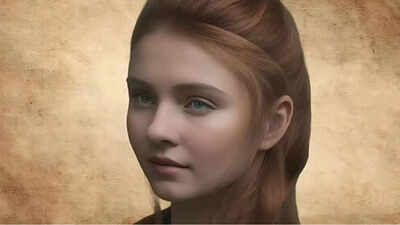
A woman who lived about 3,500 years ago in the Greek Bronze Age has reappeared before the public in a very unusual way. Not through writing or statues, but through digital facial reconstructions created by artist Juanjo Ortega J.
The image is based on previous archaeological reconstructions and gives a surprisingly human view of someone who died in his mid-30s and was buried in a royal tomb at Mycenae. It feels distant in time, yet strangely close in emotion.Reconstruction is not just about appearance. It also raises questions about who she was in life. Was it strong? Was she normal despite where she was buried? Experts say the answer is still not entirely clear, but new research is slowly changing how its story is understood.
How a 3,500-year-old tomb is rewriting the history of ancient women
The woman’s remains were first discovered in the 1950s at Mycenae in present-day Greece, a site closely associated with Greek mythology and the mythical world of Homer. Mycenae is often associated with King Agamemnon and stories of the Trojan War, although this woman lived several centuries before those events occurred.She was buried in what appears to be a royal tomb, which immediately indicates high status.
Her grave included a death mask and a collection of objects that initially baffled archaeologists. Among them were weapons, including three swords, creating decades-long confusion about her true identity and the role she might play in society. For a long time, researchers assumed that the weapons found in the grave belonged to a man buried next to them.
Because she was placed next to a man, it was widely believed that he was her husband and that the burial tools were associated with him.However, later DNA analysis dramatically changed this interpretation. It turns out that the man buried with her is actually her brother, not her husband. This discovery forced archaeologists to rethink previous assumptions about gender roles and burial customs in Mycenaean society.
Evidence of arthritis reveals a life of work and skill
Scientific analysis of her remains also provides clues about her daily life. Researchers found evidence of arthritis in her hands, which likely developed due to repetitive physical activity.
Experts suggest that she may have been involved in tasks such as weaving, which was common in Bronze Age societies.These details create a stark contrast to the weapons found in her burial. On the one hand, there are signs of housework and physical stress. On the other hand, there are symbols of war and status. It is not entirely clear how these two aspects of her life fit together, but they suggest that she may have lived a more complex life than previously assumed.
Reconstructing her face from ancient evidence
Modern facial reconstruction was created using a combination of prior scientific modeling and technical interpretation. Juanjo Ortega adopted c. In his work on a clay reconstruction process developed by researchers at the University of Manchester in the 1980s. He also used inspiration from ancient frescoes discovered in areas such as Santorini.These paintings often depict women with stylized features, including light eyes and reddish or golden hair.
Although these are not exact depictions, they provide cultural clues about how Late Bronze Age people represented beauty or status.Facial reconstructions are always partially speculative, experts say. It is based on bone structure, scientific data, and artistic interpretation. So, while the photo may not show her exact face, it likely represents a close approximation of her features.
What does this discovery tell us about ancient women?
The historian behind the reconstruction, Emily Hauser, says such findings help challenge existing assumptions regarding women in ancient Greek society.
In the past, most archaeological studies tended to focus on men and their lives, ignoring or misinterpreting the importance of women at that time.In this specific situation, women in Mycenaean society had a more developed role in society than was originally assumed. The fact that this woman was buried in arms, not because of her husband’s rank but because of her own, is of particular importance here.