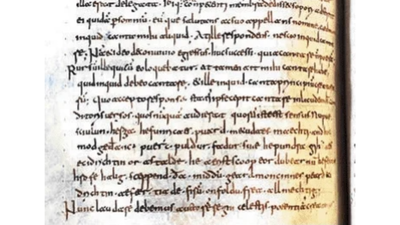
A rare copy of Cædmon’s hymn appears in the five lines above the last line of a page from an 8th-century manuscript copy of Venerable Bede’s The Ecclesiastical History of the English People (Image source: AP)
Researchers in Ireland looked at their computer screen, marveling at finding a medieval book in a Roman library. They flipped through its digital pages and found their treasure: the oldest surviving English poem.“We were very surprised. We were speechless. We couldn’t believe our eyes when we first saw it,” said Elisabetta Magnanti, a research fellow in the School of English at Trinity College Dublin. What’s more, she said, the poem was within the main body of the Latin text: “It was extraordinary.”The Caedmon Hymn was composed in Old English by a Northumbrian agricultural laborer in the 7th century, and appears in some copies of the Ecclesiastical History of the English People, written in Latin by a monk and saint known as the Venerable Bede.
His History is one of the most widely reproduced texts from the Middle Ages, with nearly 200 manuscripts, according to Magnanti Fellow Mark Faulkner, associate professor of medieval literature at Trinity.
Caedmon’s poem is considered the beginning of English literature.The manuscript he and Magnanti found is one of the oldest, dating back to the 9th century. Two earlier versions contain the poem in Old English, but as afterthoughts — translated from Latin and written in the margins by later scribes or appended but not within the main text, according to the researchers.
Faulkner said in Rome, where the pair traveled to see the text in person for the first time, that this discovery highlights the widespread use of the English language, long before it was previously understood. “Before the discovery of the Codex of Rome, the oldest manuscript was from the 12th century. So this is three centuries older than that,” Faulkner said.About 1,400 years later, this copy of the poem resurfaced in the main public library in Rome.
This version of Bede’s History was copied by monks at the scriptorium of the Benedictine Abbey of Nonantula, one of the most important copy centers during the Middle Ages, located near modern Modena in northern Italy, according to Valentina Longo, curator of medieval and modern manuscripts at the National Central Library of Rome.In the 17th century, as the monastery declined in importance, its extensive collection of manuscripts was transferred to another monastery in Rome, then to the Vatican and finally to the church.
Along the way, some texts disappeared, only to emerge in the 19th century in the possession of world-famous collectors, Longo said.The Italian Ministry of Culture has been scouring the world in search of the lost manuscripts of the Nonantola Monastery, snapping them up at auctions and from collectors around the world. She bought a copy of Bede’s History from Austrian-born rare bookseller H. P. Kraus Kraus in 1972, and the glossy text has remained in a Rome library ever since, Longo said.Enter Magnanti, who has spent more than four years studying Bede’s history. “I knew the book was in the library catalogue,” she said. I emailed the library who confirmed the book was in their stacks. Three months later, she received digital images of the entire manuscript.