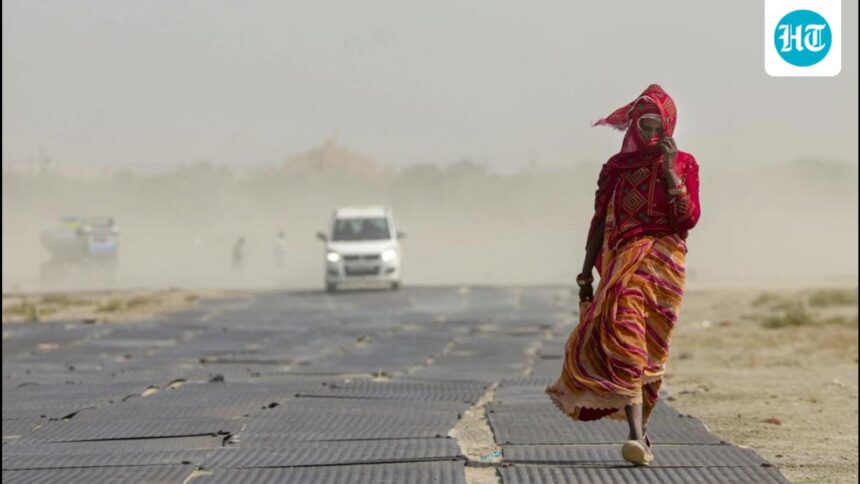
The India Meteorological Department (IMD) on Monday warned that heatwave to severe heatwave is likely to prevail over the plains of northwestern and central India during the week.

The IMD also warned of severe and widespread heatwaves over Uttar Pradesh during the week. So far this summer, heat spells over northwest India have dissipated quickly due to intermittent thunderstorms over the region.
The southwest monsoon has also advanced into more parts of the southeastern Arabian Sea, some parts of the Comorin region, more parts of the southwest and southeastern Bay of Bengal, most parts of the Andaman Sea, the entire Andaman and Nicobar Islands and some parts of the east-central Bay of Bengal.
However, hot conditions are likely to affect most of northern India.
On Sunday, maximum temperatures were significantly above normal (5.1 to 6 degrees Celsius) at a few places in eastern and western Madhya Pradesh and Gujarat; In isolated places in Bihar, East Uttar Pradesh, West Uttar Pradesh, Himachal Pradesh, Jammu Kashmir, Ladakh-Gilgit-Baltistan, Muzaffarabad and East Rajasthan; Significantly above normal (3.1°C to 5.0°C) at a few places over Saurashtra, Kutch, Madhya Maharashtra and Vidarbha; In isolated places above the Ganges in West Bengal, Uttarakhand and Marathwada.
Mohapatra, Director General, Disaster Management Authority of India: “We do not expect any weather system to bring rain immediately. We can expect widespread and intense heatwaves over Uttar Pradesh. We can also expect scattered heatwaves in surrounding areas. People should be prepared and take necessary precautions.”
Read also:The temperature in Delhi is set to rise in the next two days, and IMD issues a yellow alert for heatwave
Heatwave conditions are likely to prevail over Jammu-Kashmir-Ladakh and central Maharashtra on Monday and Tuesday; Punjab, Haryana, Chandigarh, Delhi and Madhya Pradesh until May 24; Vidarbha until May 23; Chhattisgarh. coastal Andhra Pradesh Wayanam from 20 to 24 May; Bihar, Marathwada and Telangana until Wednesday.
The IMD has warned of the possibility of heatwave to severe heatwave in a few pockets of western Uttar Pradesh till May 24.
Heatwave conditions are likely to prevail over some pockets in eastern Uttar Pradesh on Monday with heatwave to severe heatwave conditions over a few pockets of eastern Uttar Pradesh during May 19 and 20, isolated pockets till May 24. Warm night conditions are likely to prevail in isolated pockets over western Uttar Pradesh on May 19.
Hot and humid conditions likely in isolated pockets over Odisha until May 22; Coastal Andhra Pradesh Wayanam on May 19.
Scattered light to moderate rain with thunderstorms, lightning and gusty winds (up to 40-50 kmph) will be limited to higher areas over Jammu Kashmir during May 19-22; Uttarakhand from May 20 to 22; With thunderstorms, lightning and gusty winds (up to 30-40 kmph) likely to occur over Himachal Pradesh on May 21-22. Strong surface winds (up to 20-30 kmph and gusting to 40 kmph) over Punjab, Haryana Chandigarh, Delhi and Uttar Pradesh until May 24.
The IMD has issued an orange alert for large parts of northwest and central India for the next three days. It also warned of the increased possibility of symptoms of heat illness appearing in people who are exposed to sunlight for a long time or do strenuous work.
There is great health concern for vulnerable people, including infants, the elderly and people with chronic diseases.
In its agricultural advisory, IMD advised Punjab to apply light and frequent irrigation to vegetables, moong fruit plants, orchards and onion nurseries. In Haryana, it requested maintenance of adequate irrigation for sugarcane, cotton and summer fodder crops. It also advised to fully prepare rice nurseries with foolproof irrigation facilities and adopt mulching/moisture conservation practices to reduce water stress in newly planted crops.
In Uttar Pradesh, it has asked for frequent irrigation and mulching of permanent crops like maize, green gram, black gram, sugarcane, sunflower, vegetables, and fruit plants like mango, banana and papaya.
Experts recommended starting heat action plans well in advance.
“I think what past extreme events have shown us is that when you react, you come after an extreme event has happened, and that means you’re already behind the ball,” said Adele Thomas, director of climate adaptation and environmental health at the Natural Resources Defense Council, who attended the Global Heat and Cooling Forum in Delhi last month. “And what needs to happen is that you need to prepare for the extreme event, and then you will be able to respond to it more effectively.”
“That means having a plan in advance, and then putting that plan into action,” she added. “I think what’s important is early warning systems, so people know that the heat is coming. Having things to help people who don’t have access to cooling… having cooling centres, letting people know where they can go, telling people that they need to go, because some people may not realize that they are at high risk from the heat.”
In response to HT’s question about the impact on the informal workforce, Adele said: “The Natural Resources Defense Council is working on this in the US, looking at workers who are at high risk of heat and actually protecting their rights to subsistence, because heat stress can easily turn into heat deaths, especially when people are not aware of the risks. I think there is a desperate need to have enforceable mechanisms, whether it’s policies or legislation that require employers to make sure their employees are safe. And if that means allowing rest periods, allowing cooling, allowing… For water breaks, changing when we’re working outside…all of these things need to be enacted into enforceable measures to protect workers.