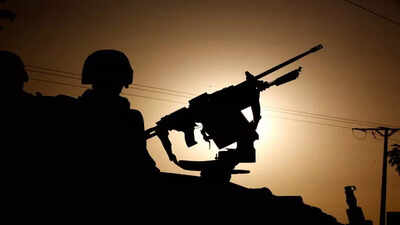
 The index, released on March 30, placed Pakistan at the top of the list of countries most affected by terrorism, the first time it has ranked first.“While Asim Munir’s army was busy projecting power and hogging the global spotlight — mediating between the United States and Iran, and sending fighter jets and troops to Riyadh — it was ‘shockingly losing ground at home’ to the militant groups it once patronized,” he said, referring to Pakistan’s powerful army chief and now field marshal.According to the report, since the outbreak of the US-Iran conflict in late February, terrorist attacks have not only continued inside Pakistan, but have also intensified in several regions, especially those bordering Afghanistan.The restive provinces of Khyber Pakhtunkhwa and Balochistan were responsible for 74% of these attacks and 67% of the deaths, the report said, adding that the Tehreek-e-Taliban Pakistan (TTP) and the Balochistan Liberation Army (BLA) had “wreaked havoc” on the Pakistani military, and had in fact become bolder, “more sophisticated and more deadly.”
The report noted that earlier this year, the Balochistan Liberation Army carried out one of its most coordinated attacks in years, launching strikes across at least nine districts in Balochistan, including the capital Quetta and the coastal city of Gwadar. The attacks reportedly targeted police stations, banks, markets and security facilities, killing dozens of civilians and security personnel.It also referred to a major suicide bombing outside a Shiite mosque in Islamabad, which killed at least 31 worshipers.
This attack, one of the deadliest in the capital in recent years, is widely attributed to ISIS-K.In a rare incident, Baloch rebels ambushed a coast guard patrol near Gwadar, killing three officials. This was the first recorded incident in which the Balochistan Liberation Army attacked a Pakistani naval ship.There were already five attacks in Khyber Pakhtunkhwa and Balochistan from May 7 to 15.“Field Field Marshal Asim Munir’s forces are struggling to secure their camps and border areas despite demonstrating their strength abroad – be it in Riyadh or in mediation talks in Islamabad,” the report stated.Pakistan signed a joint strategic defense agreement with Saudi Arabia in September last year. Under the agreement, an attack on one of them is considered an attack on the other. Under the agreement, Islamabad last month deployed a military unit consisting of about 13,000 soldiers and 10 to 18 aircraft to Saudi Arabia, which is among the Gulf states that Iran has attacked in response to US-Israeli strikes on the Islamic Republic that sparked the current conflict in the Middle East.(With agency input)