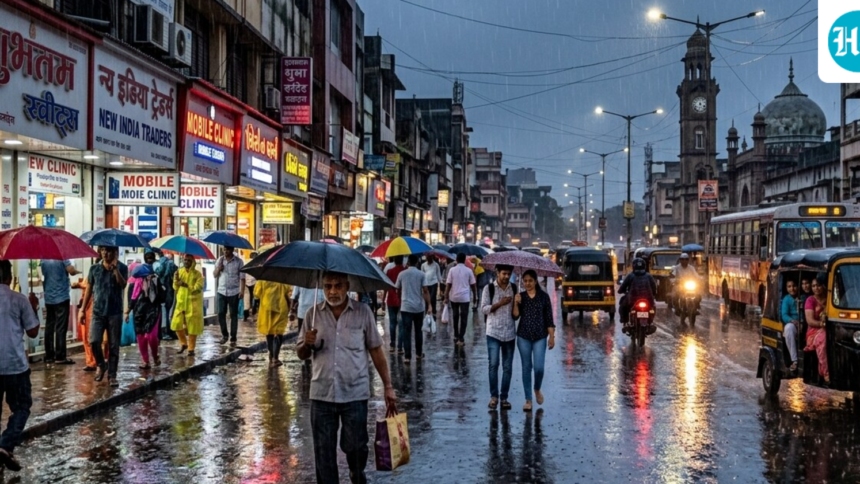
The southwest monsoon is expected to reach Kerala on May 26, about six days earlier than usual, according to the meteorological department. India Meteorological Department (IMD). The usual start date is June 1.

The early arrival of the monsoon generally brings hope of relief from the heat and a good agricultural season. Nearly half of India’s agricultural land depends on rainfall rather than irrigation.
However, weather agencies and climatologists warn about the development of this phenomenon An El Niño pattern in the Pacific Ocean may weaken the overall monsoon later in the season.
What IMD said
The IMD said the monsoon is likely to start over Kerala on May 26, with a typical margin of error of plus or minus four days. Last year too, the monsoon reached Kerala early, on May 24.
The Meteorological Office said conditions are favorable for the monsoon to advance over parts of the southern Bay of Bengal, Andaman Sea and Andaman and Nicobar Islands. Its extended-range forecast also shows widespread rainfall along the southwest coast until May 28.
The start over Kerala is the official start of the southwest monsoon season on the Indian mainland. From there, the monsoon winds gradually move northward across the country.
Early monsoon does not mean good rains
Weather experts said that the early arrival of the monsoon does not guarantee good rains for the rest of the season.
“There is no correlation between the early onset of monsoon and the total amount of monsoon rainfall. In fact, there have been years when the monsoon arrived early but the rainfall was poor. It depends on how many low pressure systems form or how the surge develops because the monsoon moves in spurts,” an earlier HT report quoted Mahesh Palawat, VP of Climate and Meteorology at Skymet Weather.
The monsoon often progresses in bursts or ‘spikes’. Even if Kerala arrives early, the distribution of rainfall later in June, July and August depends on ocean temperatures, wind patterns and the formation of low pressure systems.
What is the El Nino phenomenon?
El Nino is a weather pattern associated with unusually warm sea surface temperatures in the central and eastern Pacific Ocean. It changes global wind and rain patterns and often affects weather across Asia, Africa and the Americas.
In India, El Nino is usually associated with harsher summers and weaker monsoons.
The US National Oceanic and Atmospheric Administration (NOAA) and its Climate Prediction Center said El Niño is likely to appear between May and July of this year, and could become very strong later in 2026, according to The Washington Post.
The National Oceanic and Atmospheric Administration (NOAA) estimates the probability of El Niño occurring during this period at 82%. Scientists also warned that there is more than a 50% chance that it will become a strong or very strong event between September and November.
Why is El Nino important for India?
India receives nearly 70 percent of its annual rainfall during the monsoon season from June to September.
A weak monsoon can affect crop production, food prices, reservoir and groundwater levels, rural incomes, and power generation.
Many years of drought in India have coincided with El Niño events.
The IMD has already forecast below-normal monsoon rainfall for the 2026 season. It forecasts rainfall at 92 per cent of the long period average (LPA), with a margin of error of plus or minus five per cent.
The average LPA for the monsoon season, calculated using data from 1971 to 2020, is 87 cm.
The Meteorological Department expected less rain than usual in many parts of the country. Parts of northeastern India, northwestern India and southern peninsular India may still receive normal to above normal rainfall.
Weather conditions across India
The IMD also warned of heatwave to severe heatwave conditions across northwest and central India during most of this week.
The IMD has also forecast heavy to very heavy rainfall over several parts of the country, including northeast India, Kerala, Tamil Nadu, Puducherry, Karaikal and south interior Karnataka over the next three to four days. Heatwave to severe heatwave continues across northwest and central India.
The meteorological agency also said that a visible low pressure area still exists over the Bay of Bengal, along with a cyclonic circulation extending into the middle atmosphere.